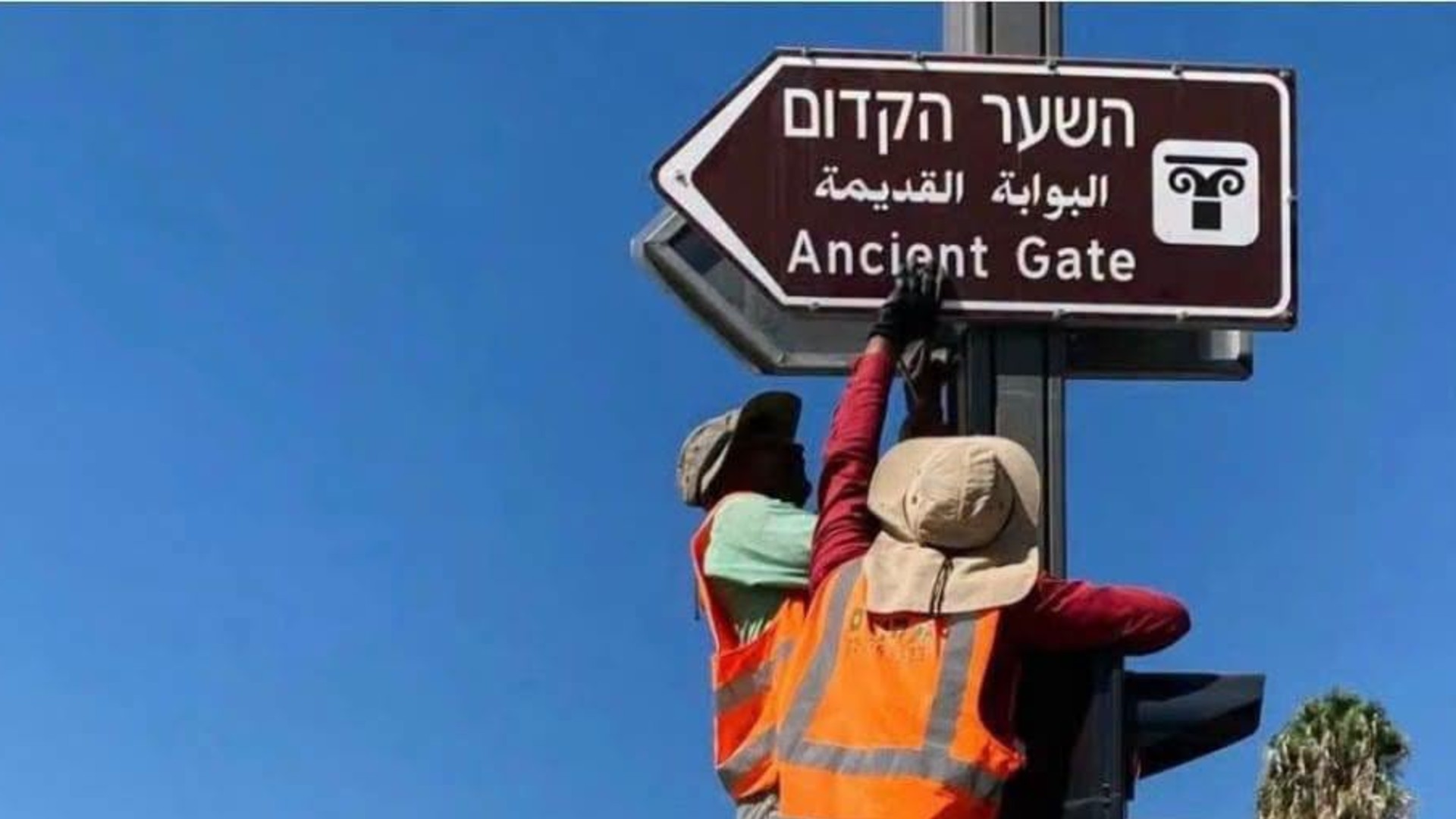
A controversial move by Israeli authorities to rename one of East Jerusalem’s most recognizable historical landmarks has drawn sharp condemnation from Palestinian leaders and analysts, who say the action is the latest step in a long-running campaign to erase Palestinian and Arab cultural identity from the occupied territory.
Located on the northern perimeter of Jerusalem’s walled Old City, Damascus Gate has for centuries stood as one of the most significant entry points to the historic urban core. Beyond its architectural and historical importance, it serves as a primary passage for Palestinian worshippers traveling to the Al-Aqsa Mosque compound, and remains a central gathering space for Palestinian communities in the area.
Earlier this week, Israeli municipal workers removed long-standing public signage labeling the site Damascus Gate, replacing it with new signs in Arabic, English, and Hebrew that read “Ancient Gate”.
Abdullah Marouf, a researcher focused exclusively on Al-Aqsa Mosque and surrounding Jerusalem affairs, argues the renaming is part of a deliberate state strategy to Judaize Jerusalem by systematically replacing Arab and Islamic cultural symbols in public life with Jewish-centric alternatives. He noted that Palestinian communities have deep, daily ties to the area around Damascus Gate, and that Israeli officials have pushed to alter the site’s name for decades.
“This Hebrew name aims to strip the place of its ‘Damascus Gate’ designation, as it is one of the main and central gates of Jerusalem,” Marouf explained in an interview with Middle East Eye. He added that attempts to rename prominent landmarks across the Old City are not a new development: Israeli authorities previously renamed Solomon’s Cave, a site located between Damascus Gate and Herod’s Gate, to Zedekiah’s Cave in an earlier push to reorient the site’s historical identity. Marouf emphasized that all such naming changes are intended to reshape the fundamental character and cultural identity of Jerusalem, though he argued the campaign has ultimately been unsuccessful.
“Israel has proven its utter failure in achieving this goal, as the image, nature and Arabic language of Jerusalem are clear, and a sign in one of the city’s streets cannot change its reality,” he said.
The renaming of Damascus Gate is not an isolated incident, but part of a broader ongoing campaign targeting street names, public landmarks, and historic sites across East Jerusalem. In a formal statement released Wednesday, the Jerusalem Governorate condemned the move as part of a deliberate state policy to reshape the city’s cultural and urban landscape.
The governorate emphasized that the renaming is far more than a routine administrative adjustment: it is a targeted effort to cut future generations of Palestinians off from the city’s deep-rooted historical Arab heritage. “The names of Jerusalem’s gates, streets and landmarks represent an integral part of the city’s national, historical and cultural memory,” the statement read. “Replacing them with new names undermines Jerusalem’s identity and its Arab, Islamic and Christian heritage.”
Like Marouf, the governorate stressed that such cosmetic changes cannot erase the city’s long-established history or entrenched cultural memory.
The broader context of this move hinges on the international status of East Jerusalem, which Israel occupied in the 1967 Arab-Israeli War before formally annexing the territory and the Old City. No country or international body recognizes Israel’s sovereignty over East Jerusalem under international law. The Fourth Geneva Convention, which governs the conduct of occupying powers, explicitly prohibits permanent changes to the social, cultural, or political landscape of occupied territory unless such changes are required for urgent military or humanitarian purposes, which the renaming of a historic gate does not qualify as.