South African law enforcement and conservation agencies have disrupted another major transnational wildlife trafficking operation, seizing 50 eggs believed to belong to internationally protected endangered parrot species at Johannesburg’s OR Tambo International Airport last Thursday. Officials also arrested a 59-year-old Thai national who was allegedly attempting to smuggle the eggs concealed in a handmade incubator bag carried as hand luggage, according to South Africa’s Department of Forestry, Fisheries and the Environment (DFFE).
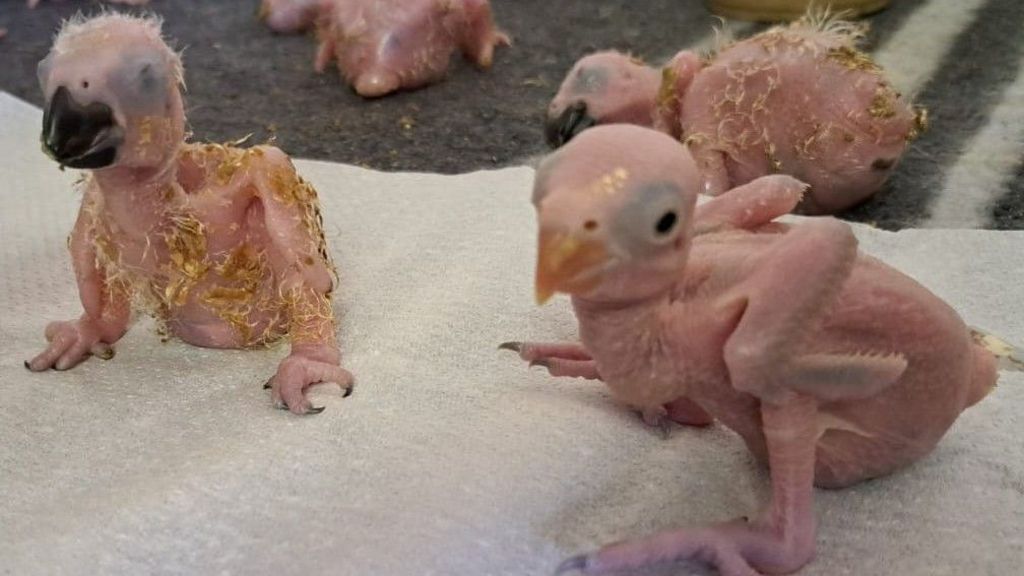
In an update on the seizure, DFFE confirmed that a significant number of the intercepted eggs have now successfully hatched. The newly emerged chicks are currently receiving round-the-clock intensive care from specialist staff at the National Zoological Garden in Pretoria, with conservation teams working to maximize the young birds’ odds of long-term survival.
The operation that led to the arrest and egg seizure was the result of coordinated work between DFFE, the Green Scorpions (South Africa’s dedicated environmental crime enforcement unit), and multiple specialized police divisions. If the suspect is convicted on wildlife trafficking charges, they could face a maximum penalty of a 10 million South African rand (equivalent to approximately $526,000) fine, up to 10 years of imprisonment, or both penalties combined.
Preliminary forensic analysis has indicated the eggs are from a parrot species listed for full protection under the Convention on International Trade in Endangered Species of Wild Fauna and Flora (CITES), which bans or strictly regulates cross-border commercial trade in listed vulnerable wildlife.
South Africa’s Environment Minister David Maynier issued public praise for all stakeholders involved in the bust, emphasizing that coordinated collective action is the only effective way to push back against the global illegal wildlife trade. “Illegal wildlife trafficking can only be challenged by a co-ordinated defence of our natural heritage,” Maynier said, singling out the Pretoria zoo team for special recognition for their tireless work incubating the seized eggs and caring for the newly hatched chicks.
This latest bust comes just one month after authorities at the same airport arrested a 23-year-old Thai citizen who was caught attempting to smuggle 418 parrot eggs in July. DFFE officials say the two back-to-back seizures reveal a worrying trend of increasing sophistication among transnational wildlife trafficking networks operating through South African ports of entry. The cases also underscore how critical coordinated, intelligence-driven law enforcement action is to stopping these criminal operations.
Conservation officials warn that the illegal harvest and smuggling of parrot eggs poses two overlapping threats: it decimates already vulnerable wild parrot populations, and the smuggling process itself subjects developing embryos and newly hatched chicks to cruel, dangerous conditions that almost always result in high mortality rates. Improvised homemade incubators, like the one used in this latest case, fail to maintain consistent temperature and humidity levels required for healthy embryo development, putting every smuggled egg at extreme risk.
As one of the world’s most biologically diverse countries, South Africa remains a key target for criminal wildlife trafficking networks, which frequently poach and smuggle high-value vulnerable species including elephants, pangolins, and rare parrots to supply the lucrative international black market. To address this growing threat, the South African government launched a national anti-wildlife trafficking strategy six years ago, designed to strengthen cross-sector collaboration between government bodies, law enforcement, conservation groups, customs authorities, prosecutors, and global partner organizations, with the core goal of dismantling the criminal networks driving the illicit trade.