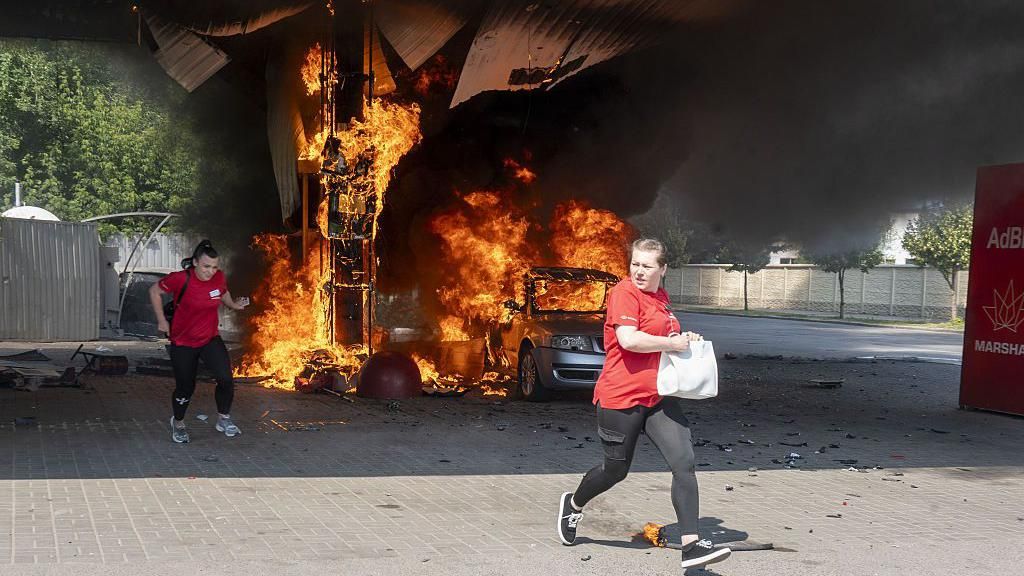
Since the start of April this year, Russia has dramatically ramped up targeted strikes against civilian fuel filling stations across Ukraine, a campaign that has killed and injured dozens of civilians, rendered key transport routes without operational fuel infrastructure, and forced widespread changes to daily life for Ukrainian motorists, new data from independent analysts and think tanks confirms. As of late August, at least 246 Ukrainian petrol stations have been hit by Russian drone and missile attacks, according to Oleksandr Sirenko, an energy analyst at Kyiv-based think tank Nafto Rynok (Oil Market).
The frequency of these attacks has accelerated sharply in recent months. Open-source non-profit organization the Centre for Information Resilience verified 114 confirmed strikes on filling stations in July alone, a 72% increase from the 66 attacks recorded in June. The targeting strategy has also evolved: initial strikes relied on small, remote-controlled drones, but Russian forces have increasingly deployed larger, far more destructive Iranian-made Shahed drones in recent months. Each Shahed drone costs an estimated $20,000 to $50,000, a cost that outstrips the value of many small regional filling stations. Sirenko told the BBC that one petrol station was hit by five separate Shahed attacks, a striking example of the resources Russia has committed to this campaign.
The human and logistical costs of the strikes have been felt acutely in frontline regions across the country. On Monday, two drone attacks on petrol stations in Kharkiv, Ukraine’s second-largest city in the country’s northeast, wounded two civilians. Just one week prior, a similar strike on a filling station outside Kryvyi Rih killed three people. In response to the growing threat, Ukrainian law enforcement has issued urgent public guidance: motorists must leave filling stations immediately and even abandon their vehicles if air raid sirens sound, with authorities emphasizing that safety outweighs property. “You can fix your car, but you won’t get your life back,” a Dnipropetrovsk region police force noted in its public warning.
Large swathes of critical infrastructure have already been knocked offline. The major highway connecting Kharkiv and Dnipro, two of Ukraine’s largest cities, now has no functioning petrol stations left. All filling stations surrounding Opishnya, a large village in Poltava region, have been destroyed. Local village chief Mykola Riznyk laid out Russia’s clear strategic goal in a public video posted to Facebook: “You can see our enemy’s strategy. They want to deprive us of fuel.” In response, local authorities have begun stockpiling small caches of fuel scattered across multiple hidden locations to avoid further targeted losses. In the partially occupied Kherson region, almost half of all filling stations in Ukrainian-controlled territory have ceased operations, and remaining sites face near-daily drone attacks, according to deputy regional administration head Oleksandr Tolokonnikov. In Trostyanets, a 20,000-person town near Ukraine’s northeastern border with Russia, every petrol station has been destroyed. Local authorities have adapted by dispensing fuel directly from mobile tanker trucks that change locations constantly to avoid detection.
Ukrainian civilians have rapidly adapted to the new threat, with widespread compliance with safety guidance. “Fill up quickly and move on,” Kharkiv Mayor Ihor Terekhov advised local drivers, a rule that most motorists now follow strictly. Oleksandr Melnychuk, head of strategic marketing at major Ukrainian fuel chain BRSM Nafta, told reporters that customer behavior has shifted dramatically: “Clients aren’t browsing the aisles anymore, looking at what we’ve got on our shelves. They fill up and are keen to get on their way as soon as possible.” BRSM Nafta has lost eight stations to attacks and is rebuilding two more, and has implemented a series of protective measures for remaining locations: building concrete customer shelters at forecourts, installing anti-drone netting, reducing working hours, and cutting on-site staff numbers to minimize casualties if an attack occurs. Southern Ukrainian resident Kateryna Stokolya, a driver based in Mykolaiv, said most civilians have accepted new restrictions that close filling stations during air raids, with no signs of panic buying or public unrest. “Security comes first. If you can’t fill up now, you’ll fill up later. There are no queues or panic buying,” she explained. Stokolya echoed other analysts in noting that Russia’s core goal for the campaign is to erode public morale: “[They want] terrorising the public so we force the government to capitulate or accept agreements that do not favour Ukraine.”
Despite the widespread disruption and loss of civilian life, the campaign has so far failed to achieve its goal of crippling Ukraine’s overall fuel supply, analysts and official data show. The National Bank of Ukraine estimates that only 4% of the country’s total filling stations have been damaged or destroyed, and the impact on national fuel markets has been minimal. Increased sales in regions further from the front line and border have fully offset losses from destroyed and damaged sites, the bank’s report found. Unlike Russia, which relies on large, vulnerable domestic oil refineries, Ukraine imports nearly all of its fuel via road tankers, and its market is structured around a dense network of independent filling stations that provide alternatives when individual sites are hit. “You curse and drive on to another petrol station. OK, you travel for 10km more than you bargained for, but that’s not such a big problem,” Sirenko explained. He added that most attacks leave the most valuable infrastructure — underground fuel tanks — intact, and that geopolitical tensions between the U.S. and Iran have had a far larger impact on domestic fuel prices in Ukraine than Russian strikes.
Ironically, while Russia’s campaign against Ukrainian filling stations has had limited strategic impact, Ukraine’s own campaign of drone strikes against Russian oil refinery infrastructure has triggered widespread fuel shortages across almost all regions of Russia. Last week, major Russian newspaper Izvestia reported that only 28% of Russian filling stations currently have available petrol for sale, a crippling shortage that has disrupted domestic economic activity across the country.