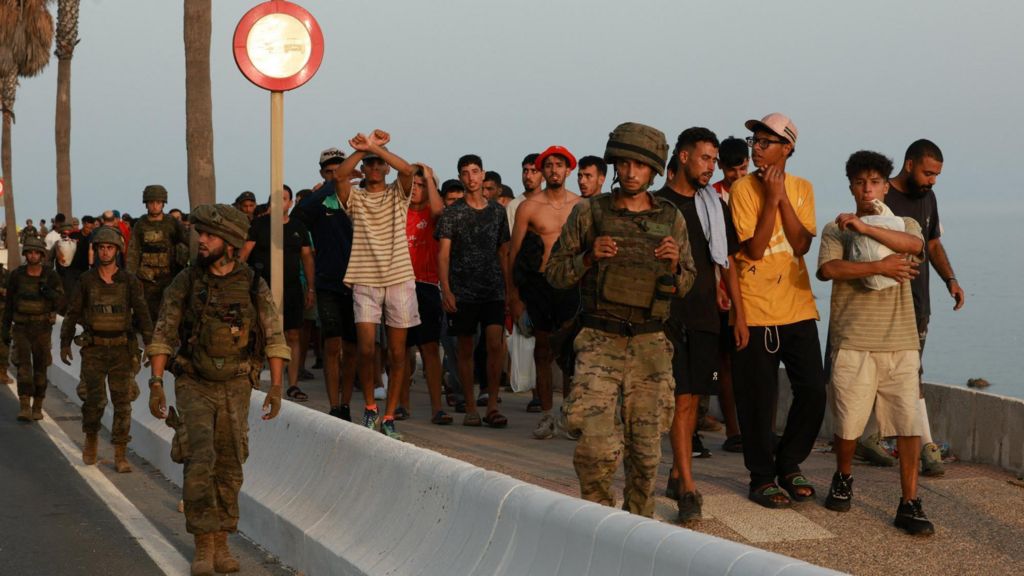
In the aftermath of a sudden, massive influx of tens of thousands of Moroccan migrants who swam across the border to reach Spain’s North African exclave of Ceuta on July 30, the majority of those arrivals have now been escorted back to Moroccan territory by Spanish security forces. What began as an extraordinary mass crossing has ended in tragedy, with at least 67 migrants confirmed dead, their bodies recovered from the Strait of Gibraltar alongside discarded rubber flotation devices and swimming flippers. Beyond the human cost, the crisis has sent political shockwaves across the European Union, reopening long-simmering rifts over the bloc’s most divisive migration policy debates.
Root causes of the unprecedented surge remain unconfirmed, with two leading hypotheses emerging. One line of inquiry points to viral social media content that falsely promised an open, unregulated path into Europe for migrants. Spanish Prime Minister Pedro Sanchez, leader of the country’s Socialist government, argues that smugglers misrepresented a recent Spanish Supreme Court ruling barring immediate pushbacks of sea arrivals to lure hopeful migrants. Notably, most participants in the crossing were Moroccan citizens who did not pay smuggler fees; instead, false claims that “Spain is open” spread rapidly across social platforms, with videos of young migrants in wetsuits jumping into the water and footage from inside Ceuta racking up tens of thousands of likes from accounts that only launched weeks earlier.
The other open question is whether the influx was a deliberate, organized act to weaponize migration for political gain, echoing the 2021 crisis on the Belarus-EU border. While Sanchez has refrained from blaming Morocco, a key Spanish ally that currently faces new tensions with Madrid over the Western Sahara dispute, critics argue that Moroccan border forces could not have missed large crowds gathering for the crossing. Observers also note that external actors have already seized on the crisis to exacerbate division in Europe: Russian state actors have gloated over the chaos that weakens allies of Ukraine, while former U.S. President Donald Trump, who faces an upcoming election and has a longstanding rift with Spain over its opposition to his Iran policy, has labeled the event a “catastrophic invasion.”
Within the EU, the crisis has sparked open confrontation between Spain and Italy, whose far-right Prime Minister Giorgia Meloni moved quickly to condemn Sanchez’s approach. Meloni’s party, Fratelli d’Italia, early on shared viral images of migrants in Ceuta mocking what it called the “Sanchez model” favored by Italy’s left-wing opposition. Meloni then announced Italy would suspend its Schengen Zone free movement agreement with Spain, citing a national security threat. The move drew fierce anger from Madrid, which points out that Ceuta is not part of the Schengen area, meaning migrants could never travel unchecked to mainland Europe. Analysts widely view Meloni’s hardline stance as a political calculation: with Italian elections scheduled for next year and her coalition losing support to a more virulently anti-immigrant new party, the crisis gave her an opportunity to bolster her tough-on-migration credentials to recapture voters.
Meloni is far from alone in criticizing Spain’s migration approach. Her call for an urgent meeting of EU interior ministers this week has been co-signed by nearly two dozen EU heads of state, who are pushing to scrap policies they frame as “pull factors” drawing migrants to Europe. Their primary target is Spain’s controversial 2025 policy that allowed hundreds of thousands of undocumented migrants to apply for work and residence permits to regularize their status, a pragmatic move for a rapidly aging country facing critical labor shortages. Notably, the migrants who arrived in Ceuta were not eligible for this program, which has already closed to new applicants.
In response to the crisis, Spanish authorities have moved quickly to secure the Ceuta border, extending barriers out into the water with lines of orange buoys patrolled by ships to deter future mass swimming crossings. For the next several weeks, Italian police will conduct random document checks on travelers arriving from Spain, a largely symbolic move that does little to alter cross-border travel in practice. Next week, EU interior ministers will convene to discuss strengthening the bloc’s external borders, with populist right-wing parties across the continent emboldened by the crisis to push for harder line policies.
Amid the political maneuvering and policy debates, the deepest tragedy of the event remains: dozens of young migrants who chased the false promise of a new life in Europe shared online now lie dead, their bodies returned to Morocco in coffins.