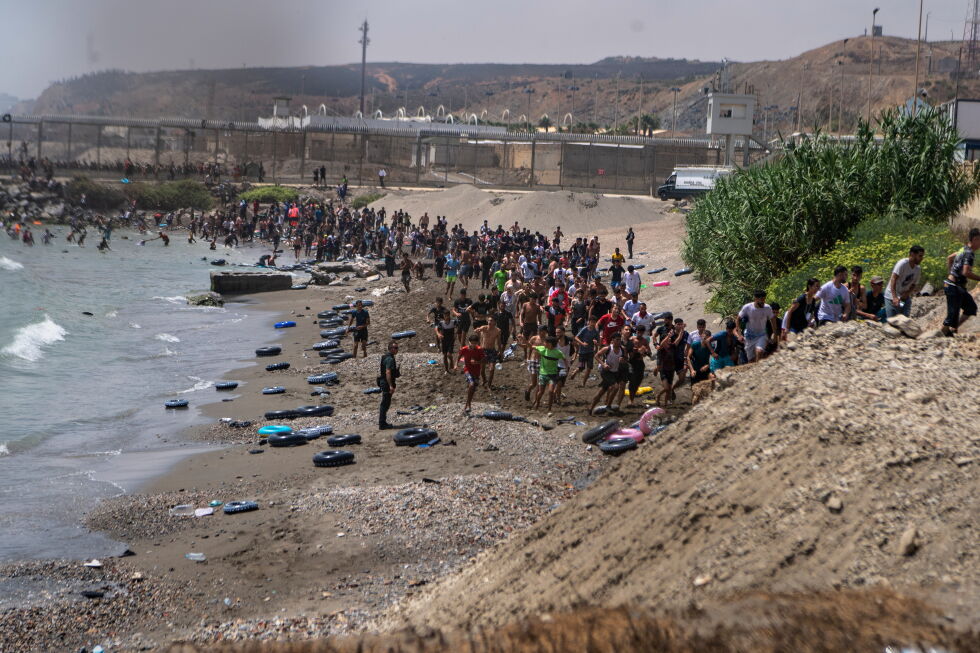
MADRID – A sudden and massive influx of thousands of migrants crossing from Morocco into Spain’s small North African exclave of Ceuta has forced local authorities to urgently request support from the national government in Madrid to secure the border and restore order.
Visual footage captured at the frontier shows large crowds, overwhelmingly composed of Moroccan nationals but including entire families with women and children, crossing over breakwaters at an urban beach adjacent to the official border checkpoint and moving onto local roads inside Ceuta. Most of the migrants crossing were young men, according to on-site observations.
Spain’s Interior Ministry has publicly committed to upholding the safety of Ceuta’s existing residents and protecting the integrity of Spain’s border, but confirmed that a national state of emergency over the migration crisis will not be declared at this time.
The large-scale crossing follows a sharp 24-hour increase in migration attempts, many of which saw migrants attempting to swim across the maritime boundary to reach the exclave. As of initial reporting, the root cause of the sudden surge in crossings remains unconfirmed.
To understand the significance of this event, context about Ceuta’s unique geopolitical status is critical. Along with Melilla, a larger Spanish territory located 250 miles further along the African Mediterranean coast, Ceuta is one of two Spanish autonomous territories on continental Africa. These two regions host the only land borders between the European Union and the African continent, a position that has made them a persistent flashpoint for migration and diplomatic tension.
Ceuta has been under Spanish administration since 1580, and is currently home to a diverse, largely peaceful mixed population of Christian and Muslim residents, including both Spanish and Moroccan citizens and daily cross-border workers. However, the government of Morocco has never formally recognized Spanish sovereignty over Ceuta and Melilla, consistently referring to both territories as illegally occupied lands.
With a permanent population of just 85,000, Ceuta has long been at the center of major diplomatic standoffs between Spain’s central government in Madrid and Morocco’s ruling monarchy in Rabat. Thousands of Moroccan day workers cross the border legally into Ceuta each day to access employment, a routine arrangement that has been repeatedly disrupted by political disputes.
The most significant prior crisis occurred in May 2021, when the Moroccan government relaxed its own border security controls, allowing roughly 8,000 migrants from Morocco and sub-Saharan African nations to flood into Ceuta over a 48-hour period. That move was widely analyzed by global diplomatic observers as a retaliatory action against Spain’s decision to permit a pro-independence leader from the disputed Western Sahara region to receive COVID-19 medical treatment in a Spanish hospital.
Tensions were only de-escalated and full border operations restored after Spanish Prime Minister chose to revise Spain’s decades-long diplomatic stance on the Western Sahara dispute, followed by an official meeting between the Spanish leader and Moroccan King Mohammed VI the next year.
As a key entry point to the European Union, Ceuta is a common target for migrants and asylum seekers fleeing conflict, political repression, or economic hardship across Africa, who hope to ultimately gain residency in mainland Spain or other EU member states. Both Ceuta and Melilla are heavily fortified with border security infrastructure to manage irregular migration attempts.
Irregular migrants that successfully reach Ceuta or Melilla face one of two outcomes: many are immediately repatriated back to Morocco, while those that are not repatriated are held in dedicated migrant processing centers, where they can complete the required steps to apply for asylum in Spain. Migrants attempting to reach Ceuta most often swim from the Moroccan coastal town of Castillejos, a crossing of roughly 3.1 miles, while others depart from the closer coastal town of Belyounech for a shorter maritime journey.
Despite its status as a migration flashpoint, total annual irregular arrivals to Ceuta and Melilla remain far lower than the number of migrants that reach mainland Spain via airports or the Canary and Balearic Island routes. For decades, Spain has seen consistent growth in its total immigrant population: of the country’s 50 million total residents, roughly 10 million are foreign-born. The largest groups of immigrants currently residing in Spain come from Colombia, Venezuela, and Morocco, and many fill critical labor roles in key Spanish economic sectors including agriculture, tourism, and domestic and commercial services.