As the current U.S. Supreme Court term draws to a close, the nation’s highest judicial body is preparing to issue two of the most consequential and widely anticipated decisions of the Donald Trump presidency on Tuesday, rulings that could reshape long-standing American legal and social frameworks.
The first and arguably most closely watched of the two cases centers on the Trump administration’s bid to restrict the long-standing principle of birthright citizenship, a rule that guarantees automatic U.S. citizenship to any person born on American soil. Enshrined in the 14th Amendment of the U.S. Constitution for nearly 160 years, this principle, legally known as jus soli (or “right of the soil”), has its roots in the aftermath of the American Civil War. Ratified in 1868, the amendment’s opening citizenship clause was originally crafted to grant citizenship to formerly enslaved people born in the U.S., cementing a core tenet of equal citizenship after the abolition of slavery.
Shortly after taking office, Trump made restricting birthright citizenship a central pillar of his hardline immigration agenda, signing an executive order that directed federal agencies to deny citizenship to children born in the U.S. to parents who are in the country illegally or hold only temporary visas. This policy followed through on repeated campaign promises to overhaul the U.S. immigration system, alongside other administration actions including aggressive crackdowns on illegal border crossings and the revocation of Temporary Protected Status for hundreds of thousands of vulnerable migrants from Haiti and Syria — a move the Supreme Court previously allowed to stand.
The American Civil Liberties Union (ACLU) and allied civil rights groups quickly launched a class-action lawsuit, Barbara v. Trump, challenging the executive order as unconstitutional. The entire dispute hinges on the interpretation of one key phrase from the 14th Amendment: “subject to the jurisdiction thereof.”
Administration legal arguments contend that this clause explicitly excludes children of parents who are not lawfully present in the U.S. on a permanent basis, arguing the 14th Amendment was never intended to grant birthright citizenship to the children of undocumented or temporary migrants. Trump himself has repeatedly framed birthright citizenship as a “scam” that enables both undocumented immigrants and wealthy foreign nationals to exploit the U.S. immigration system for unfair advantage.
On the opposing side, the ACLU argues that the jurisdiction clause refers exclusively to the physical presence of a person born on U.S. soil, regardless of their parents’ immigration status. The organization warns that ending birthright citizenship would create a permanent underclass of people born in the United States who are denied basic citizenship rights from birth. During oral arguments held in April, multiple Supreme Court justices appeared openly skeptical of the Trump administration’s position. Liberal Justice Elena Kagan noted that the administration was seeking to undo a legal tradition that stretches all the way back to English common law, stating “What the 14th Amendment did was accept that tradition and not attempt to put any limitations on it. That was the clear rationale.” Legal experts remain divided on whether the court will issue a broad sweeping ruling on constitutional grounds or a narrower decision tied to statutory interpretation, a distinction that could drastically alter the long-term impact of the decision.
The second landmark decision due Tuesday addresses a separate divisive cultural and legal issue: whether U.S. states have the authority to bar transgender athletes from competing on women’s and girls’ school and college sports teams. The cases before the court stem from laws passed in Idaho and West Virginia, which require public school and college sports teams to be organized based on an athlete’s sex assigned at birth. Transgender students in both states have challenged the bans, with one arguing the policy violates equal protection guarantees under the U.S. Constitution, and the other claiming it contradicts federal civil rights legislation.
Currently, more than two dozen U.S. states have enacted similar restrictions on transgender athlete participation, making the Supreme Court’s ruling a decision that will impact trans students across nearly half the country. Banning transgender athletes from competing in categories aligned with their gender identity has been a top policy priority for Republican officials at both the state and federal level during the Trump administration.
Proponents of the bans argue that transgender women hold an inherent biological advantage over cisgender women — athletes assigned female at birth — a position that received backing earlier this year from the International Olympic Committee (IOC). In March, the IOC announced new rules limiting the women’s Olympic category to biological females, following an 18-month review of existing scientific research. The IOC working group concluded there was a “clear consensus” that male sex provides a measurable performance advantage in all sports that rely on strength, power, and endurance.
Critics of the state-level bans push back on both scientific and ethical grounds, arguing the policies amount to unlawful, unfair discrimination against transgender students and dispute the claim that there is a universal scientific consensus on inherent competitive advantage for all trans women athletes.
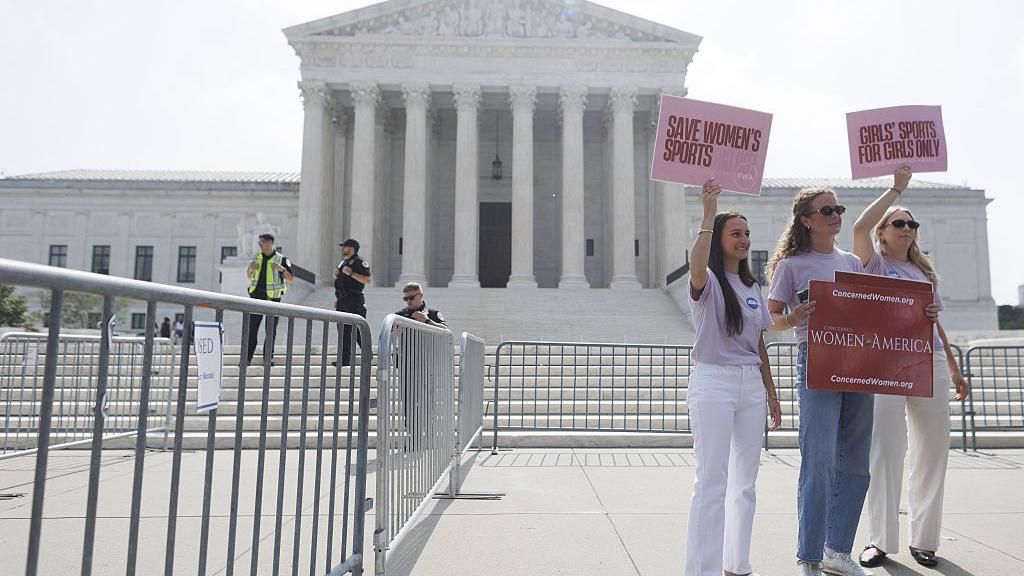
With the Supreme Court holding a 6-3 conservative majority, observers noted that during more than three hours of oral arguments in January, at least five justices appeared inclined to uphold the state-level bans. A ruling upholding the restrictions would set a binding nationwide precedent that reshape how civil rights protections are applied to transgender students in public education across the United States, a outcome that would ripple through state education and athletic policies for decades to come. As crowds of supporters gathered outside the Supreme Court building this week holding signs in favor of the transgender athlete bans, the nation waits for two decisions that will define the trajectory of American law and society for a generation.