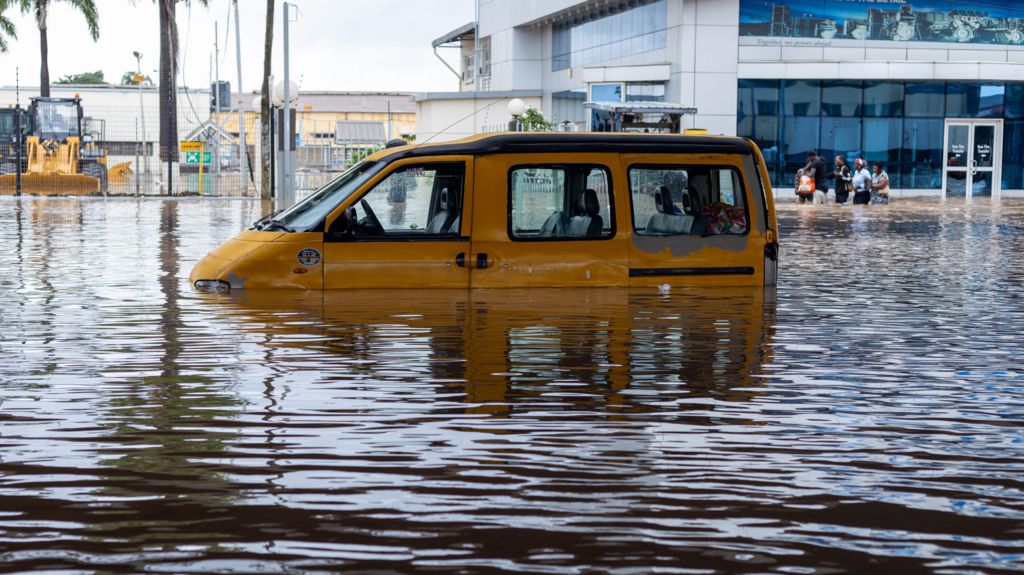
In Ghana’s capital Accra, catastrophic flash flooding driven by an unprecedented torrential downpour has left at least 13 people dead, with authorities warning the death toll could climb further as search and recovery operations continue across the devastated city. The extreme weather event, which dumped roughly 140 millimeters of rain on the metropolis overnight Sunday – nearly three times the highest single-day rainfall recorded in 2025 – has already caused widespread destruction, submerging entire neighborhoods, destroying hundreds of structures, and leaving thousands of residents displaced or trapped. According to officials from the Ghana National Fire Service, one of the lead agencies coordinating rescue efforts, more than 470 people have been pulled from floodwaters to safety so far, with emergency response teams from the police, military, and National Disaster Management Organisation also deployed across hard-hit low-lying areas. Social media footage circulating from the region shows cars fully submerged under muddy floodwater and collapsed buildings, confirming the scale of the damage that has forced local markets and businesses across the capital to remain closed, with some small commercial operations completely washed away. As teams work to reach trapped residents, national officials have issued urgent public safety advisories, urging residents in flood-prone zones to relocate to higher ground immediately and avoid all unnecessary travel through inundated areas. “Stay indoors if you are in a safe location,” a statement from the Ghanaian president’s office read. “Do not attempt to cross flooded roads, whether on foot or in a vehicle. If your home is being inundated, move immediately to higher ground and call 112 for emergency assistance.” Compounding the risk to public safety, the flooding triggered an unexpected large fire at a local rubber factory shortly after the downpour began. Utility providers Ghana Grid Company Limited and the Electricity Company of Ghana have also enacted a temporary power shutdown across flood-impacted parts of the capital, noting that rising floodwaters have compromised critical infrastructure at multiple substations, creating life-threatening hazards for both workers and residents. The Ghana Meteorological Agency has amplified government warnings, forecasting additional heavy rain across southern Ghana – where Accra is located – from Tuesday morning through the afternoon, raising the specter of further flooding and worsening damage. Agency officials have also advised residents to avoid sheltering under trees, steer clear of downed or exposed electrical lines, and never walk or drive through standing floodwater. For many local residents, the disaster has already upended daily life and destroyed irreplaceable personal property. Philip Mensah, one flood-affected Accra resident, told reporters that his decades-long collection of 1970s vinyl records was entirely lost to floodwaters. Patience Naa Adjeley Adjei, a local schoolteacher, described hours of futile efforts to hold back water from entering her home, saying, “I have mopped my room more than eight times. I can’t even step out because my room is flooded, and outside is flooded.” While the extreme rainfall is the immediate trigger for the disaster, experts and officials alike point to longstanding structural issues that amplified the flood’s severity. Accra, one of Africa’s fastest-growing urban centers with a population of over 4 million according to the World Health Organization, has long struggled with inadequate drainage infrastructure, with clogged public gutters and widespread construction of unpermitted illegal structures on natural waterways preventing floodwater from receding. Following an aerial assessment of the damage on Monday, Ghana’s president ordered the immediate demolition of all illegal structures built on waterways, noting that “the irresponsible actions of a few individuals end up putting entire communities at risk.” Disaster and climate advocates warn the event is far from unexpected, linking the increasing frequency of extreme flooding in the region to both accelerating climate change and unplanned rapid urban expansion. This is not the first time Accra has faced catastrophic flooding: in 2015, a similar extreme weather event triggered a fuel station explosion that killed more than 150 people. Ewurabena Yanyi-Akofur, country director for WaterAid Ghana, called for urgent systemic changes to prevent future tragedies, noting that “what we are witnessing in Accra is not an isolated weather event, but part of a pattern intensified by climate change and rapid, unplanned urbanisation.” She added that stronger urban planning and pre-event preparedness measures are critical to safeguard communities before, during, and after extreme weather events strike.