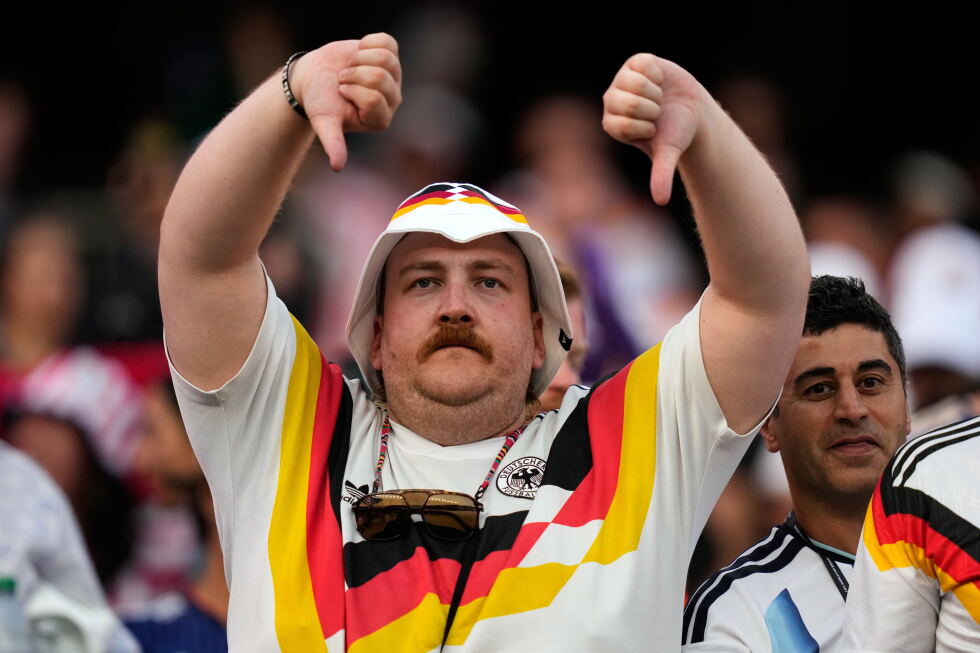
For German men’s soccer, another World Cup campaign has ended in another disappointing early exit — a bitter outcome for one of the sport’s most storied powerhouses, which had entered the tournament holding tentative hopes of lifting a fifth World Cup trophy and rebuilding its squandered reputation.
Unlike its 2018 and 2022 campaigns, Germany did manage to clear the group stage for the first time since its 2014 World Cup triumph. But that small milestone offered little consolation after Monday’s knockout round opener in Foxborough, Massachusetts, where unranked underdog Paraguay defeated the four-time champions on penalties to send them packing.
“We messed it up,” captain Joshua Kimmich told reporters immediately after the final whistle. The early elimination marked a familiar bitter pill for Kimmich, who was also part of the 2022 Qatar squad that crashed out in the group stage, and he offered no excuses for the underperformance.
“As a child, when you watched the national team during tournaments, it was always semifinals, finals, or world champions. There was always lots of success. You grew up with that, cheering them on,” the 31-year-old said, as he apologized to fans for failing to meet sky-high expectations. “All of us who were on the pitch should feel that, rather than looking to blame someone else. We blew it,” Kimmich stated, per reporting from German news agency dpa.
Head coach Julian Nagelsmann has become the central target of fan and media criticism following the exit, after a series of controversial selection decisions that have come under intense scrutiny. Most notably, Nagelsmann reversed months of public denials to recall veteran goalkeeper Manuel Neuer from international retirement just weeks before the tournament began.
The 40-year-old Neuer failed to live up to his legendary billing, with many analysts arguing he was directly at fault for Ecuador’s game-winning goal in the final group stage match — a result that only narrowly allowed Germany to advance. His selection came at the cost of Hoffenheim keeper Oliver Baumann, who many argued deserved the starting spot. “I gave it my all,” Neuer said of his performance.
Nagelsmann only yielded to public pressure late to hand striker Deniz Undav his first start against Paraguay, but the tactical move failed to deliver the intended impact. Undav, a Kurdish Yazidi player who had notched three goals and two assists coming off the bench in his first two tournament appearances, was unable to add to his score sheet against the underdogs. The coach also drew fire for leaving highly touted forward Nick Woltemade on the bench until the final minutes of extra time against Paraguay; Woltemade ended up as one of three German players who missed their penalties in the deciding shootout.
Nagelsmann had built high expectations ahead of the tournament, openly stating that Germany’s goal was to win the entire title. Four games later, that bold promise lies in tatters. Germany’s campaign ended with two wins — against first-time qualifier Curaçao and Ivory Coast — followed by back-to-back losses to Ecuador and Paraguay.
For Paraguay, the upset victory sparked wild celebrations across the capital city of Asunción. The result was one of the biggest upsets of this year’s tournament: few German fans could name a single Paraguayan player before kickoff, and most German supporters had already begun looking ahead to a projected round of 16 clash with defending champions France.
“You have to beat such a team,” Neuer said of Paraguay. “That’s a fact when you want to measure yourself against teams like France.”
Nagelsmann has publicly committed to staying on as head coach, though he faced additional criticism for his sharp, defensive responses to reporter questions after the match. German national team director Rudi Völler offered the coach a measured vote of confidence. “I’m still convinced that he’s probably the right one to continue,” Völler said. “It’s not only up to me.”
The disconnect between Germany’s inflated pre-tournament hopes and harsh on-pitch reality was perfectly highlighted by a widely mocked social media post from German Chancellor Friedrich Merz. “What a match, @DFB_Team! You thrilled our country with your commitment and team spirit at this World Cup. We’re proud of you,” Merz wrote on X shortly after the loss.
The post was immediately met with widespread ridicule from users across the political spectrum, who flooded the comment section asking “which match” Merz was referring to. The phrase “which match” quickly began trending on the platform. “I honestly don’t know which was worse. The match or this analysis,” wrote Marie-Agnes Strack-Zimmermann, a senior politician from Germany’s Free Democratic Party.