### Race Against Time: Nepal Flood Disaster Traps Hundreds in Hydropower Tunnels, Exposes Critical Rescue Gaps
In the wake of catastrophic flash flooding that has already claimed more than 1,000 lives across Nepal and southern China, rescue teams in Nepal are locked in a desperate race against the 72-hour critical window for disaster survival to locate hundreds of missing construction and operational workers, hundreds of whom are feared trapped inside flood-ravaged hydropower project tunnels.
Official and industry data confirms that at least 900 workers from affected hydropower facilities remain unaccounted for, with an estimated 500 believed to be trapped deep inside damaged underground tunnel networks. Access to these remote sites has been severely compromised by the flooding, which left behind massive debris fields, washed out critical infrastructure, and cut off most access routes to the affected projects.
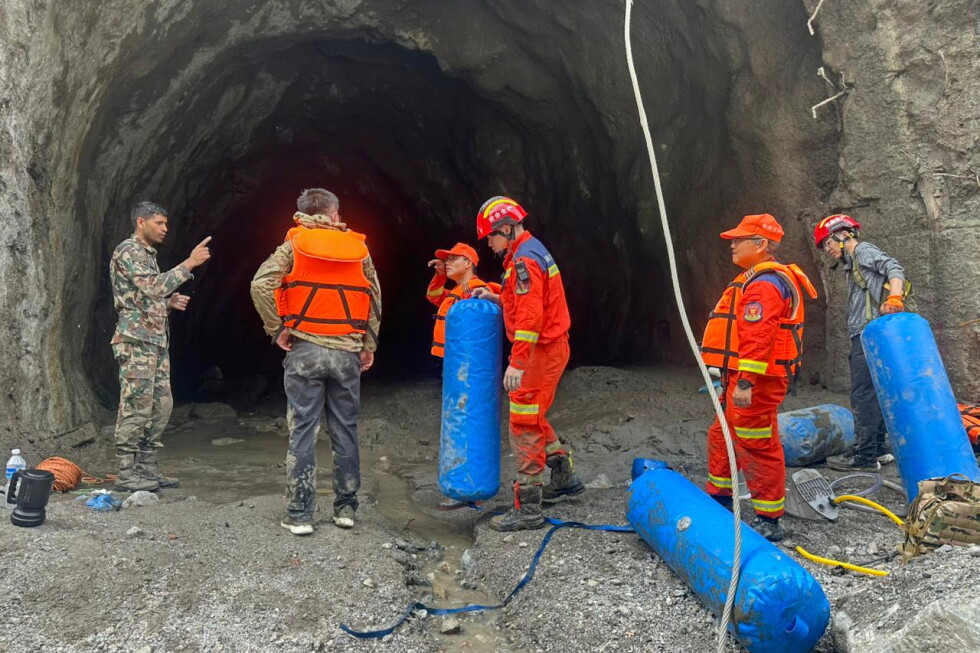
According to Brigadier General Raja Ram Basnet, spokesperson for the Nepal Army, rescue operations are currently underway at multiple affected sites, with support from international technical experts. Released army footage documents the grueling conditions rescuers face: teams navigate pitch-black tunnels choked with mud and debris, wading through thick silt and scrambling over loose rock dislodged by floodwaters to search for any signs of the missing.
Mohan Kumar Dangi, president of the Independent Power Producers Association of Nepal, outlined the scale of damage to the country’s hydropower sector: at least 12 projects spanning the Rasuwa and Nuwakot districts, with a total combined energy generation capacity of 670 megawatts, have sustained major damage. Of the affected facilities, four were still under active construction, seven were fully operational, and one was in pre-launch testing when the floods struck on August 26. Despite mandatory risk assessments and geological surveys completed prior to construction, Dangi described the extreme flood event as “something unimaginable” that exceeded all projected disaster scenarios.
The single greatest barrier to rescue efforts remains access to the trapped workers. Most of Nepal’s hydropower projects are sited in remote, steep mountainous terrain, where narrow, winding roads are already vulnerable to disruption. The flooding compounded these challenges, destroying paved routes and leaving few passable paths to project sites. Even when tunnel entrances can be reached, floodwaters carried massive boulders, mud, and timber debris into underground passages, collapsing entire tunnel sections and blocking entry deeper into the networks. Crews must clear thousands of tons of debris before they can begin searching for trapped workers.
Locating the missing has been made even more difficult by the extreme conditions inside tunnels. Manish Maharjan, a documentary filmmaker and skilled drone pilot who has volunteered his expertise to support the Nepal Army’s efforts, explained that many tunnels are completely filled with packed mud, comparing the conditions to “toothpaste in a tube.” During one search mission, Maharjan flew a drone through the entire length of an accessible tunnel to search for signs of life, returning with no evidence of survivors. In the immediate aftermath of the flood, some trapped workers were able to make emergency contact for help, and escapees confirmed colleagues remained underground. As of now, there has been no update on whether rescuers have reestablished contact or whether any of the missing are still alive.
Disaster response experts emphasize that the first 72 hours following a disaster are the most critical for finding living trapped people. While people trapped underground can survive for several days without food, the limited supply of breathable air and clean drinking water in enclosed tunnel spaces quickly turns the situation life-threatening, making every hour of delay count.
The crisis has laid bare longstanding gaps in Nepal’s ability to respond to large-scale complex disasters, particularly in remote industrial sites. Anil Pokhrel, a disaster risk reduction expert and former head of Nepal’s national disaster management authority, said that the operation has exposed critical weaknesses in the country’s rescue infrastructure. Rescuers lost critical hours early on just confirming the exact coordinates and entry points of the trapped tunnels, and operations have been hampered by a lack of heavy excavation equipment and properly trained personnel for technical tunnel rescues.
“Harsh and remote locations with inclement weather worsened the situation. Also, we didn’t have adequately trained human resources to undertake such operations,” Pokhrel noted. Despite more than a century of experience designing and constructing hydropower tunnels across the country’s mountainous terrain, Nepal remains woefully underprepared for large-scale tunnel rescue operations. “We are focused on tunnel design and construction but are not adequately prepared for rescue operations,” he added.
(Reporting from Kathmandu, Nepal by Kafle)