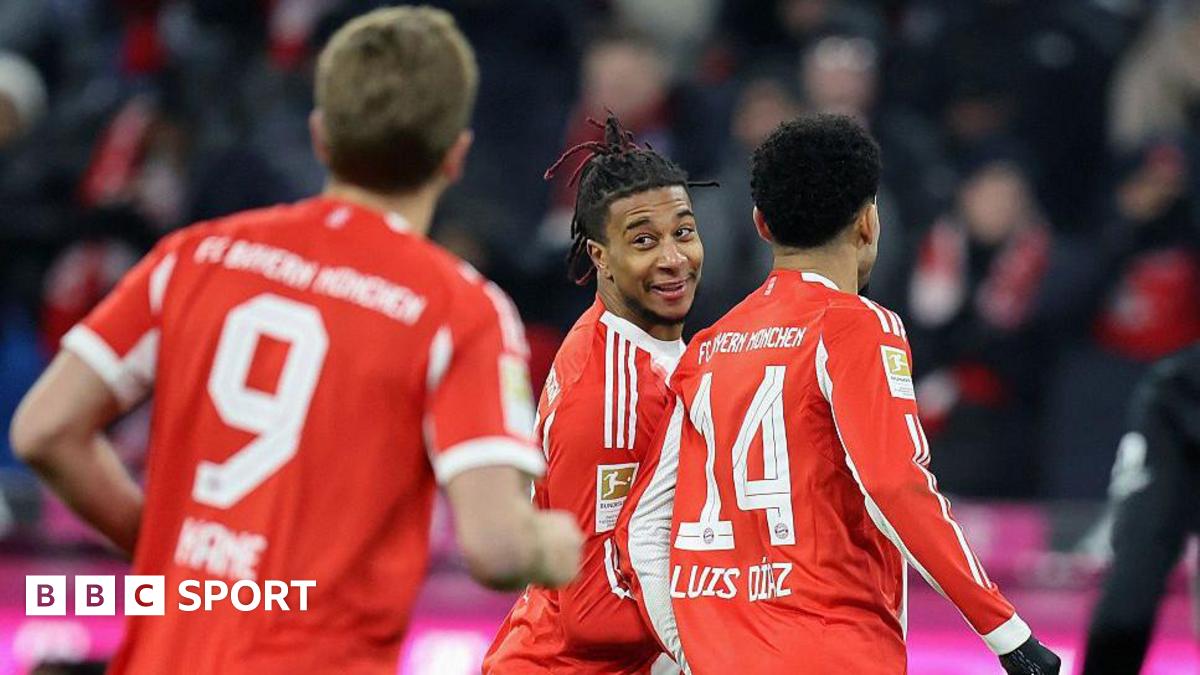
When Harry Kane, Michael Olise and Luis Diaz surge toward the opponent’s goal, opposition defenses rarely come away unscathed. From top-flight German sides to Champions League giants like Real Madrid and Atalanta, every team that has faced this Bayern Munich trio has seen firsthand just how lethal this attacking unit can be.
Since the three forwards first linked up at the Allianz Arena in August 2024, they have racked up more than 100 goals across all club competitions this season, making them only the fifth European front three to hit the century mark since the turn of the 21st century. This historic milestone is one of the core reasons the Bavarian giants are on the cusp of a historic treble, having already secured the Bundesliga title last month and now competing for the DFB Pokal and Champions League trophies. With the second leg of their Champions League semi-final against Paris Saint-Germain kicking off Wednesday — after a chaotic nine-goal first leg left Bayern trailing 5-4 — BBC Sport journalists Keifer MacDonald and Charlotte Coates break down how this dynamic trio stacks up against the greatest forward threes in modern football.
Three-man forward lines have been a foundational tactical setup across football history, but the system has seen a major mainstream resurgence over the past 15 years. This revival can be traced directly to Pep Guardiola’s dominant Barcelona side between 2008 and 2012, where Guardiola built a trophy-winning dynasty around a fluid possession-based system centered on a mobile front three. Though Lionel Messi, a nine-time Ballon d’Or winner, was typically positioned as the nominal central attacker, he frequently dropped deep to pull opposing defenders out of shape, create gaps for his attacking teammates, or add a numerical advantage in midfield. This flexible, unstoppable style delivered 14 major trophies for Barcelona during Guardiola’s first tenure, cementing the three-front system as a go-to for elite clubs across the continent.
In the years following Barcelona’s breakthrough, teams from Real Madrid to PSG began adopting similar tactical setups. In the Premier League, the closest parallel to Guardiola’s legendary front three came from Jurgen Klopp’s Liverpool, where Sadio Mane, Roberto Firmino and Mohamed Salah fired the club to both a Premier League title and a Champions League crown across five seasons together. Mirroring Messi’s role at Barcelona, Firmino served as the central forward, dropping between opposition lines to link play with midfield and open up attacking channels for Mane and Salah to exploit. The trio is widely considered one of the greatest attacking units in English football history, having claimed a full haul of major domestic and European honors.
Today, that mantle has passed to Bayern Munich, who have carefully constructed this dominant attacking unit through three consecutive summer transfer windows starting in 2023. After all three forwards got on the scoresheet in last week’s thriller against PSG, the club made German football history: no Bayern front three had ever hit the 100-goal mark in a single season before, with the previous high of 99 goals set by Gerd Muller, Uli Hoeness and Willi Hoffman back in 1972-73.
Century-goal front threes remain an extraordinary rarity in modern European football. Since the 2013-14 season, only five different attacking trios have broken the 100-goal barrier, and three of those came from the same legendary Barcelona unit: Messi, Luis Suarez and Neymar. Across three consecutive seasons from 2014-15 to 2016-17, the iconic Barcelona trio hit 122, 131 and 111 goals respectively, setting a benchmark that has yet to be matched. Real Madrid’s iconic trio of Gareth Bale, Cristiano Ronaldo and Karim Benzema also hit the 100-goal mark in the 2014-15 season, while Liverpool’s Salah-Firmino-Mane unit came close in 2017-18, finishing with a total of 91 strikes.
Now, Bayern’s Kane-Olise-Diaz trio has joined that exclusive 100-goal club, leading to inevitable comparisons with the treble-chasing PSG side they face in this year’s Champions League semi-finals. PSG itself once boasted a star-studded front three of Messi, Neymar and Kylian Mbappe, and currently fields a dynamic attacking unit led by Ousmane Dembele, Desire Doue and Khvicha Kvaratskhelia. While Luis Enrique’s current PSG trio is not as prolific as Bayern’s century-mark unit, they overwhelm defenses with constant positional rotation and creative flair. Even so, the numbers don’t lie: this season, Dembele, Doue and Kvaratskhelia have combined for 48 goals, less than half of Bayern’s 101. Last campaign, PSG’s highest-scoring attacking trio (Dembele, Goncalo Ramos and Bradley Barcola) managed 72 goals in total, still far behind Bayern’s historic mark.
Beyond the raw goal count, the two sides’ front threes differ sharply in tactical approach. Bayern operates with a fixed, predictable structure that delivers consistent output week in and week out: Diaz lines up on the left flank, Olise on the right, and Kane leads the line as the out-and-out central striker. PSG, by contrast, leans fully into the fluid approach that popularized the modern three-front system, with forwards constantly swapping positions and stepping up to deliver in high-stakes matches. As the two sides prepare for a decisive second leg to decide who advances to the 2025 Champions League final, football fans will get to see whether Bayern’s historic, record-breaking attacking unit can overturn PSG’s first-leg lead and secure their place in the final — and cement their spot among the all-time great front threes.