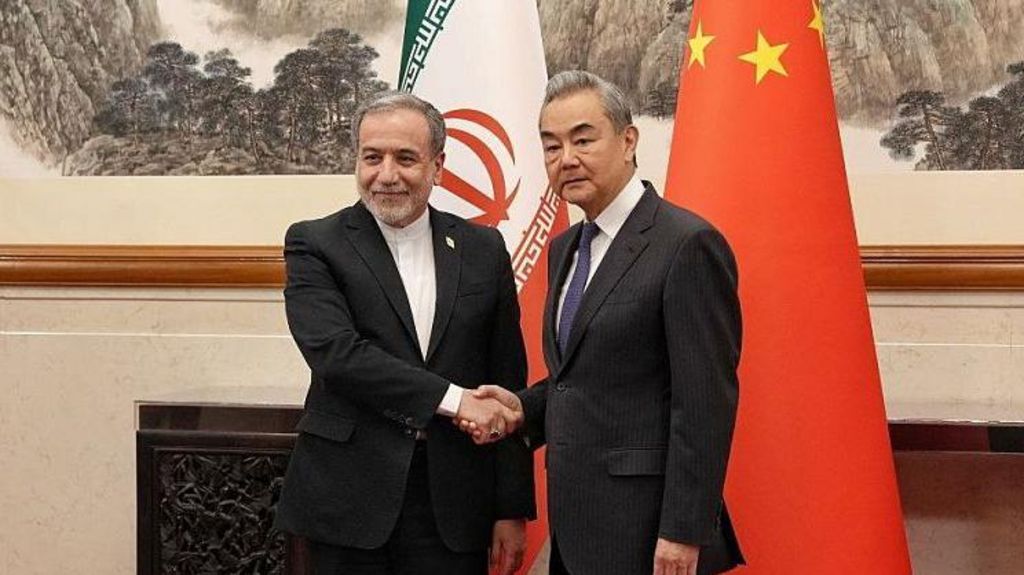
In a high-stakes diplomatic gathering in Beijing on Wednesday, Chinese Foreign Minister Wang Yi held talks with his newly appointed Iranian counterpart Abbas Araqchi, marking Araqchi’s first visit to China since the outbreak of the US-Israeli military conflict against Iran. At the top of the agenda was the ongoing crisis in the Strait of Hormuz, with Wang pressing for the immediate reopening of the critical global waterway that has been largely blocked by reciprocal restrictions from Iran and the US since the war began.
As one of the world’s most vital chokepoints for global energy trade, the Strait of Hormuz carries roughly a fifth of the world’s daily crude oil supplies. Its prolonged closure has sent ripples through energy markets, leaving the international community on edge about potential price spikes and supply disruptions. Wang emphasized in the meeting that restoring safe and unobstructed navigation through the strait aligns with the shared interests of the entire global community, and he called on all relevant parties to answer the international community’s urgent call to lift the blockades without delay.
On the broader conflict, Wang stressed that reaching a lasting, comprehensive ceasefire remains the world’s most urgent priority. He warned that any resumption of large-scale hostilities would only deepen the region’s crisis and bring more catastrophic harm to civilians and infrastructure. Reaffirming China’s consistent neutral mediation position, Wang noted that Beijing has long avoided direct entanglement in the conflict while working quietly behind the scenes to push all sides toward dialogue. He reiterated that China remains fully ready to facilitate further talks and support international efforts to de-escalate tensions across the Middle East.
In a notable gesture of diplomatic engagement, Wang also publicly recognized Iran’s longstanding commitment to not developing nuclear weapons, a point that aligns with China’s broader efforts to preserve the non-proliferation framework in the region. According to Iranian state media readouts of the meeting, Araqchi used the occasion to reaffirm Iran’s commitment to deepening bilateral cooperation with China, telling Wang that partnership between the two countries will grow even stronger in the coming years.
This meeting comes as the international community prepares for a landmark summit next week between US President Donald Trump and Chinese President Xi Jinping, a meeting that was originally scheduled for March but postponed after the US and Israel launched their wide-ranging military strikes on Iran. If the summit proceeds as planned next week, it will mark the first visit by a sitting US president to China in nearly a decade, and the Iran conflict and the Strait of Hormuz impasse are widely expected to top the bilateral agenda.
Notably, both US and Iranian officials have already credited Chinese diplomatic mediation for helping broker the April ceasefire between the two sides, which was formally arranged through Pakistan. China has also repeatedly criticized the US naval blockade of Iranian ports, describing the move as “irresponsible and dangerous” that risks unraveling the fragile ceasefire agreement that has been in place for months.
For China, the stakes of the Strait of Hormuz reopening are deeply personal. China is one of the largest buyers of Iranian crude oil, even as the oil remains under US unilateral sanctions. Data from the Center on Global Energy Policy shows that China imported an average of 1.38 million barrels of Iranian crude per day in 2025, accounting for roughly 12 percent of China’s total crude imports. Despite this heavy reliance on energy supplies that pass through the strait, Trump told reporters at the White House earlier this week that Xi Jinping has acted with “very respectful” posture toward the US in recent months. He claimed that China has not challenged US positions on the conflict, adding that “Xi would not challenge the US because of me.”
As diplomatic activity ramps up on multiple fronts ahead of the Trump-Xi summit, the outcome of the talks on the Strait of Hormuz could have far-reaching implications for global energy security, the future of the Iran conflict, and the trajectory of bilateral relations between the world’s two largest economies.