Nestled on Tunisia’s Mediterranean island of Djerba, the 2,600-year-old El-Ghriba Synagogue has long hosted one of Africa’s most enduring Jewish pilgrimage traditions. This year, the annual Lag B’Omer gathering welcomed a small but meaningful comeback of international worshippers, held under robust security measures one year after a fatal attack shattered the 2023 event.
In the 2023 attack, a Tunisian national guardsman opened fire near the synagogue shortly after that year’s festival, killing five people — two French pilgrims and three local security officers. The violence sowed deep anxiety among Tunisia’s small, centuries-old Jewish community and diaspora pilgrims who travel to the site annually. This year, attendees included visitors from France, China, Ivory Coast, and Italy, among them France’s ambassador to Tunisia, a symbolic show of solidarity following the 2023 deaths of two French citizens in the attack.
Organizers reported roughly 500 attendees for this year’s pilgrimage, which ran from April 30 to May 6. Jewish communities have existed in Tunisia since the Roman era, and the Ghriba gathering remains the centerpiece of religious and cultural life for the country’s long-standing Jewish population. Unlike the sharp decline in international attendance seen in 2024, this year marked the first resumption of cross-border participation, with many diaspora Jews returning to honor their ancestral roots.
Inside the ancient synagogue, the mood blended quiet devotion and quiet celebration. Worshippers followed long-held traditions: lighting candles, reading sacred Torah texts, and writing personal wishes on eggs that are placed in a holy cave on the site, a custom believed to bring divine blessing. Redj Cahen, a Tunisian-Italian pilgrim who skipped the 2024 gathering, called his return this year deeply meaningful. “We are back, and we are proud to be Tunisian Jews,” he said. “It is a feeling you cannot explain. Only those who come here understand.”
For decades, the pilgrimage has stood as a powerful symbol of interfaith coexistence in Tunisia, drawing Muslim visitors alongside Jewish worshippers from across the globe. Historically, the event attracted thousands of attendees each year, but numbers plummeted after the 2023 attack — and the site was already targeted in a 2002 al-Qaida truck bombing that killed roughly 20 people.
To ensure participant safety this year, Tunisian authorities deployed a layered security operation. A visible but unobtrusive security cordon surrounded the synagogue, while intensified checkpoints, barricades, and vehicle searches were set up at all entry points to Djerba island. Extra security personnel were assigned to Hara Seghira and Hara Kebira, the island’s two historic Jewish quarters.
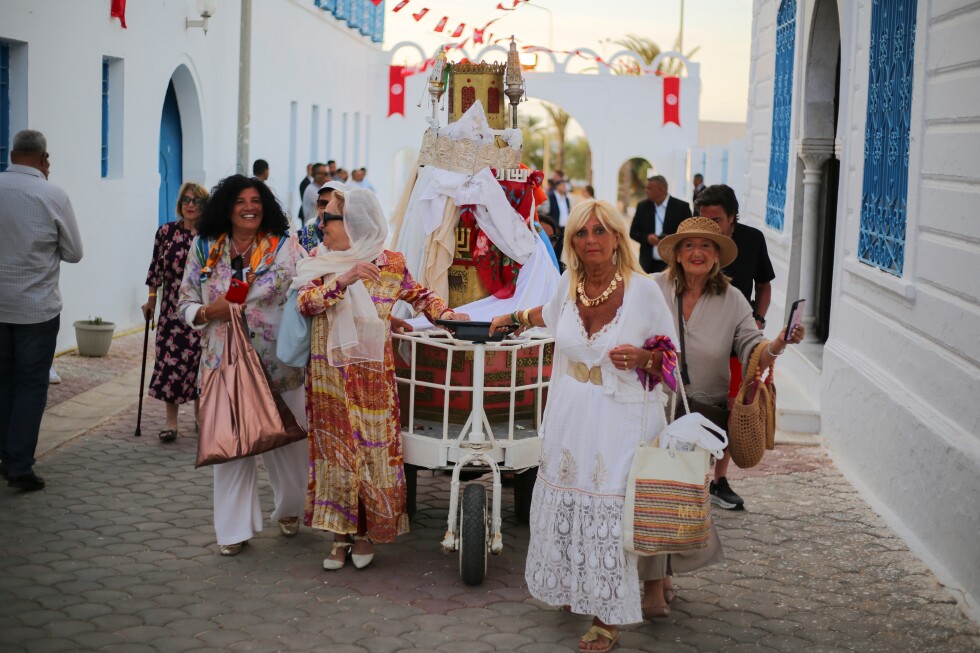
In a key sign of cautious recovery, the iconic traditional Minara procession was held this year for the first time since the 2023 attack. The Minara — a pyramid-shaped tower crafted from gold and silver — sits at the heart of the synagogue. As part of the tradition, women drape the structure in colorful scarves, a ritual linked to wishes for good fortune, fertility, and marriage. A symbolic auction of artwork and religious artifacts follows, raising funds for the synagogue’s ongoing maintenance. The scarf-decorated Minara is then placed on a cart and paraded through the surrounding streets, accompanied by the rhythm of traditional darbuka drums, communal singing, and the throwing of candy to onlookers before being returned to the synagogue to close the ceremony.
Local leaders and community members framed the 2025 gathering as a deliberate, gradual step toward normalcy. “This year’s Ghriba pilgrimage marks a gradual return,” said former Tunisian Tourism Minister René Trabelsi. “We are returning little by little.” Trabelsi noted that Tunisian officials prioritized keeping the tradition alive despite ongoing security challenges, emphasizing that the annual event provides critical economic support to Djerba’s local tourism and hospitality sectors.
Khedir Hnaia, who has worked at the El-Ghriba Synagogue for more than 30 years, expressed hope that the gathering will regain its former vibrancy. “We would like to reflect a good image to the world, to bring back the glory of Ghriba and make it even better than how it used to be,” he said. Haim Haddad, a member of the pilgrimage organizing committee from the Tunisian city of Zarzis, reaffirmed the community’s commitment to their home country. “We need to stand up for our country, we love Tunisia very much and in the same way our country stood up for us we will always stand up for it,” he said.