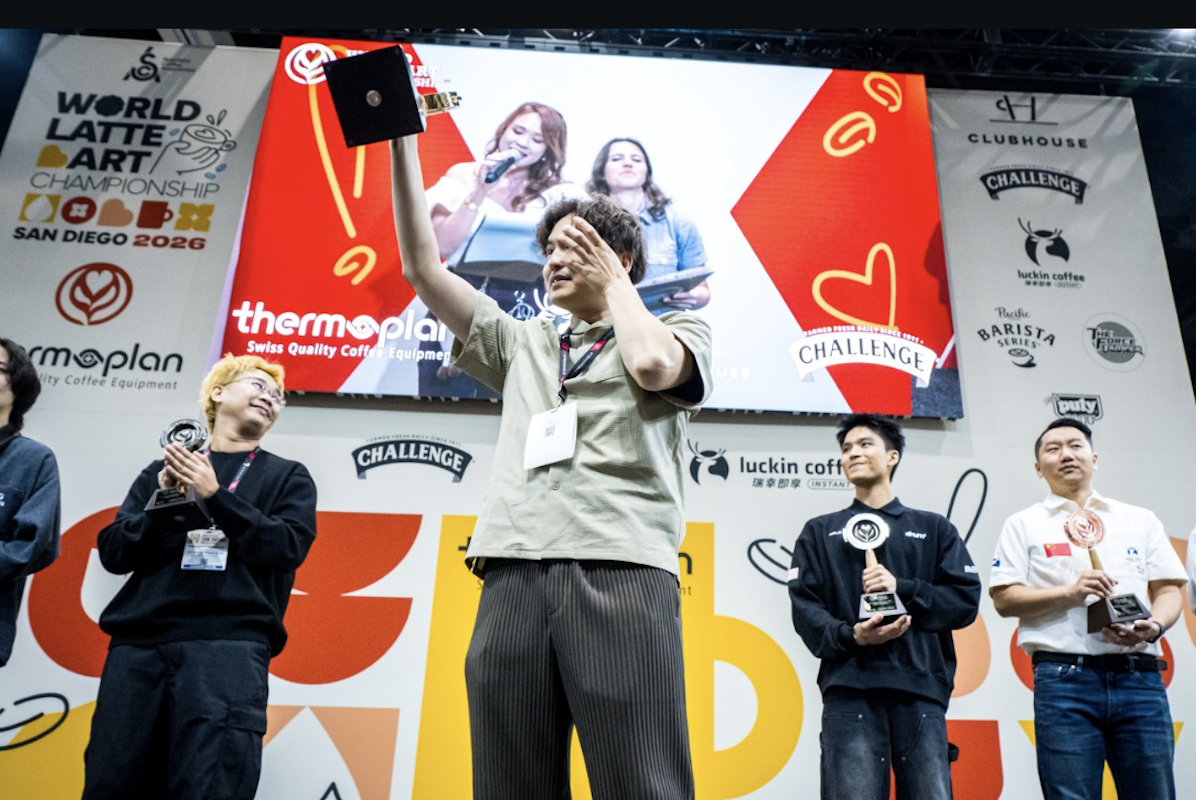
In April 2026, barista Bala claimed the top prize at the World Latte Art Championship in San Diego, wowing judges with intricate latte art of a raccoon, giraffe, and red pandas to secure a winning score of 531 points. The event counted Chinese coffee chain Luckin Coffee as an official sponsor, and when Bala stepped onto the winner’s podium, competition organizers initially listed him as representing Taiwan.
What followed just one week later was a quiet, unannounced revision that has exposed how geopolitical pressure can penetrate even niche, seemingly apolitical global cultural industries. The Specialty Coffee Association (SCA), which oversees the World Coffee Championships (WCC), altered Bala’s affiliation in official records, changing the listing from “Taiwan” to “Chinese Taipei” with no public explanation. The organization went further, removing older ranking documents from its website that had for years listed past Taiwanese champions under the same original designation.
This small bureaucratic change is far more than a trivial footnote to broader geopolitical tensions between Beijing and Taiwan. It marks a clear signal that Chinese coercive pressure has expanded into an under-monitored domain: the global governance infrastructure of the international specialty coffee sector. The incident also lays bare a stark truth: when private non-governmental organizations that manage global cultural and industrial activities face large-scale geopolitical pressure, their long-proclaimed neutrality collapses almost immediately.
Taiwan’s specialty coffee community climbed to global prominence gradually, building its legacy over more than two decades of competition. The World Barista Championship launched in 2000, but it was not until 2007 that the first Taiwanese competitor, national champion Lin Tung-Yuan (Van Lin), stepped onto the international stage. What came next was an extraordinary streak of success: Pang-Yu Liu took gold at the 2014 World Cup Tasters Championship, while Jacky Lai won the 2014 World Coffee Roasting Championship in the same year. Berg Wu became Taiwan’s first World Barista Champion in 2016, followed by Chad Wang’s win at the 2017 World Brewers Cup, and Xie Yi-chen claimed the 2024 World Latte Art Championship title. Bala’s 2026 victory was the latest milestone in this decades-long journey.
As recently as 2022, the SCA itself celebrated Taiwan’s thriving specialty coffee scene when it announced it would bring the WCC event to Taipei, highlighting the island’s estimated 4,000 roasters and 16 world championship finalists, explicitly naming the island’s top competitors under their Taiwanese affiliations. Through 19 years of advocacy, the Taiwan Coffee Association had fought to retain the “Taiwan” designation for its competitors — a fight that ended in defeat with the 2026 revision.
The name change did not occur in a vacuum. Just six months prior, in October 2025, the SCA made another consequential institutional shift: it absorbed the widely recognized Q Grader Program — a global certification for coffee quality assessment held by roughly 10,000 professionals worldwide — from the Coffee Quality Institute, which had managed the program for 20 years. The SCA restructured the certification around its 2023 Coffee Value Assessment (CVA) framework, which for the first time formally recognizes origin, processing method, and cultural context as core components of a coffee’s overall value, noting publicly that “coffee is more than a score — it is culture, craftsmanship and context.”
The contrast between this rhetoric and the quiet renaming of Taiwan is not a contradiction, but a reflection of a single underlying logic. Once origin becomes a formal part of commercial coffee value, the question of who controls how an origin is named shifts from a mundane administrative task to an exercise of geopolitical power. The progressive language of respect for cultural context serves as a market positioning tool, while the renaming demonstrates how that power is actually exercised.
In a May 1 statement, the SCA defended its decision, framing it as a routine administrative change and pointing to the naming conventions used by the International Olympic Committee and FIFA as precedent. That comparison confirms the core issue: like these large international sports bodies, the SCA is a private organization that governs a global cultural activity while remaining highly vulnerable to pressure from its largest single market, China. Its commitment to neutrality holds only until pressure becomes too great to resist.
Coinciding with the SCA’s revision was another major shift in the global coffee industry that underscores growing Chinese influence. In late April 2026, just days before the name change was implemented, Centurium Capital — the controlling shareholder of Luckin Coffee, the official sponsor of Bala’s winning championship — announced it had acquired iconic American third-wave coffee chain Blue Bottle Coffee from Nestle in a deal worth under $400 million. While the two events have not been publicly linked, their timing tells a broader story: Chinese capital is not only lobbying for policy changes in global coffee governance, it is actively buying up the cultural infrastructure that these global bodies regulate.
For analysts and policymakers tracking Chinese “sharp power” expansion, the incident carries a clear warning: coercive pressure has now reached niche global sectors that have flown under the radar of most monitoring efforts. The Taipei Times reported that the name change followed suspected behind-the-scenes political pressure from China, with sources noting Luckin’s role as a top championship sponsor points to implicit Chinese influence. If a global standards body for a cultural industry can be pressured into such a change with no public pushback, no similar private global governance body is immune to the same pressure — from industry consortia to certification groups to sports federations across the world.
For consumers who see purchasing ethically sourced specialty coffee as a small political act of supporting producers and their identities, the lesson is equally sobering. The specialty coffee industry’s widely used progressive language of honoring origin, terroir, and cultural context did not protect Taiwan’s coffee community from erasure of its identity. In fact, it created the conditions for that erasure, by shifting authority over defining origin from producers themselves to global certifying bodies.
In response to the change, Taiwan’s coffee community has launched a public pushback, organizing a “one-person-one-email” campaign calling on the WCC to reverse the revision. Berg Wu, the 2016 world champion, was among the first to speak out publicly. “Taiwan is not just a name,” he wrote on Facebook shortly after the change. “It is an identity and a shared memory built by many competitors, coaches, judges, cafes, roasters, and all the consumers who have supported us along the way.” That 26-year-old shared legacy was altered in just seven days, a quiet reminder of how geopolitical power can reshape even the most unexpected corners of global culture.