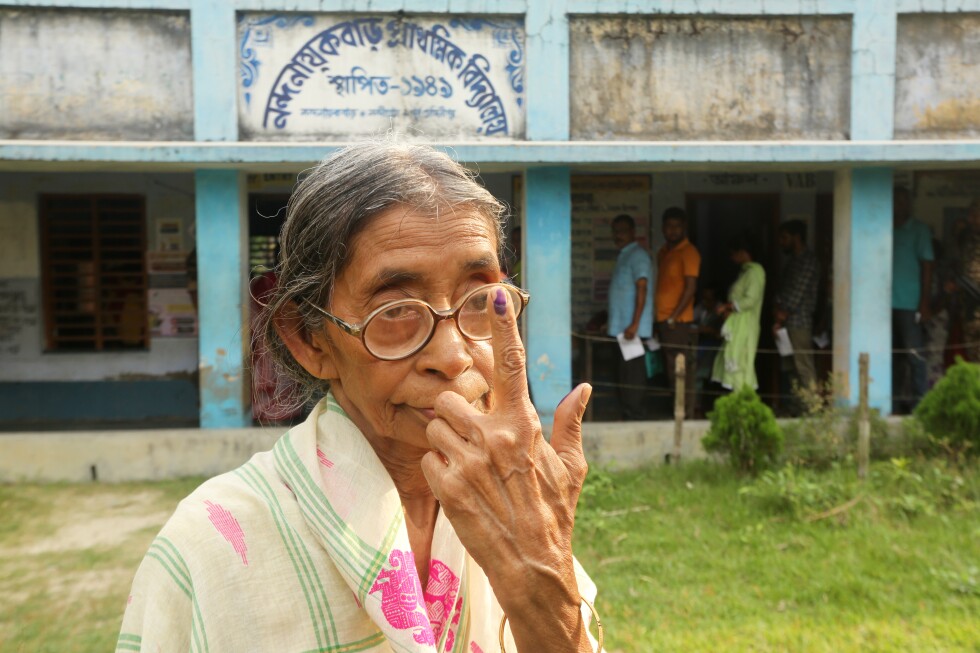
Polling for one of India’s highest-stakes regional elections opened on Thursday in West Bengal, launching a vote that carries nationwide political consequences after a national electoral roll revision stripped millions of people of their voting eligibility, stoking widespread fears of disenfranchisement. West Bengal stands out as one of the largest Indian states still not controlled by Prime Minister Narendra Modi’s ruling Bharatiya Janata Party (BJP), making the election a critical battleground for national power dynamics.
This contest is far more than a regional race: it is a major test of the BJP’s ability to expand its footprint into long-held opposition strongholds across the country. For the BJP, a win would cement the party’s growing dominance across Indian states, while a victory for incumbent Chief Minister Mamata Banerjee, leader of the regional opposition Trinamool Congress, would reinforce her standing as one of Modi’s most formidable national challengers. Voting is also underway simultaneously in the southern state of Tamil Nadu, with a second phase of polling scheduled for next week in West Bengal. Final results from this round of state elections, alongside earlier voting in Kerala, Assam, and the union territory of Puducherry, will be announced on May 4.
The controversy at the heart of this election centers on a sweeping voter roll update carried out by India’s Election Commission, billed as a measure to remove duplicate entries, names of deceased voters, and ineligible registrations. In total, roughly 9 million names — equal to 12% of West Bengal’s entire electorate — were struck from the rolls. Officials confirm 6.3 million of those deletions were for voters listed as deceased or permanently absent, while 2.7 million more were marked “doubtful” and left pending verification. But hundreds of thousands of affected voters report they participated in previous elections, hold all required valid government identification, and were removed from the rolls without any formal explanation.
Take Sheikh Najrul Islam, a 53-year-old paramilitary officer who was deployed to West Bengal to oversee election security. He voted as recently as 2021 and holds all valid citizenship documents, yet his name vanished entirely from the updated voter list. “The Election Commission has deputed me to ensure free and fair polls. Yet, it does not consider me a citizen of this country,” Islam told reporters. Similarly, 62-year-old retired school administrator Taibunessa Begum, who holds a valid Indian passport, official pension records, and a decades-long history of voter registration, said she was stunned to find her name deleted. “It felt like being told I don’t exist,” she said.
Opposition leaders have levied serious allegations that the deletions disproportionately target Muslim residents and other marginalized communities in the state, a charge national election officials and the ruling party have outright denied. The Election Commission maintains the revision was a straightforward administrative effort to clean up outdated rolls, while BJP officials frame the process as a routine, nationwide exercise that affected Hindu voters as well. The party argues any perceived disproportionate impact in West Bengal stems from a large population of undocumented migrants in the state.
Critics, however, tie the voter roll changes to polarizing political rhetoric from Modi and senior BJP leaders, who have repeatedly framed the revision as a crackdown on illegal immigration from neighboring Bangladesh. Opposition figures say this rhetoric has amplified deep-seated fears among minority communities that the roll update is being weaponized for political gain to exclude them from the democratic process. Derek O’Brien, a senior Trinamool Congress spokesperson, called the process “invisible rigging,” adding “The motive is to disenfranchise voters.”
Political analysts warn the controversy could have far-reaching consequences beyond this single election, eroding trust in democratic institutions among marginalized groups. “Losing one’s place in the electoral roll can be deeply unsettling. It is not only about voting rights; it is about dignity, recognition, and the assurance that one counts as a citizen,” said political analyst Iman Kalyan Lahiri. For affected voters like Begum, the stakes are intensely personal, extending far beyond partisan politics. “This is not just about politics,” she said. “It is about identity, about whether we belong to this country.”