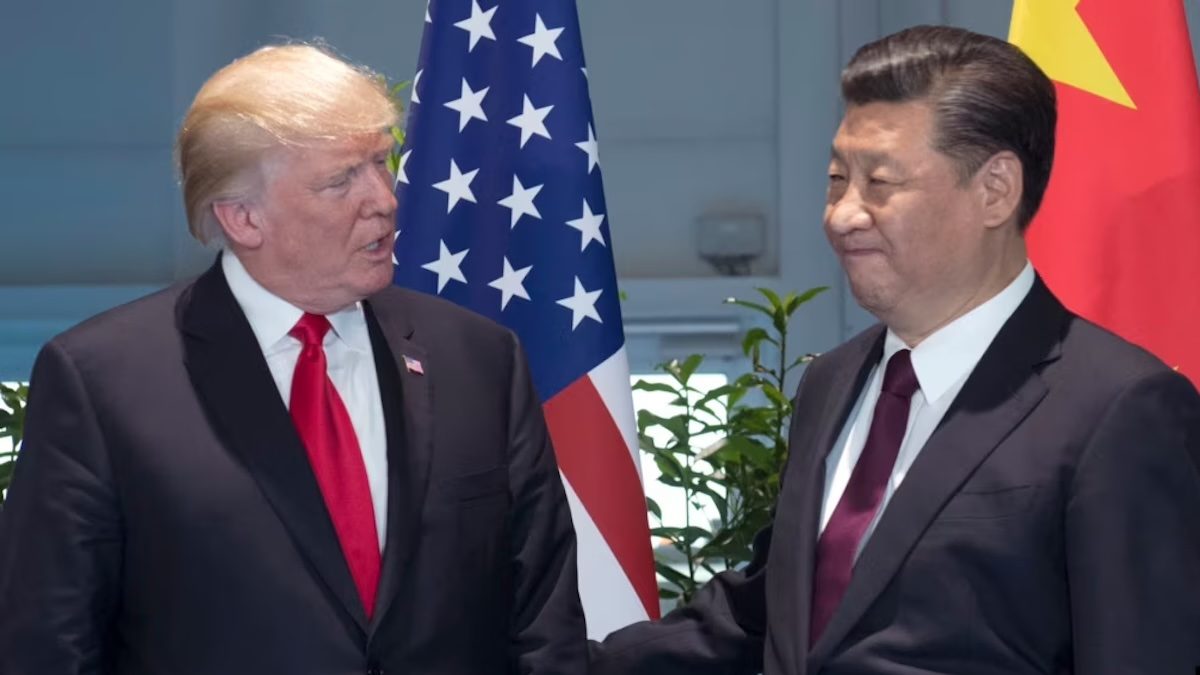
Next week, when U.S. President Donald Trump travels to Beijing for a high-stakes meeting with Chinese President Xi Jinping, the diplomatic choreography will follow the familiar, carefully scripted playbook for top-level bilateral encounters. Behind the polished ritualistic exchanges, crafted public reaffirmations and statesman-like rhetoric, however, lies an unavoidable reality: this meeting is not aimed at reconciling deep-seated differences, but at managing a rivalry that has become fundamentally structural, with the modest overarching goal of preserving fragile global stability.
The United States and China together account for more than 42% of the world’s total gross domestic product, making them the dual anchors of the global supply chain network. This interconnected system is already reeling from disruptions triggered by protracted geopolitical conflicts in Europe and the Middle East, which have sent shockwaves through global commodity markets and threatened livelihoods and food security across every region of the world. Even so, analysts do not expect the upcoming summit to deliver any sweeping, utopian resolution to the U.S.-China rivalry. At most, the two leaders are expected to openly acknowledge the structural nature of their competition and commit to joint efforts to keep it contained.
### Moving Beyond Détente to Building Tacit Guardrails
Cold War-era comparisons between current U.S.-China relations and 20th-century U.S.-Soviet ties often confuse rather than clarify the current dynamic. There is no path to the kind of wide-ranging détente that defused tensions between Washington and Moscow in the 1970s. Today, Washington and Beijing lack mutual strategic trust, have seen no ideological softening toward one another, and share no overlapping long-term strategic vision.
Instead of formal détente, the two powers are now focused on developing unwritten “guardrails” — informal limits to escalation that can prevent small crises from spiraling into open, catastrophic conflict. Unlike the formal, codified arms control agreements that structured U.S.-Soviet relations in the Cold War, these new mechanisms will not be written into public treaties or celebrated in joint announcements. They will exist only as quiet, tacit understandings between the two sides.
This incremental approach reflects a far more complex reality than the dominant narratives of either full détente or total decoupling can capture. Since 2022, Washington has built an extensive export control regime targeted directly at China, restricting access to cutting-edge semiconductors, artificial intelligence technology and other frontier technologies critical to future great power competition. Beijing has responded by leveraging its global dominance in critical raw materials including gallium and germanium, key inputs for semiconductor and clean energy manufacturing. Even amid this escalating technological standoff, however, deep economic interdependence between the two economies remains intact. Bilateral trade continues to flow at massive scale, financial linkages remain strong, and cross-border production networks remain deeply integrated by design.
What has emerged from this dynamic is a stratified, complex form of interdependence: high, fortified barriers around technologies that will define future global power, while maintaining open trade and investment in sectors where mutual economic benefits still outweigh strategic risks. Full decoupling is neither economically feasible nor politically desirable for either side, so the core challenge now becomes restructuring guardrails to allow this limited interdependence to survive.
### Geo-Economics as the New Face of Geopolitical Rivalry
In recent years, the center of gravity of the U.S.-China rivalry has shifted decisively from the military domain to the economic sphere. Export controls, targeted sanctions and the reorganization of global supply chains now serve as core instruments of strategic coercion, replacing traditional military posturing as the primary tool of competition. Economic tools are now regularly deployed to advance geopolitical goals, and the line between commercial policy and national security strategy has blurred almost beyond recognition. Trade policy is now inextricably tied to each side’s core national security doctrines.
This transformation has created acute dilemmas for third countries across the globe. Governments now must carefully navigate between two competing great power ecosystems, each with constantly evolving rules of conduct and demands for strategic alignment. The choice is no longer a simple binary between aligning with Beijing or Washington; instead, states operate in a complex landscape where their policy autonomy is constrained, and the boundaries of strategic flexibility grow increasingly hard to define.
Given this context, any lasting outcome from the Beijing summit will not take the form of a grand bilateral bargain or a formal, public treaty. Following the pattern of the previous Xi-Trump meeting in Busan, the summit is expected to produce a set of technical, opaque, yet highly consequential mutual understandings that leave room for varying interpretations by both sides.
Recent frictions in the South China Sea and around Taiwan underscore the constant risk of inadvertent escalation between the two powers. The lack of a formal, codified crisis management mechanism only amplifies these risks. In this context, even the most modest agreements — for restored direct communication channels, shared operational protocols, or agreed thresholds for escalation — could have a transformative impact on regional and global security. After the 1962 Cuban Missile Crisis, the U.S. and Soviet Union moved quickly to establish de-escalation mechanisms to prevent accidental war. Today, U.S.-China relations require a similar, even if less formalized, framework of mutually accepted guardrails to reduce risk.
### The Impact of Divergent Leadership Styles
The contrasting personal leadership styles of the two presidents add an extra layer of complexity to summit negotiations. Trump’s diplomatic approach is inherently transactional, focused on securing immediate, visible, tangible outcomes that can be marketed as political wins back home. By contrast, Xi’s approach is rooted in long-term strategic planning, embedded in a broader vision for China’s continued rise as a global power. This fundamental disconnect in negotiating priorities will shape the final outcomes of the Beijing meeting.
Trump will arrive pushing for demonstrable, short-term gains: adjustments to bilateral trade balances, symbolic concessions from Beijing, or explicit security assurances on contentious issues. As host, Xi will calibrate his responses to ensure any concessions made align with China’s long-term strategic trajectories, and do not undermine core national interests.
As a result, even the most successful agreements emerging from the summit are likely to be tactical, reversible arrangements. They will deliver useful short-term stabilization but will be insufficient to build a durable, long-term framework for managing competition. Any deals will also remain contingent on the personal dynamics of the two leaders, rather than being rooted in institutionalized cooperation that can outlast changes in leadership.
The most consequential dimensions of the U.S.-China rivalry also extend far beyond their bilateral relationship. Across Asia, Africa and Latin America, states are increasingly being pulled into competing visions of development, governance and global connectivity. China’s Belt and Road Initiative has already built a significant physical and institutional presence across the developing world, embedding Chinese infrastructure standards and financing models in dozens of countries. The Trump administration has struggled to articulate a coherent alternative vision to the BRI, and has often resorted to coercive hard power tactics to counter Chinese influence, as seen in recent actions in Venezuela and Iran.
For countries across the global south, the question is no longer which great power vision is normatively preferable, but which can deliver tangible, reliable economic benefits. In the end, the outcome of the U.S.-China rivalry will be determined not by deals struck in summits, but by the long-term global credibility of each power’s model.
### Selective Coordination for Competitive Coexistence
Paradoxically, even amid deep structural rivalry, global systemic shocks can open limited space for targeted cooperation between the two powers. Issues including volatile global energy markets, emerging pandemic risks, transnational terrorism, and nuclear proliferation are all areas where Washington and Beijing share overlapping priorities, even as they compete in every other domain.
The ongoing market disruptions tied to conflicts in the Middle East illustrate this dynamic clearly. For different strategic and economic reasons, both the U.S. and Chinese economies depend on stable global energy markets, and both are deeply vulnerable to extreme price volatility. Even without broader strategic alignment, these shared vulnerabilities can open narrow corridors for transactional, issue-specific cooperation.
This dynamic aligns with what international relations scholars term “competitive interdependence”: a relationship marked by intensifying strategic rivalry alongside persistent economic and technological entanglements that neither side can fully unwind without inflicting massive damage on itself.
The cumulative effect of these overlapping dynamics is that bilateral engagements will continue to face regular setbacks, full containment of China’s rise is practically impossible for the U.S., and full convergence of interests between the two powers has proven illusory. What remains is selective coordination to enable competitive coexistence.
In this framework, bilateral stability does not come from deep mutual trust or shared ideological values. Instead, it emerges from a clear recognition of mutual vulnerability and the catastrophic costs of unconstrained escalation. The U.S.-China relationship today follows a simple logic: rivalry will persist, but it must be bounded by mutual necessity.
### What to Expect From the Beijing Summit
Against this backdrop, the upcoming Beijing summit is not expected to resolve the core tensions at the heart of the U.S.-China rivalry. The Taiwan question will remain a deeply contested flashpoint, technological competition will continue to intensify, and long-standing mutual strategic suspicion will endure. What the summit may achieve is a modest, yet highly consequential outcome: it will buy valuable time for both sides to adjust to the new reality of structural competition.
In an international system marked by widespread uncertainty and growing fragmentation, time is a critical strategic resource. Managed rivalry, for all its imperfections, is unquestionably preferable to unconstrained competition that risks open conflict.
Trump and Xi do not view each other as reliable partners, and there is little prospect that this meeting will change that fundamental dynamic. At a deeper level, they are rivals by design: leaders of two great power systems whose long-term trajectories are fundamentally at odds, but whose peaceful coexistence is the only viable option for both sides and for the world. The understandings they reach in Beijing will not end their rivalry. At best, they will clearly define its boundaries. For now, that is likely the most the world can hope for from this high-stakes meeting.
*This analysis is by Swaran Singh, Professor of International Relations at Jawaharlal Nehru University in New Delhi.*