Amid widespread global energy market volatility triggered by the U.S.-Israeli war on Iran, the United States is actively negotiating a landmark power-sharing agreement aimed at unifying oil-rich Libya under the control of its two most influential rival political families, multiple informed sources including current and former Western officials, regional Arab insiders, and independent analysts have confirmed to Middle East Eye.
The proposed framework would restructure Libyan governance by aligning the western-based Dbeibeh family and the eastern-based Haftar clan, while transitioning leadership from the older generation of political strongmen to a new cohort of younger leaders. Though negotiations have been ongoing for months, the initiative has gained urgent new momentum in recent weeks as rising oil prices driven by the Iran conflict have rekindled interest from U.S. energy firms in accessing Libya, which holds the largest proven crude oil reserves on the African continent.
Libya’s existing ruling factions have already seen a dramatic surge in revenue amid the Brent crude price rally: the country’s National Oil Corporation reported April oil revenues hit $2.9 billion, a three-fold increase from the start of 2025, and Libya’s oil minister traveled to Washington for high-level talks last week.
“This process has been in the works for several months, and the U.S. is actively laying the groundwork for a comprehensive agreement between the two families,” explained Riccardo Fabiani, North Africa director at the International Crisis Group. “There is enormous profit to be gained from expanded upstream oil exploration, so Washington has enormous stake in this outcome—especially now with the ongoing conflict in Iran.”
Leading the U.S. diplomatic push is Massad Boulos, U.S. President Donald Trump’s special envoy for Africa. While the proposed deal has been acknowledged in limited public discourse and faces widespread opposition from Libyan civil society groups, it has received little mainstream attention in Western capitals, overshadowed by the regional focus on the war against Iran.
Under the terms of the draft arrangement, the Trump administration is pushing for Ibrahim Dbeibeh, a veteran western Libyan powerbroker, to replace his cousin, incumbent prime minister Abdul Hamid Dbeibeh, who has struggled with ongoing health issues in recent months. An Arab source familiar with negotiations and a former senior Western official confirmed that Boulos coordinated this leadership reshuffle with Turkish officials as recently as April during the Antalya Forum, which hosted a high-level Libyan delegation.
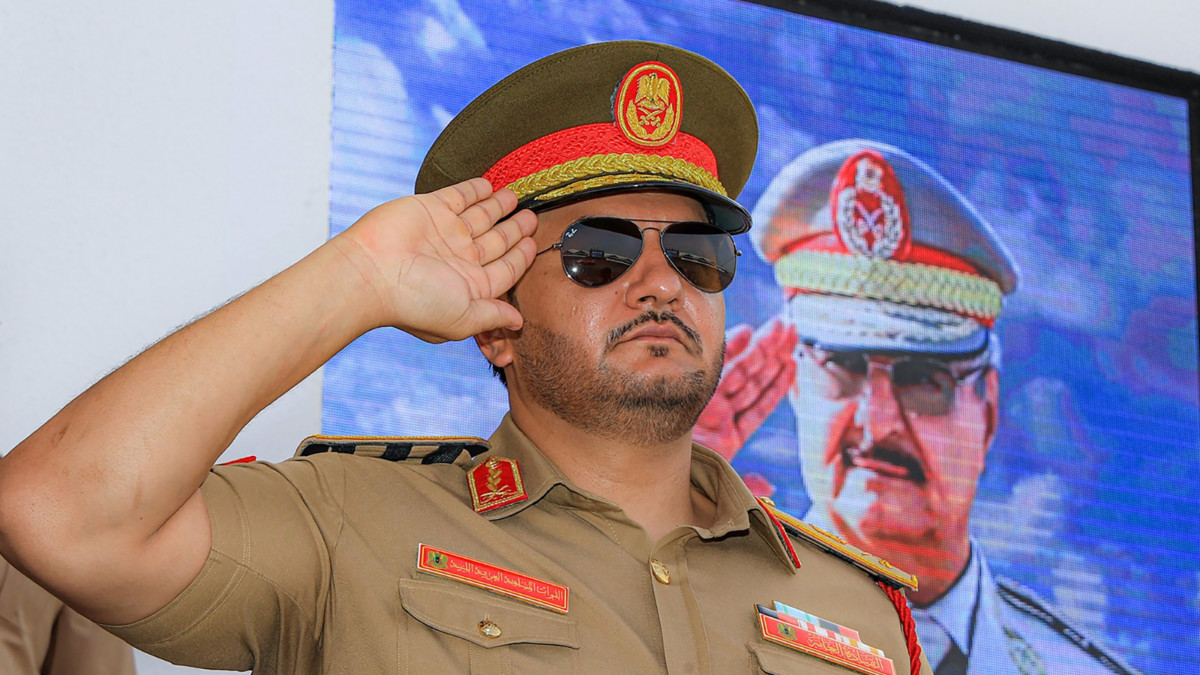
As previously reported and confirmed by *The New York Times*, Ibrahim has built an unusually close relationship with Boulos, and the pair have held private discussions about unlocking billions of dollars in Libyan sovereign assets that have been frozen in Western financial institutions for decades. On the eastern side of the proposed power split, 35-year-old Saddam Haftar—son of 82-year-old eastern Libyan strongman General Khalifa Haftar, who has controlled the eastern half of the country for more than a decade—would be appointed as Libya’s president.
Saddam Haftar currently serves as deputy commander of his father’s Libyan National Army, and has already moved to rework the Haftar family’s diplomatic ties, building new relationships with former rivals including Turkey. He is widely viewed as the U.S.’s preferred successor to his aging father, and the Arab source confirmed Saddam met with the Central Intelligence Agency’s deputy director during an official visit to Washington last year. As part of Boulos’s negotiating process, Ibrahim Dbeibeh and Saddam Haftar held high-level unity talks at the Élysée Palace in Paris earlier this year.
This latest effort to unify Libya comes after more than 14 years of fragmented governance following the 2011 NATO-backed uprising that ousted and killed long-time dictator Muammar Gaddafi. Since 2011, the country has been split into two competing political blocs: an internationally recognized government based in the western capital of Tripoli, and a parallel administration in the east led by Khalifa Haftar. The two sides fought a brutal civil war in 2019, when Khalifa Haftar launched an assault on Tripoli that devolved into a full proxy conflict: Turkey backed the UN-recognized western government, while Russia, Egypt, and the United Arab Emirates provided military and financial support to the Haftar-led eastern bloc. Abdul Hamid Dbeibeh was appointed prime minister in 2021 as part of a UN-backed initiative to lead the country toward unified democratic elections, which have been repeatedly delayed and ultimately collapsed.
“Outside powers, including the U.S., have effectively abandoned any pretense of pushing for democratic elections in Libya,” said one former senior Western official. “Their preference is to cut a deal with the already entrenched ruling families and split the country’s energy wealth between the two most corrupt factions. But the Haftar name is toxic in western Libya, and the Dbeibeh family does not exert full control over the west. This entire process bypasses the Libyan people entirely, and it could easily backfire.”
The Dbeibeh family has built alliances with powerful militias in western Libya but faces persistent opposition from other regional factions. Any power-sharing deal that includes Saddam Haftar is expected to face fierce pushback in Misrata, a key Mediterranean coastal city with a large, influential network of independent business families. Libya’s highest religious authority, Grand Mufti Sadiq al-Ghariani, publicly came out against any power-sharing agreement between the two families in late April.
Even within the rival clans, internal divisions threaten to derail the deal: while Saddam Haftar has consolidated control over the eastern military, he is locked in a bitter power struggle with his brothers, most notably Belqasim Haftar, who controls the lucrative Benghazi-based Fund for Development and Reconstruction.
“Neither the Dbeibeh family nor the Haftar clan currently operate as cohesive, unified political blocs,” said Jalal Harchaoui, a Libya expert at the Royal United Services Institute. “That fragmentation could actually make this change possible. The status quo is completely unsustainable, so if a new unified government is announced, it would mark the start of a new political process for the country.”
A former U.S. official familiar with the Libya initiative noted that the Trump administration is building on gradual reconciliation efforts first launched by the Biden administration, but the current White House’s willingness to negotiate unlocking frozen assets and approve new commercial deals has accelerated diplomatic progress. “This is not just a personal initiative from Boulos—it is a whole-of-government effort designed to open Libya up to U.S. oil companies and create new economic opportunities for Libyan stakeholders,” the former official said. “Let’s be honest: the UN-led election process never delivered on its promises.”
Negotiators have already notched limited tactical wins: in early April, Libya’s Central Bank announced the country’s first unified national budget in more than a decade. Last month, eastern and western Libyan military units conducted joint training exercises in Sirte as part of the U.S.-led Flintlock security drills, a surprise development for many long-time Libya analysts.
U.S. energy firms had already begun scouting investment opportunities in Libya before the outbreak of the Iran war: Chevron won an exploration license for Libya’s Sirte Basin back in February, and Exxon Mobil signed a memorandum of understanding with the National Oil Corporation to re-enter the Libyan market by August 2025. Libya’s National Oil Corporation reported oil exports hit 1.2 million barrels per day in April, a 10-year high, though some analysts question the accuracy of those figures and argue the Iran conflict has not meaningfully altered the country’s long-term investment climate.
Most of Libya’s oil infrastructure is more than 50 years old, and official national data remains notoriously unreliable due to the lack of transparent governance across the country. Jason Pack, founder of Libya-Analysis and author of *Libya and the Global Enduring Disorder*, argues that Washington and its allies will be disappointed if they expect Libya to replace the oil volumes lost from global markets amid the Iran conflict.
“Libya’s inability to ramp up oil production stems from deep internal governance failures, not a lack of U.S. or external support,” Pack explained. “The idea that Libya can deliver globally significant volumes of additional oil over the course of the Iran war is completely unrealistic.” Pack noted that a similar debate emerged after Russia’s 2022 invasion of Ukraine, when policymakers claimed Libya could replace Russian natural gas supplies to Europe— a goal Libya never came close to meeting. “At the start of the Ukraine war, everyone claimed Libya would become the new Algeria for European energy, and they failed to deliver. They will fail again this time,” he said.
That said, most experts agree that a power-sharing deal that unites the two ruling families under U.S. mediation to divide Libya’s current energy profits is a far more achievable short-term goal, in large part because the external powers that once turned Libya into a proxy battleground have significantly reworked their regional alliances. Saddam Haftar has actively courted Turkey and has begun receiving new weapons shipments from Pakistan under Saudi auspices, while Egypt—once a staunch backer of Haftar and opponent of the Tripoli government—has built closer ties with the western administration and mended relations with Turkey, its former rival in Libya.
“Turkey and Egypt are both willing to support a deal between the two sides because the regional political context is completely different than it was even a few years ago,” Pack said. “This dynamic has nothing to do with the current U.S. administration.” Harchaoui added that the U.S. already has formal backing from Turkey, which remains one of the most influential military actors on the ground in Libya. “There are clear signs that Turkey is comfortable with whatever major announcement is coming, and that carries a lot of weight,” he said. “Saudi Arabia will likely back whatever Turkey agrees to, largely because of shared strategic interests in Sudan.”
The initiative also gives Washington an opportunity to push Russia out of its foothold in eastern Libya: Russia has deployed private mercenary forces to support Haftar for years and has long sought permanent port access in the country. With a Russian-backed military regime in neighboring Mali on the brink of collapse amid an advance by al-Qaeda-linked militants, U.S. officials see an opening to shift Haftar away from Moscow. “It is not just energy money drawing U.S. policymakers to this initiative. Russia is already retreating in Mali, so it is not unreasonable to think they could be pushed out of Libya too,” Harchaoui said.