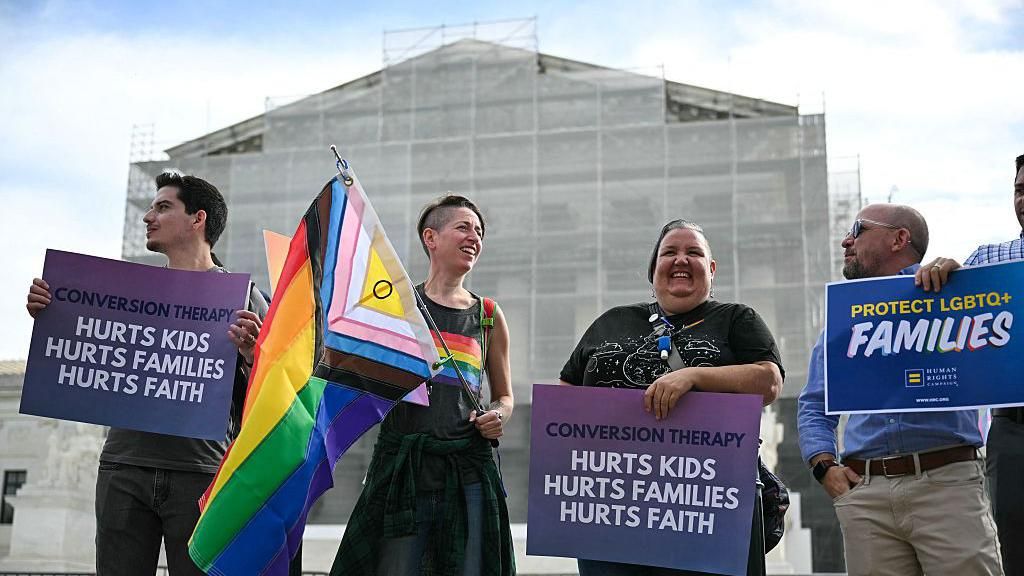
In a landmark 8-1 ruling that has reignited fierce national debate over free speech protections versus public health safeguards for LGBT youth, the U.S. Supreme Court has struck down a Colorado state law that banned the discredited practice of conversion therapy for lesbian, gay, and transgender people. The court’s majority sided with Kaley Chiles, a licensed Christian counselor from Colorado Springs, who argued that the state’s restriction on the practice violated her First Amendment right to free speech.
Conversion therapy, an umbrella term for interventions that purport to change a person’s sexual orientation or gender identity, is universally condemned by leading medical and mental health professional associations across the United States. Despite this widespread rejection by the scientific community, the practice retains support among some religious conservative groups, who frame it as a matter of personal faith for clients who prioritize their religious beliefs over their gender or sexual identity.
Chiles, who launched her legal challenge against the 2021 Colorado law, argued that the ban blocked her from providing talk-based support to clients who sought help reducing or eliminating unwanted same-sex attractions or altering their gender expression. She contended that the restriction targeted her specific viewpoint, interfering with her ability to deliver care aligned with both her faith and her clients’ stated wishes.
Writing for the court’s majority, Justice Neil Gorsuch echoed Chiles’ argument, ruling that Colorado’s law amounted to unconstitutional viewpoint-based censorship. “The First Amendment stands as a bulwark against any effort to prescribe an orthodoxy of views, reflecting a belief that each American enjoys an inalienable right to speak his mind and a faith in the free marketplace of ideas as the best means for finding truth,” Gorsuch wrote in the majority opinion. He emphasized that Chiles’ work exclusively involves talk therapy, with no physical interventions or prescription medications involved, and reaffirmed that First Amendment protections extend equally to licensed professionals as they do to all other Americans. The court ruled that lower courts had applied insufficiently strict scrutiny to the state’s speech restrictions, and ordered the case remanded back to lower courts for further proceedings.
Colorado state officials had defended the law, arguing that it did not regulate speech but rather governed the professional conduct of licensed mental health providers, and did not ban general discussions of sexual orientation or gender identity. But the majority rejected that framing.
Justice Ketanji Brown Jackson issued the only dissenting opinion, arguing that the majority had overlooked a key contextual detail: Chiles provides services as a licensed medical professional operating in a heavily regulated field. “Chiles is not speaking in the ether; she is providing therapy to minors as a licensed healthcare professional,” Jackson wrote. She noted that licensed therapists are already subject to broad regulatory requirements under Colorado law, including a mandate to provide care that meets accepted national standards of care, and that First Amendment protections carry far less weight for professionals providing regulated clinical services.
Reaction to the ruling split sharply along ideological and advocacy lines. Colorado Attorney General Phil Weiser, a Democrat, publicly condemned the decision as wrong, noting that conversion therapy is universally rejected by every major U.S. medical association, and that the practice is a matter of public health, not free speech.
LGBT advocacy groups have also decried the ruling as a dangerous setback that puts vulnerable youth at risk. Jaymes Black, a leader with the Trevor Project — the nation’s leading LGBT youth suicide prevention organization — called the decision “painful” and “tragic.” “The Supreme Court’s decision to treat the dangerous practice of conversion therapy as constitutionally protected speech is a tragic step backward for our country that will put young lives at risk,” Black said in a formal statement. “These efforts, no matter what proponents call them, no matter what any court says, are still proven to cause lasting psychological harm.”
Critics of conversion therapy have long documented the devastating public health impacts of the practice: multiple peer-reviewed studies confirm it increases the risk of severe emotional harm, chronic mental health conditions, and suicide among LGBT youth. While many practitioners rely on talk therapy or prayer-based intervention, extreme documented cases have involved physical abuse, forced isolation, and food deprivation as tactics to change a person’s identity. The American Medical Association has formally rejected the core claim of conversion therapy, affirming that same-sex attraction and non-conforming gender identity are not mental disorders, and that no credible medical evidence supports the idea they can or should be changed.
Prior to this ruling, more than 20 U.S. states had already implemented similar bans on conversion therapy for minors. A 2023 Trevor Project report estimates that more than 1,300 active conversion therapy practitioners currently operate across the United States. The Supreme Court’s ruling, which aligns with the justices’ skeptical questioning of the Colorado ban during oral arguments held last October, is expected to trigger legal challenges to conversion therapy bans in other states, opening a new front in national battles over LGBT rights and free speech. Chiles first filed her lawsuit against the Colorado law in 2022, after multiple lower courts rejected her request to pause enforcement of the ban, leading her to appeal to the nation’s highest court last year.