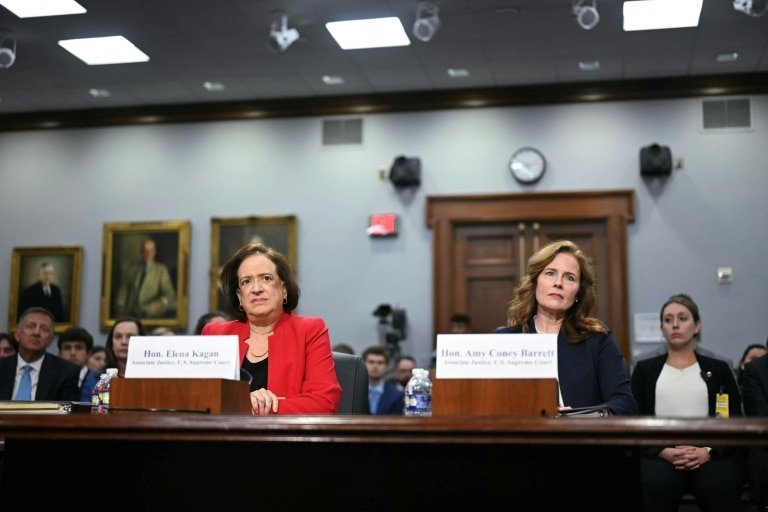
On a historic day on Capitol Hill this week, two sitting US Supreme Court justices delivered unprecedented testimony before congressional spending panels, laying bare the escalating wave of intimidation targeting the nation’s highest judicial body while issuing a defiant commitment to uphold judicial independence amid a toxic political climate.
Liberal justice Elena Kagan and conservative justice Amy Coney Barrett — the first sitting Supreme Court justices to appear before Congress since 2019 — opened up about the unthinkable dangers that have become part of daily life for top US judges, as the judiciary requests hundreds of millions in additional security funding to counter growing risks.
Barrett, whose 2020 nomination to the court came from former President Donald Trump, shared a deeply personal anecdote that underscores the human cost of rising threats. In the weeks following the 2022 leak of the draft ruling that overturned the federal constitutional right to abortion, Barrett was provided with a bulletproof vest. When she set the protective gear down at home, her 12-year-old son found it, forcing her to explain the item and why she needed it. “I didn’t expect that performing the service was going to put me in the position of explaining to my children what a bulletproof vest was and why I had to wear one,” she told lawmakers.
Kagan echoed that gravity, noting that threats have reached alarming proximity for many members of the court. “For some of us, those threats have come very close, and all of us live with the knowledge that they may again materialize,” she said. Still, she reaffirmed the court’s core promise: “all members of the court can do their jobs as they believe legally right, adjudicating cases without fear or favor.”
This rare public appearance comes as the federal judiciary seeks a total of nearly $921 million in dedicated security funding to upgrade protections across federal courthouses and judicial facilities. The Supreme Court itself is requesting a $20.5 million annual increase to its budget, bringing its total security allocation request to $228.4 million. Of that increase, $14.6 million would go toward expanding the court’s specialized police force and upgrading building security, while $6.5 million would fund a new visitor screening facility on Supreme Court grounds. Kagan noted that current screening protocols leave gaps that put justices and staff at risk, saying “We are concerned about people coming into the building before they’ve been checked.”
Security data paints a stark picture of the crisis: House Appropriations Committee top Democrat Rosa DeLauro told attendees that US Marshals recorded 564 threats against federal judges last year, a 31 percent jump from the prior year that DeLauro called “deeply alarming.”
Barrett has direct experience with these threats: her private residence was targeted in a May swatting incident, where bad actors file a false emergency report to draw an armed police response to a target’s home. Last year, her sister’s South Carolina home was the subject of a bomb threat. The most high-profile recent plot targeting a justice unfolded in 2022, when an armed man from California traveled to Justice Brett Kavanaugh’s residential neighborhood with plans to assassinate him. The assailant was ultimately arrested and later sentenced to more than eight years in federal prison.
The testimony comes on the heels of a divisive Supreme Court term that delivered a series of major rulings intersecting with former President Trump’s political agenda, including decisions blocking his attempt to end birthright citizenship and striking down his sweeping global tariffs. While Trump has praised the court’s conservative majority when it rules in his favor — most recently on a case granting him broad presidential immunity — he has repeatedly launched harsh public attacks on justices who rule against him. Chief Justice John Roberts warned earlier this year that escalating personal hostility toward sitting judges poses a grave danger to the judiciary, saying the trend “has got to stop.”
Despite the intense pressures and personal risks, both justices stressed that the court will continue to carry out its constitutional duty without bending to political intimidation, reaffirming that rulings will be based on law rather than outside pressure.