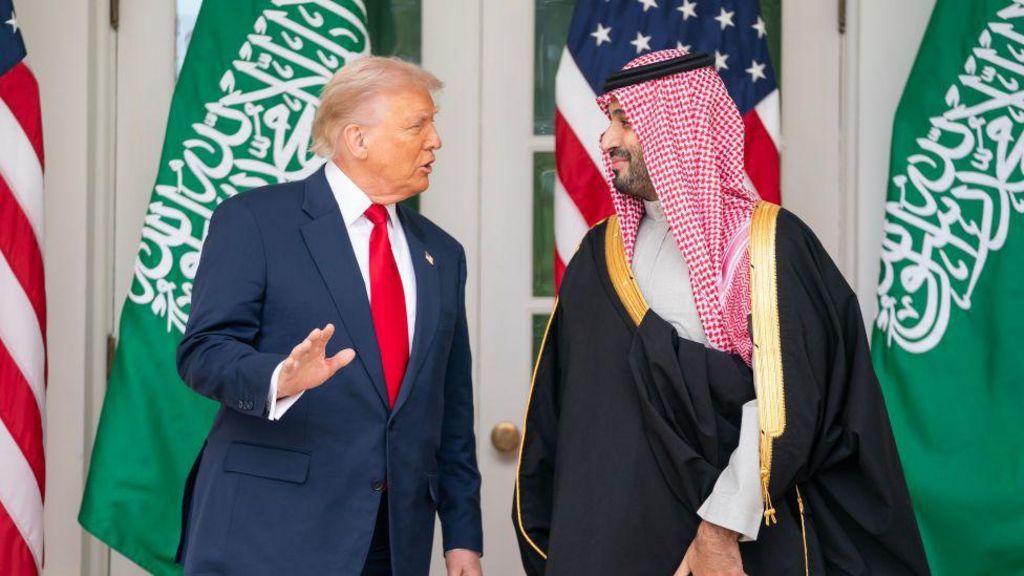
In a sharp break with decades of U.S. diplomatic precedent in the Middle East, the second-term Trump administration has finalized a civilian nuclear cooperation agreement with Saudi Arabia that abandons longstanding requirements for the Gulf kingdom to normalize ties with Israel in exchange for access to American nuclear technology. For years, every sitting U.S. president maintained the non-negotiable stance that Saudi civilian nuclear access would be tied directly to progress on Israeli-Saudi normalization. The Trump administration has set that condition aside, granting Saudi Arabia’s long-sought request without extracting reciprocal concessions for Israel – a move that has already drawn fierce criticism from analysts and policymakers who warn it could ignite a regional nuclear arms race.
This nuclear pact marks the latest instance of President Trump discarding the traditional U.S. approach to Middle East diplomacy, which for generations centered on protecting Israeli security and advancing a two-state solution to the Israeli-Palestinian conflict. Since returning to office, Trump’s foreign policy agenda has been anchored in his revived “America First” framework, with a primary focus on amplifying U.S. economic influence to counter rising competition from China and other global rivals. Regional analysts argue the agreement sends a clear signal that Washington is prioritizing retaining Gulf alliances in its great power competition, even at the cost of straining relations with long-time ally Israel.
“Countries across the Middle East are determined to develop their domestic nuclear infrastructure, and they will move forward with or without U.S. involvement, and Washington is finally acknowledging that reality,” explained Yusuf Can, a Middle East specialist at global consulting firm Amena Strategies. “Through this deal, the U.S. is essentially telling regional states: you don’t need to partner with China for this development – you can work with us instead,” Can added.
Transactional diplomacy has defined Trump’s second term in global affairs. Since taking office, the administration has ramped up economic and strategic competition with adversaries including China and Russia across multiple regions, from the Arctic to the Middle East. But striking a nuclear cooperation deal with Saudi Arabia stands out as an especially high-stakes move, one that threatens to further raise tensions in an already volatile region where the U.S. is currently engaged in open conflict with Iran.
For Saudi Arabia and its de facto leader Crown Prince Mohammed bin Salman, widely known as MBS, the agreement represents a landmark political victory. MBS has pursued a U.S. nuclear pact for years as a core pillar of his campaign to deepen Saudi Arabia’s integration with Western economies and security alliances. Back in 2018, the crown prince made clear his position: if Iran moves forward to develop nuclear weapons, Saudi Arabia will insist on matching that capability.
Full details of the agreement have not yet been released to the public by the Trump administration, but early reporting indicates the pact lacks strict, enforceable nonproliferation measures to prevent Saudi Arabia from converting its civilian nuclear program to a military weapons program down the line. This sets it apart sharply from the 2009 U.S.-United Arab Emirates nuclear cooperation deal, which required rigorous, ongoing inspections by the International Atomic Energy Agency (IAEA) to block proliferation. A second, highly controversial difference is that the new Saudi deal reportedly permits the kingdom to enrich uranium domestically on its own soil – a capability that can be directly repurposed to build nuclear weapons.
Analysts note that even if Saudi Arabia chooses not to accelerate a nuclear weapons program immediately, retaining the technical capability to do so already grants the kingdom a strengthened regional deterrent. “This agreement definitely lays the foundational groundwork for Saudi Arabia to develop nuclear weapons at any point in the future it chooses,” said Imran Bayoumi, a resident fellow at the Atlantic Council and former policy advisor to the U.S. Department of Defense.
Energy sector analysts point to a clear practical benefit for Saudi Arabia: the agreement allows the kingdom to diversify its energy mix and deploy nuclear power to meet rapidly growing domestic electricity demand. Over the long term, nuclear power could reduce Saudi Arabia’s heavy reliance on oil exports, insulating its economy from the extreme price and supply volatility that plagues global oil markets, explained Christopher Russo, an energy expert at consulting firm Charles River Associates.
“Oil supply chains are vulnerable to disruption: oil fields can be targeted in attacks, tankers can be blocked in strategic chokepoints like the Strait of Hormuz, which we’re seeing firsthand right now,” Russo noted. “Nuclear power infrastructure is far more self-contained and less exposed to these kinds of disruptions.”
Saudi Arabia will not see meaningful economic benefits from the deal for decades. Industry analysts estimate it will take at least 10 years, and likely longer, for the kingdom to complete construction and commission new civilian nuclear power plants. But the short-term political gains are already clear: the deal further solidifies Saudi Arabia’s status as the dominant military and political power in the Gulf region. Most notably, the kingdom secured the agreement without having to recognize Israel, and without abandoning its longheld demand that any future normalization deal with Israel must be tied to the creation of an independent Palestinian state.
The Trump administration’s concession on normalization reflects a broader calculation that a breakthrough between Saudi Arabia and Israel is unlikely in the near term. Negotiations over normalization advanced during the Biden administration, but stalled entirely following the outbreak of the Israel-Hamas conflict in Gaza and the subsequent escalation of open war between the U.S.-Israel alliance and Iran.
The administration has not publicly explained its timing for announcing the agreement, nor have officials outlined why it chose to finalize the deal now. But regional analysts widely agree that the ongoing war with Iran played a major role. Since the conflict began, Washington has prioritized mending and strengthening ties with Saudi Arabia and other Gulf allies that have been targeted by Iranian proxies. Earlier in the war, Saudi Arabia briefly denied the U.S. military access to its airspace, and has repeatedly pushed for de-escalation between Washington and Tehran.
U.S. nuclear technology firms will also benefit from the deal, though those economic gains will also take years to materialize. Saudi Arabia has committed to partnering with U.S. companies to develop its civilian nuclear sector, opening a massive lucrative new market for major U.S. reactor manufacturers such as Westinghouse.
Despite these potential benefits, the agreement has already drawn sharp bipartisan criticism from both Israel and U.S. political leaders. When news of the deal broke Wednesday, multiple Israeli politicians warned that a Saudi civilian nuclear program could evolve into a direct nuclear threat to Israel. Israel is widely understood to possess an unacknowledged nuclear arsenal, and joined the U.S. war against Iran over shared concerns about Tehran’s nuclear ambitions.
“A civilian nuclear program in Saudi Arabia will trigger a mad nuclear arms race across the entire Middle East,” Avigdor Lieberman, a former Israeli defense minister and current member of the Knesset, wrote in a social media post.
Democratic lawmakers in the U.S. Congress have echoed these concerns. “This deal is a total giveaway to the Saudis, and it will only fuel Iran’s own nuclear ambitions, and it will further destabilize the region alongside Israel,” Democratic Congressman Ro Khanna of California told the BBC. “This is simply not smart or responsible policy.”
U.S. Energy Secretary Chris Wright has pushed back against criticism, arguing the agreement will boost the U.S. economy and strengthen American national security. In a public social media statement, Wright claimed the U.S.-Saudi pact “upholds the highest standards of nuclear safety and nonproliferation.”
Still, the Trump administration has fueled public skepticism by refusing to release full details of the agreement. In a notable departure from standard diplomatic practice, President Trump did not preside over the official signing ceremony for the pact. On the day the deal was announced, Trump instead attended a dignified transfer ceremony for four U.S. service members killed in action in Iran, before traveling to Georgia for a campaign rally where he claimed his policies have made the Middle East more stable than at any point in modern history.