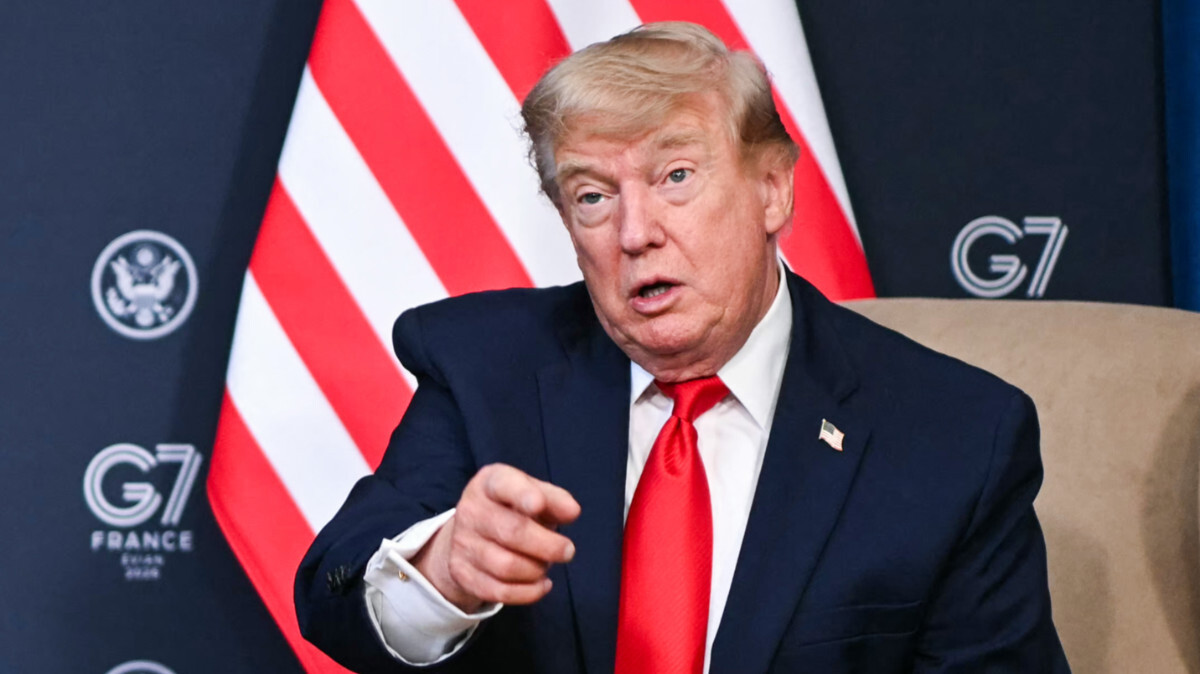
On the sidelines of the G7 Summit held in Evian, France, former U.S. President Donald Trump made a striking and controversial proposal alongside Qatar’s ruling monarch, telling reporters that he believes Syria, under the leadership of Ahmed al-Sharaa, should invade Lebanon to eliminate the Iran-aligned Shia political and paramilitary group Hezbollah. Trump argued that Damascus could carry out the mission far more effectively than Israel, which has been locked in a prolonged, high-casualty conflict with Hezbollah along the Lebanon-Israel border.
“Israel’s fighting Hezbollah too long and too many people are being killed,” Trump told reporters. “I suggested to Israel to let Syria take care of Hezbollah. He’s very capable. If Israel can’t do the job, without killing everyone else, he’ll do the job. Syria will do the job,” he added, referring directly to al-Sharaa.
This is not the first time Trump has floated this provocative idea this month. He first raised the prospect of Syrian intervention in Lebanon in comments on June 7, when he claimed al-Sharaa “would love to help” with the operation against Hezbollah. Trump has repeatedly praised the Syrian leader in recent public remarks, framing him as “a very strong leader…a tough guy” who is firmly opposed to the group. “He is very good with Hezbollah; he does not like them,” Trump said of al-Sharaa during the G7 gathering.
Experts and regional analysts warn that any Syrian military deployment into Lebanon would reignite a decades-old historical tinderbox. Syria first invaded Lebanon in 1976 at the start of the Lebanese Civil War, and maintained a partial military occupation of the country for nearly 30 years before withdrawing all forces in 2005. The proposal also carries major risks of escalating sectarian conflict across the region. Al-Sharaa’s core support base draws heavily from Salafist fighters, an ultra-conservative Sunni Islamist movement that adheres to a literalist interpretation of early Islamic tradition. By contrast, Hezbollah is Lebanon’s largest Shia political and military organization, backed by Iran, and fought alongside former Syrian President Bashar al-Assad throughout Syria’s 13-year civil war.
Al-Sharaa, who is 43 years old, has a well-documented militant background: he spent roughly five years in a U.S. prison after traveling to Iraq to fight against the 2003 U.S.-led invasion, before going on to found al-Nusra Front, al-Qaeda’s official Syrian affiliate. His Hay’at Tahrir al-Sham coalition toppled Assad’s government in December 2024, bringing him to power in Damascus. Despite Trump’s claims, al-Sharaa’s transitional government has publicly stated it has no plans to deploy military forces into Lebanon. Syria remains economically and physically decimated after more than a decade of civil war, and is only in the earliest stages of reconstruction, backed by financial and political support from Gulf states including Saudi Arabia and Qatar.
Al-Sharaa also faces pressing security challenges on his own country’s southern border. After Assad’s government collapsed, Israel seized control of a UN-monitored buffer zone in southern Syria, and carried out large-scale air strikes that reached as far as central Damascus last summer. Israeli forces have also fortified their position on Mount Hermon, the region’s highest peak, and regional security experts report that Israel has provided arms to local Druze leader Sheikh Hikmat Salaman al-Hajri in a bid to position itself as a protector of Syria’s Druze minority community. Al-Sharaa’s government has also expressed concern that any incursion into Lebanon could trigger retaliatory Iranian missile strikes and spark sectarian unrest among Syria’s own Shia minority; the country has already seen scattered outbreaks of sectarian violence targeting Alawites, Druze, and Christian communities in recent months.
Trump’s latest remarks stand in direct contradiction to statements from his own senior diplomatic appointee. Tom Barrack, Trump’s ambassador to Turkey and special envoy to Syria, denied a March media report that claimed the Trump administration was lobbying Syria to invade eastern Lebanon to disarm Hezbollah. The original report, first published by Reuters, claimed the U.S. had approved a Syrian incursion into eastern Lebanon, and that Damascus was “cautiously considering” the proposed operation, despite the regime’s wariness of potential Iranian retaliation and domestic sectarian unrest.
Regional security analysts have already warned that any Syrian military move into Lebanon would worsen already simmering sectarian tensions in the country, which have been significantly inflamed by months of sustained Israeli air and ground attacks on Hezbollah targets across Lebanon.