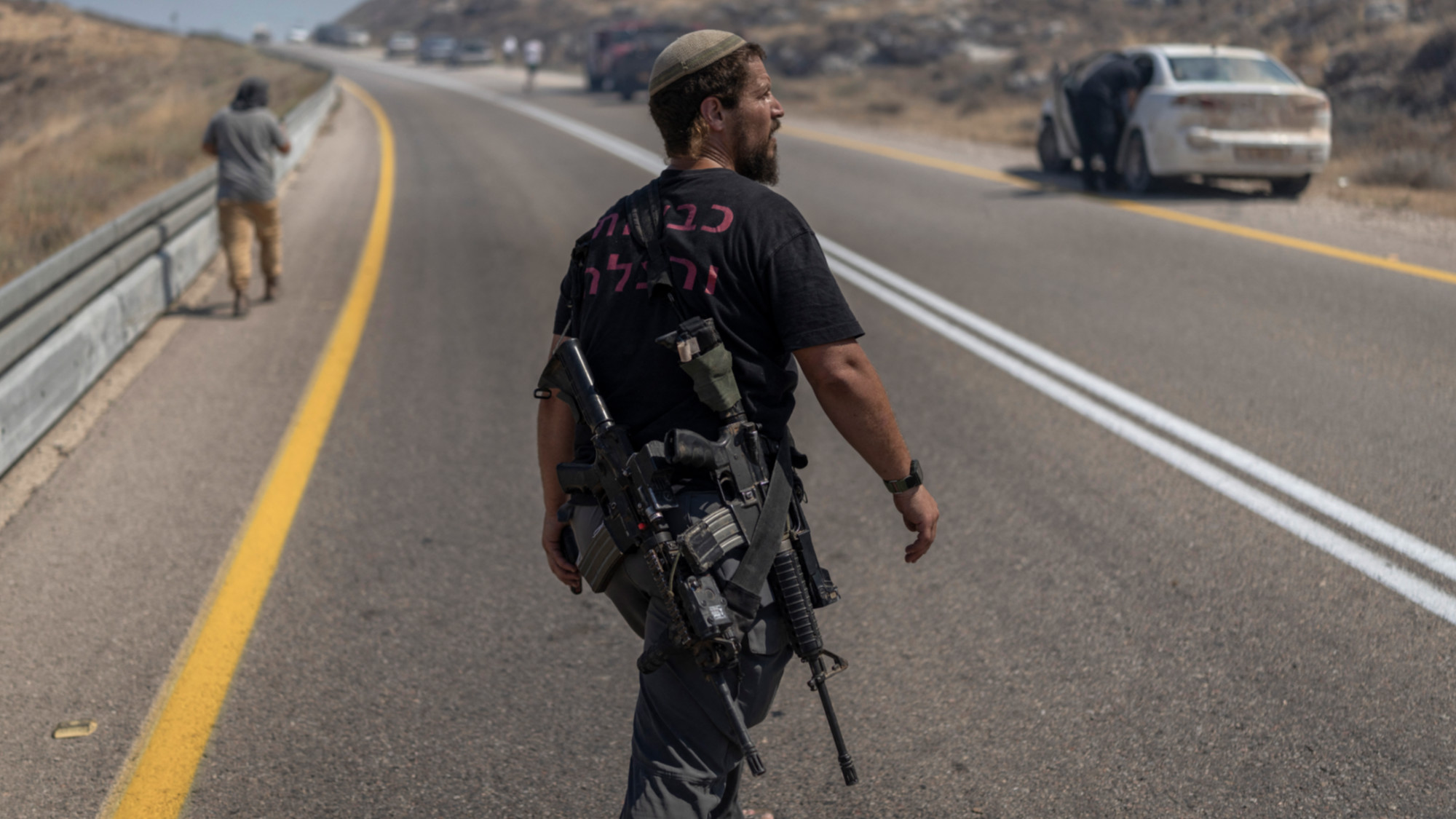
On Tuesday, a cross-community Palestinian-Israeli grassroots political movement unveiled a urgent new campaign pushing for the deployment of a multinational civilian protection force in the occupied West Bank, as violent attacks by Israeli settlers against Palestinian communities continue to escalate unchecked.
The group behind the push, A Land for All – Two States, One Homeland, argues that rising settler aggression, paired with the Israeli government’s consistent failure to safeguard Palestinian civilians living under occupation, has made direct international intervention an unavoidable and time-sensitive priority. The formal appeal was launched during a public press conference hosted in Kafr Malik, a Palestinian village located east of Ramallah, where local residents have documented months of persistent settler attacks, limited access to their agricultural lands, and growing anxiety over forced displacement.
Movement leaders emphasize that a deployed international protection force would not act as a replacement for a long-term political resolution or the future establishment of an independent Palestinian state. Instead, it would serve as an immediate emergency mechanism to shield vulnerable civilian populations and preserve the fragile possibility of a negotiated political settlement down the line. Branded under the slogan “Multinational Force in the West Bank — Now”, the campaign holds that verbal international condemnation of settler violence is no longer sufficient to address the crisis, and calls for a formally mandated force with authority to protect civilians and catalog human rights violations on the ground.
Rula Hardal, Palestinian co-director of A Land for All, confirmed that the movement circulated an official statement last week to global diplomatic bodies and foreign missions operating in both Israel and Palestine, urging formal backing for the protection force deployment following the recent sharp escalation in settler attacks. Kafr Malik was selected as the press conference venue, Hardal explained, because of its central location in the West Bank, its direct experience of ongoing settler violence, and its relative accessibility and safety for both Palestinian and Israeli Jewish members of the movement compared to other at-risk Palestinian communities.
“We are a joint Palestinian-Israeli political movement that advocates for a confederative two-state solution along the 1967 internationally agreed borders,” Hardal told reporters during the event. “But we cannot continue clinging to the outdated traditional model of a two-state solution, because the on-the-ground reality has shifted dramatically over the past three decades.” The movement’s work centers on updating and refining the two-state framework to address long-standing core issues including existing Israeli settlements, the right of return for Palestinian refugees, the status of Jerusalem, and cross-community security arrangements, all of which are detailed in the movement’s formal political platform.
Meron Rapoport, an Israeli co-founding president of the movement, warned that security conditions in the occupied West Bank have deteriorated drastically over the past 12 months. He went as far as accusing the current Israeli government and military of advancing “a clear plan of ethnic cleansing” in the occupied territory. “We hear open plans to target Palestinian refugee camps. The writing is on the wall. The era of waiting, asking, and begging Israel to protect Palestinian lives is over,” Rapoport stated during the press conference.
Other Israeli members of the movement echoed Rapoport’s assessment, agreeing that they no longer have confidence that Israeli authorities are either willing or able to protect Palestinian civilians living under occupation. Professor Yael Berda, co-chair of the movement’s joint board, noted that Kafr Malik specifically faces consistent, systematic threats of violence from organized settler militias. She added that the press conference was organized to demonstrate cross-community solidarity, amplify the call for international intervention, and remind the global community of its legal and moral responsibility to protect civilians at risk of mass atrocities.
“These mass atrocities include ethnic cleansing, and we are currently seeing imminent ethnic cleansing unfolding. Abstract international pressure is no longer enough,” Berda said. “We see an Israeli government that gives full backing to settler militias, and we see a military that either lacks the capacity or the political will to rein in settler violence.”
For residents of Kafr Malik, the event was less a forum for abstract political debate and more an opportunity to highlight the daily crisis they navigate. Local villagers shared accounts of repeated settler invasions of their lands, blocked access roads, and steadily tightening restrictions on their ability to reach and work their agricultural plots. Abdel Fattah Hamayel, a long-time resident of Kafr Malik, welcomed the solidarity visit from the joint movement.
“We appreciate this step, and we hope it will be the foundation for broader action to help the Palestinian people confront this settler-colonial aggression,” Hamayel said. He noted that a single gathering cannot capture the full scope of suffering experienced by Kafr Malik residents, or by Palestinian rural communities across the West Bank more broadly. “This issue is no longer hidden from anyone. The current Israeli government, through its leading fascist figures, states its goals openly and clearly. Our situation is not easy, because we face two core challenges,” he explained.
The first challenge, Hamayel said, is the lack of a coordinated official Palestinian strategy or functional institutions with the capacity to counter the violence and support Palestinian farmers whose livelihoods are under threat. The second is that all attacks are carried out with the explicit backing of Israel’s far-right government, which has emboldened settlers to abandon all restraints and moral standards, according to Hamayel.