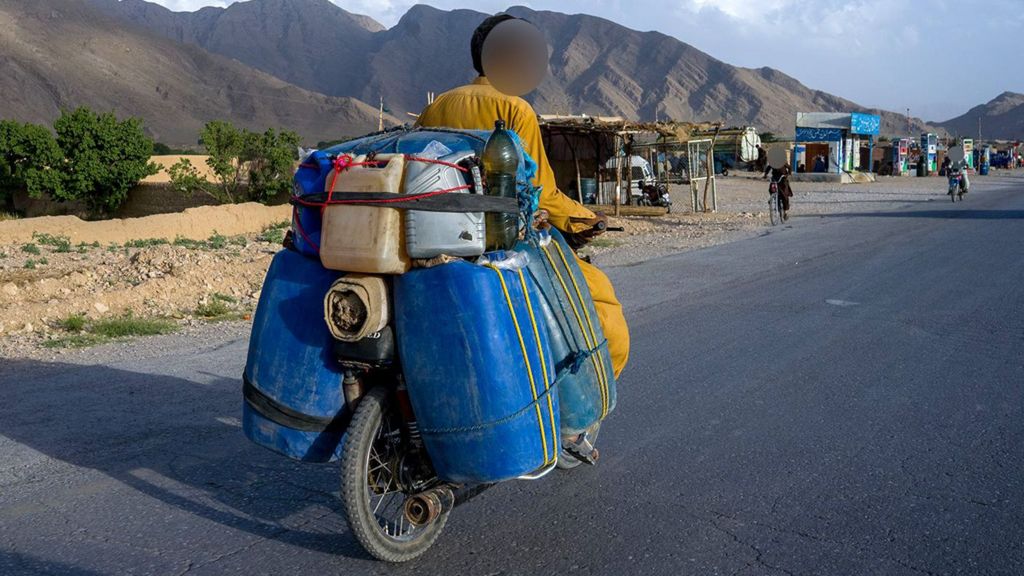
In the sweltering, dust-scoured badlands of Pakistan’s Balochistan province – the country’s largest, poorest and most sparsely populated region – 38-year-old Mazaar (a pseudonym used to protect his identity) prepares for another deadly 350-kilometer journey across one of the hottest landscapes on Earth. His small, worn motorbike groans under the weight of five 70-liter plastic canisters holding 272 kilograms of petrol, tied precariously to its frame with frayed rope, leaving barely any space for him to sit. This is the dangerous daily reality for thousands of ordinary Baloch people who have turned to smuggling subsidized Iranian fuel into Pakistan, a trade that has surged dramatically in recent months amid escalating regional conflict tied to US-Israeli tensions with Iran.
For decades, cross-border fuel smuggling has been a quiet undercurrent of life along the 900-kilometer Iran-Pakistan border, but shifting geopolitics and economic chaos have supercharged the illicit trade. Rising tensions have disrupted oil shipments through the Strait of Hormuz, sending global fuel prices skyrocketing. That has driven explosive demand in Pakistan for far cheaper smuggled Iranian petrol and diesel, which benefits from heavy Iranian government subsidies for domestic consumers. Today, an estimated 2.4 million of Balochistan’s 15 million residents rely on the trade for their primary income, according to a leaked Pakistani intelligence report reviewed by Nikkei Asia in 2024 – a statistic that underscores how deeply the illicit business is woven into the province’s fragile economy.
Mazaar is no organized crime kingpin; he is a former farmer driven into smuggling by crippling drought that destroyed his ability to earn a living tending crops. As the main breadwinner for his extended family, which includes his young child and several brothers, he has no other viable option for work. Temperatures in Balochistan regularly climb to 50 degrees Celsius during the hot season, turning the plastic fuel canisters soft and swollen, raising the constant risk of ruptures, leaks, catastrophic fire or even explosion. Dozens of smugglers die this way every year. Beyond the environmental and mechanical risks, the journey takes Mazaar through conflict-ridden territory where clashes between Pakistani security forces and separatist insurgents demanding greater regional autonomy have persisted for decades, with thousands of local residents having disappeared amid the violence. Even with these threats, Mazaar says he has no other choice: “We do this because we don’t have any other option. The weather is hot, the prices are high and we spend day and night on the road.”
His story is not unique. Irfan, another smuggler whose name has also been changed for his safety, turned to the trade after a childhood polio infection left him with permanent mobility impairment in one leg and one hand. Unable to access most formal work, he transports diesel instead of petrol, saying the lower risk of ignition is the only small safety concession he can make: “I can’t carry petrol because what if it catches fire? If I can’t stand up, I’ll get badly burned.”
Local economic leaders say deep-rooted systemic failure has left ordinary Baloch people with no alternative to the smuggling trade. Fida Hussain Dashti, former president of the Quetta Chamber of Commerce and Industry, notes that despite Balochistan’s vast territory and abundant mineral reserves, decades of underdevelopment have left it with poverty rates matching some of the world’s poorest regions. “Even a student who graduates with an MA degree ends up joining this oil business,” Dashti says. “People are helpless and have no other way. The Pakistani government should have done more to create employment opportunities in the region.”
The impact of the booming smuggling trade is now being felt across Pakistan’s formal economy. In May 2025, Pakistan’s five largest oil refineries sent a formal letter to the federal government warning that cross-border smuggling was accelerating and urging official intervention. Earlier this month, the Oil Companies Advisory Council, which represents Pakistan’s domestic oil industry, confirmed that official domestic fuel sales have dropped to a 27-year low for this time of year, a decline directly tied in large part to the rise of cheaper smuggled Iranian fuel. An intelligence estimate cited by Nikkei Asia puts the annual value of smuggled fuel at nearly $1 billion, a staggering hit to formal industry and government revenue.
Geopolitics has amplified the smuggling surge, according to analysts tracking illicit global markets. Paddy Ginn, a researcher with the Global Initiative Against Transnational Organised Crime, says large-scale smuggling is not just driven by desperate local workers – it is also enabled by powerful actors with ties to the Iranian government. “The main traffickers, we believe, are either part of or closely linked to IRGC [Islamic Revolutionary Guards Corps],” Ginn says, noting that the trade helps Iranian actors avoid US economic sanctions and capitalize on price hikes driven by regional conflict. The BBC requested comment from the Iranian government on these allegations but received no response.
For Pakistan, the issue presents a complicated policy dilemma. The country currently serves as a mediator between Iran and the United States, working toward a permanent end to hostilities, and the large-scale smuggling trade creates awkward diplomatic and political pressures. Islamabad has periodically launched crackdowns on the illicit trade, but efforts to fully eliminate it have always stalled. The remote, rugged terrain of the border region makes comprehensive policing almost impossible, and many within Pakistan’s government recognize that the trade is a critical lifeline for millions of impoverished Baloch residents who have no other source of income. Multiple smugglers told the BBC that Pakistani security officials often turn a blind eye to the trade in exchange for small bribes – a claim the Pakistani government denies, noting that Prime Minister Shehbaz Sharif has ordered law enforcement to intensify crackdowns, with authorities seizing roughly $5 million worth of smuggled fuel over the past year.
Even for the smugglers who rely on the trade, the recent regional conflict has eroded already meager profits. Mazaar says the price he pays for smuggled petrol has jumped sharply amid the tensions, but the price he can charge to downstream sellers has remained flat. After covering fuel for his bike, food, and motorbike lease costs, his daily income has fallen from 5,000 Pakistani rupees ($13) to 3,000 rupees ($7.80) – still roughly double Pakistan’s official minimum wage, but barely enough to support his large family. “The war started and we were ruined,” he says.
As Mazaar and a group of 11 fellow motorbike smugglers set out from the Mastung open-air fuel market toward Sindh province, they are immediately hit by a brutal heat storm: a prolonged heatwave paired with blinding dust storms. When asked about the constant risk of deadly injury or death, Mazaar shrugs off the danger with a fatalism forged by poverty and lack of choice: “I don’t worry about it. I have to die one day anyway. I could die now. Who knows? That is Allah’s decision, whether he lets me live or takes my life.”