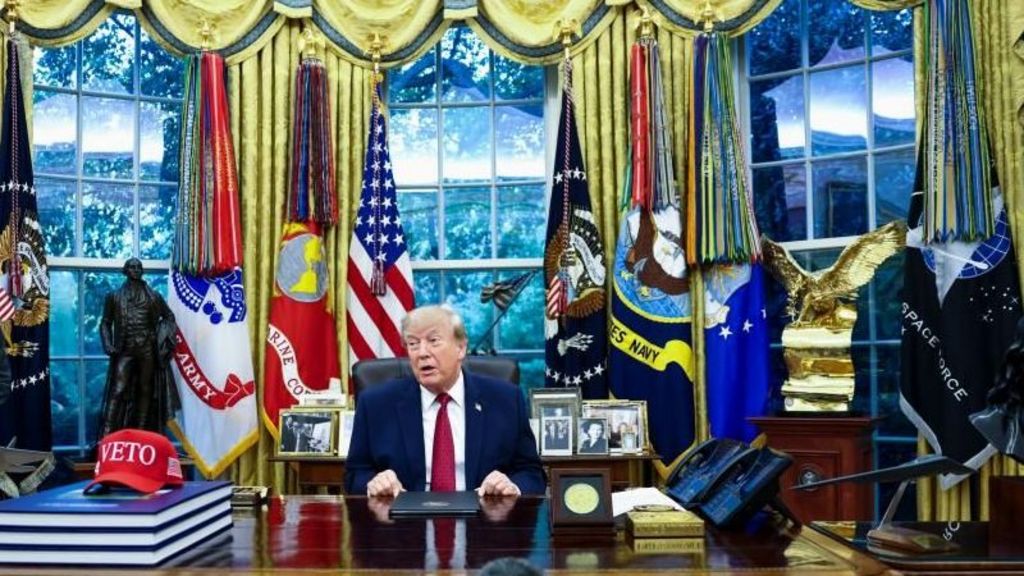
In a Thursday public announcement to assembled White House reporters, U.S. President Donald Trump formalized a landmark executive order that grants formal national monument status to the Oval Office and its adjacent surrounding spaces, framing the directive as a permanent safeguard to prevent future presidential administrations from altering the iconic executive chamber’s core architectural identity. A former real estate developer renowned for sweeping aesthetic overhauls, Trump has already implemented extensive modifications to the Oval Office during his second term, most prominently the addition of extensive gilded decorative elements across its wall surfaces. “We are codifying this space as a protected national monument, so no one will ever be allowed to tamper with it, tear it down, or reshape it into something unrecognizable at the hands of foolish decision-makers,” Trump told the press during the signing ceremony.
Prior to this new directive, U.S. presidents held broad discretionary authority to make minor cosmetic adjustments to the White House interior, though any large-scale structural renovation projects required explicit congressional approval. The text of the new executive order explicitly carves out narrow carve-outs that preserve the sitting president’s ability to redecorate select surfaces, swap out furnishings, and implement routine operational and security upgrades, provided those changes do not erode the space’s historic structural integrity or distinct architectural character. Trump emphasized that the Oval Office stands as a defining national symbol on par with the full White House complex, embodying the legacy and enduring greatness of the United States’ executive branch.
Under existing U.S. federal law, the sitting president holds unilateral authority to designate new national monuments, a classification that affords similar protective status to national park sites. The order tasks the National Park Service with long-term stewardship of the Oval Office, mandating that the agency manage the space in a way that fully preserves its historic character, architectural coherence, and unique association with the institution of the American presidency. Notably, the entire White House complex already holds official National Historic Landmark designation, a classification designed to block unvetted, sudden large-scale modifications to the historic property. Trump’s proclamation acknowledges this existing layer of protection, but argues that the Oval Office warrants distinct, targeted protective oversight as a standalone historic structure of unparalleled national cultural significance.
The current iteration of the Oval Office was first commissioned under President Franklin D. Roosevelt in the early 1930s, and Congress has long maintained a specific exemption within the National Historic Preservation Act that grants sitting presidents flexibility to implement necessary operational adjustments to the executive workspace. Greg Werkheiser, a leading historic preservation legal expert from the specialized firm Cultural Heritage Partners, explained to BBC News that temporary adjustments such as furniture swaps and decorative updates have always fallen under the full discretion of the sitting president, as long as no permanent damage is inflicted on the space’s fixed architectural features or historic art installations. However, Werkheiser has emerged as a vocal critic of the Trump administration’s broader track record on historic preservation, pointing to repeated attempts to weaken federal preservation statutes through legal challenges, and describing the new Oval Office designation as largely legally meaningless. He highlighted that his firm has already filed active lawsuits to block two of the administration’s controversial Washington D.C. construction projects: a sweeping renovation of the Kennedy Center, a planned new triumphal arch on federal grounds, and a proposal to repaint the granite exterior of the historic Eisenhower Executive Office Building.
The announcement comes in the immediate aftermath of a sweeping midterm election that saw Trump’s Republican Party suffer decisive losses to Democratic opponents, even as the president has spent the past week hosting three separate public events to tout his administration’s large-scale D.C. beautification initiatives. Critics have seized on the timing and substance of the order to accuse Trump of rank hypocrisy, noting that just months earlier in an October interview with *Time* magazine, Trump himself had floated the possibility of fully demolishing the existing Oval Office to address U.S. Secret Service security concerns, before walking back that suggestion in public remarks. During the midterm campaign cycle, former President Barack Obama publicly mocked Trump’s gilded Oval Office redesigns, joking that the changes made the iconic space look like a venue that “Saddam Hussein opened a Cheesecake Factory.”
Trump signs order preventing future presidents from changing Oval Office