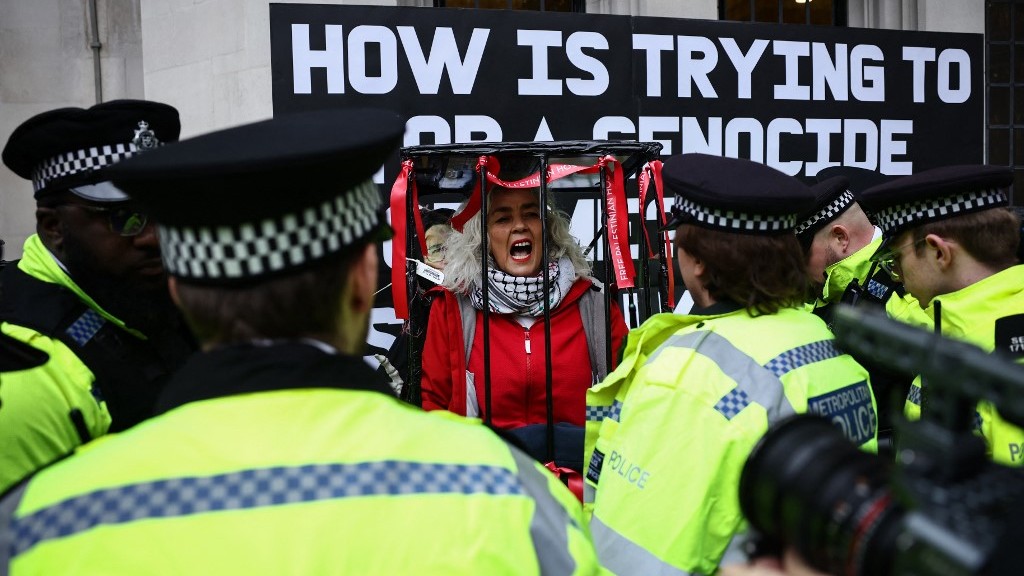
On Thursday, the UK Supreme Court transitioned into closed, non-public proceedings for the high-stakes appeal challenging the official terrorist designation and ban of pro-Palestine direct action network Palestine Action, immediately after legal representatives for both the UK Home Office and the group’s co-founder Huda Ammori wrapped up their rounds of public oral arguments. This procedural shift paves the way for a panel of five senior justices to review sensitive, undisclosed evidence submitted by the UK government that will not be accessible to Ammori’s legal team. Leading the Home Office’s case, top government barrister James Eadie KC opened the public segment of the two-day hearing by pushing back firmly against the defence’s framing of Palestine Action as a legitimate heir to Britain’s long, celebrated legacy of peaceful civil disobedience movements. Eadie argued that the group’s operations are deliberately planned and executed under a veil of secrecy to evade law enforcement detection, and that its targeted property damage campaigns against sites linked to Israeli defence firm Elbit Systems qualify as serious, unlawful destruction that meets the statutory legal definition of terrorism. Eadie further asserted that the group’s targeting of Elbit facilities amounted to a deliberate campaign against “Jewish businesses” – an allegation Palestine Action has consistently and categorically rejected as baseless and discriminatory. The senior government counsel also noted that the group’s history of property damage was the core rationale that led the UK’s Joint Terrorism Analysis Centre (JTAC) to formally classify Palestine Action as a terrorist organisation. When pressed by presiding Judge Lord Sales to disclose the full membership roster of JTAC, Eadie confirmed that the body’s composition documents are not cleared for public release. This Thursday’s public proceedings stood in sharp contrast to the often tense opening day of the hearing on Wednesday, during which Raza Husain KC, lead counsel for Ammori, faced repeated interruptions from the bench as he laid out his client’s case. Undeterred, Husain used his closing public remarks on Thursday to dismantle the Home Office’s core claims, warning that the ban on Palestine Action has severely eroded fundamental civil liberties for vast swathes of the UK public. “There are at minimum hundreds of thousands of people whose deeply cherished, legally protected rights to political speech, free association, and peaceful assembly have been completely erased or gravely compromised by this designation,” Husain told the court. He went on to refute the government’s claim that Palestine Action poses a tangible threat to UK democratic institutions, noting that the only harm the group has ever inflicted was limited to property belonging to Elbit Systems and its commercial partners. To counter the antisemitism allegations levelled by Eadie, Husain submitted formal court testimony from prominent Jewish anti-apartheid activist Andrew Feinstein, who confirmed that Palestine Action never targets individuals or businesses on the basis of Jewish identity. For the upcoming closed segment of the appeal, Ammori’s legal team will not be granted security clearance to review or respond directly to the government’s classified evidence. Instead, a pre-vetted special advocate with full top-secret clearance, selected in consultation with the defence, will represent Ammori’s interests during the closed sessions, though the advocate is strictly prohibited from sharing any details of the classified materials with Ammori or her legal team. This two-day Supreme Court hearing represents the final legal avenue for Ammori to overturn the ban, which was formally ratified by the UK Parliament in February 2025 following a designation order issued by then Home Secretary Yvette Cooper. The challenge has worked its way up through every tier of England and Wales’ senior court system, and to date, UK law enforcement has arrested over 4,000 people under the UK Terrorism Act for displaying placards or engaging in public acts of support for Palestine Action in defiance of the ban. The five-member Supreme Court panel has indicated it will release its final ruling on the appeal at a later, unspecified date.