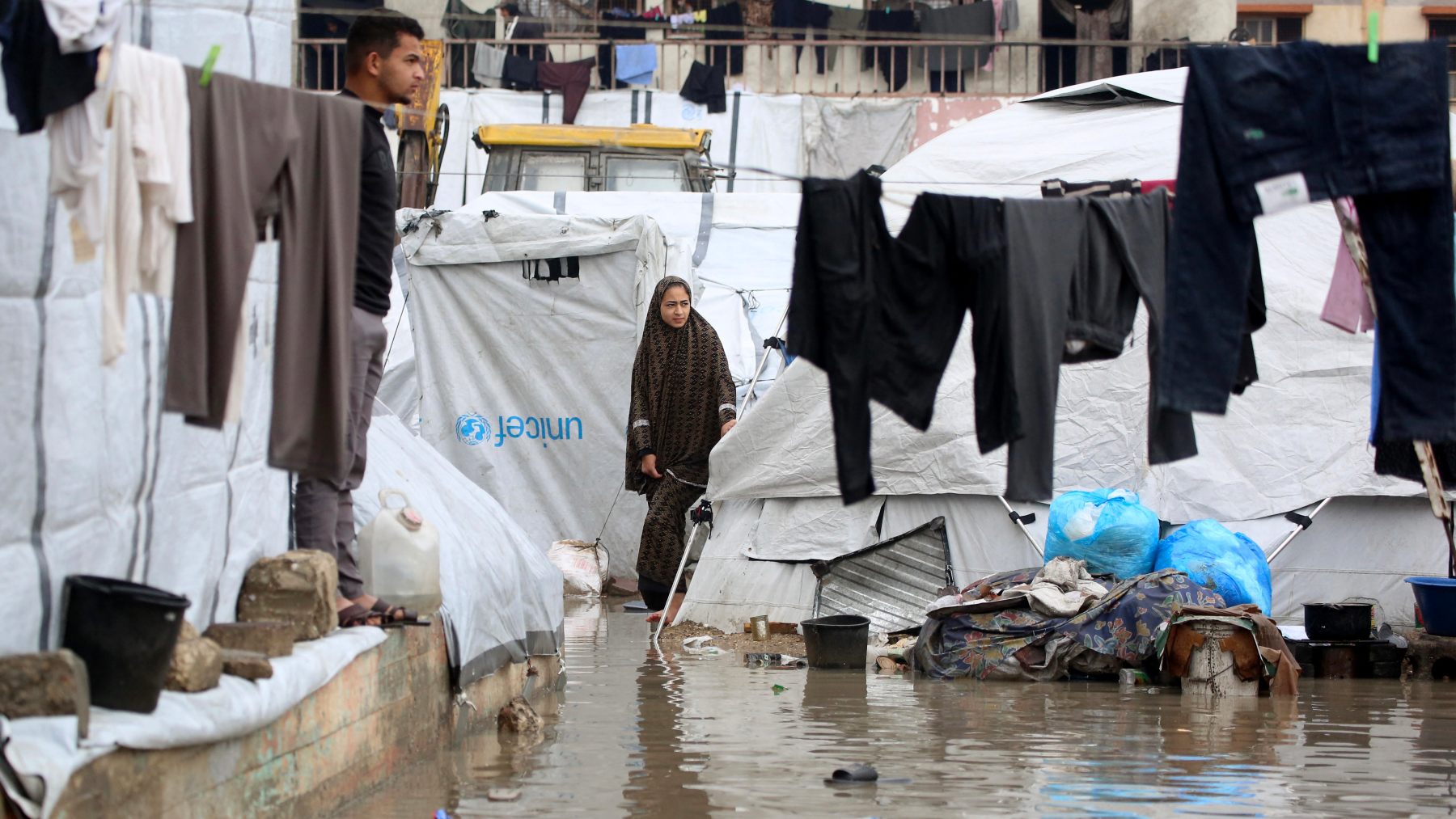
As the first brutal winter storm of the season swept across the Gaza Strip in early November 2026, 33-year-old displaced resident Mansour al-Sakni watched in utter despair as rainwater surged through the flimsy rooftop makeshift shelter he shared with his wife and four young children in Gaza City’s al-Tuffah neighbourhood. Just two weeks prior, Sakni had made a painful sacrifice: he sold the family’s two only water storage barrels to scrape together cash for heavy-duty new tarpaulins, hoping the reinforced covering would shield his loved ones from the elements. But the storm’s relentless downpour and gale-force winds rendered the new canopy nearly useless.
“We woke up ankle-deep in frigid floodwater, my kids screaming in terror, and I broke down crying too because I had no idea how to keep them safe,” Sakni told reporters from Middle East Eye. The family huddled under the dripping tarpaulin for hours, waiting for the rain to ease so they could begin bailing murky, debris-filled water out of their 30-square-metre weather-beaten room with tarpaulin walls already frayed from months of exposure. Before the ongoing conflict, Sakni earned a modest but steady income selling local newspapers; now he has no formal employment, and his entire family relies on free meals distributed by a local community food kitchen, known locally as a takiya. His 10-year-old daughter Jana suffers from progressive poor eyesight that requires prescription glasses, but Sakni cannot afford to purchase the pair she needs. When a friend gave him 200 shekels earmarked for the glasses, he diverted the entire sum to buy wooden planks to reinforce the shelter’s failing frame instead. Sakni also carries a shrapnel injury sustained in 2024, when he was waiting in a bakery queue on al-Nasr Street; the fragment lodged in his back causes searing, debilitating pain whenever the temperature drops. “We are just poor ordinary people of Gaza. We don’t want to be killed by airstrikes, and we don’t want to freeze or drown in the rain. Enough. The world needs to have mercy on us,” he pleaded.
The storm, which began in the early hours of Saturday 7 November 2026, submerged thousands of displacement camps and makeshift shelters across the territory in hours. Gaza’s Civil Defence agency reported receiving roughly 1,500 distress calls in a 10-hour window after the rain started, with floodwaters reaching 30 to 40 centimetres deep in many designated shelter centres, according to Al Jazeera. “All our worst fears have come to pass: dozens of shelter facilities are completely underwater now, and every family that was taking refuge there has been forced out into the cold, with nowhere safe to go,” said Mahmoud Basal, spokesperson for Gaza’s Civil Defence.
For 26-year-old Nasmeh al-Khatib, the storm reawakened the raw trauma of displacement that has defined her life since her husband was killed in 2024 while the family was fleeing violence in Gaza City. Khatib now lives with her two-year-old daughter Alina in the ground floor of a partially destroyed building in northern Gaza’s Mashrou Amer neighbourhood, where five separate displaced families share the remaining livable space. The structure was heavily damaged in an October 2025 airstrike, just days before a temporary ceasefire was declared: three of the original four floors were reduced to rubble, leaving only the ground floor standing. “We patched up every hole in the walls with tarpaulin, but every time it rains, the water still pours in,” Khatib explained. Overnight, the storm’s fierce winds tore loose the tarpaulin sheets covering the building’s broken window and door openings, letting rain gush into every room. Her toddler daughter was so terrified by claps of thunder that she cried nonstop for hours, mistaking the loud booms for incoming airstrikes. “She kept asking me, ‘Mummy, why is the rain inside our house? I hate this rain,’” Khatib said. The family’s solar power system shorted out repeatedly through the night, leaving stray electric currents running through wet walls and floors that delivered painful small shocks to anyone who touched them, while all lights and phone chargers stopped working entirely. “We have been patching holes and retying tarpaulins since sunrise, but we know none of this will hold. The next time it rains, we will be flooded all over again. We need a real, lasting solution to this endless suffering,” she added.
The unprecedented flooding has laid bare the catastrophic vulnerability of more than a million displaced Palestinians across Gaza, who are currently crammed into overcrowded tents, flimsy makeshift shelters, and half-collapsed buildings damaged by years of sustained bombardment. Gaza’s local emergency committee estimates that over 1 million displaced people face acute winter-related health and safety risks, with the territory in urgent need of 200,000 additional fully functional tents and massive stockpiles of heating fuel and thermal blankets. A November 5 report from the United Nations Office for the Coordination of Humanitarian Affairs (OCHA) confirmed that as of 1 November, Gaza still required 121,000 tents and 561,000 protective tarpaulins to meet the needs of displaced populations, but available local stocks only amounted to 2,800 tents and 76,000 tarpaulins, with zero complete emergency shelter kits in reserve. OCHA officials noted that Israeli authorities have repeatedly blocked entry to the timber required to assemble emergency shelter kits, and warned that bureaucratic supply delays, arbitrary import restrictions, and global funding shortfalls mean many critical shelter materials may not reach Gaza until the second half of the winter, long after the coldest, wettest season peaks. The Norwegian Refugee Council had previously warned in a 5 October statement that these combined restrictions would leave 1.65 million displaced Gazans facing their fourth consecutive winter in tattered, waterlogged tents and structurally unsound damaged buildings. An October OCHA assessment also found that roughly 950,000 displaced people are currently residing in displacement sites classified as medium or high flood risk, including over 400,000 people living in areas at extreme risk of catastrophic inundation during heavy storms.
Beyond flooding, the storm has also triggered new structural failures in hundreds of buildings already weakened by months of bombardment. Gaza’s Civil Defence reported that emergency teams evacuated dozens of residents from a partially collapsing building in the Nuseirat refugee camp, while two civilians sustained injuries when a wall collapsed in northern Gaza, according to Palestinian state news agency Wafa. Compounding the crisis, Gaza’s overstretched first responders have almost no capacity to deliver relief to affected families: Raed al-Dahshan, director of Gaza governorate’s Civil Defence department, confirmed to Al Jazeera that the agency currently does not have “a single spare tarpaulin or a single undamaged tent” to distribute to flood-displaced families. For families like Sakni’s and Khatib’s, the crisis is far more than a temporary weather event: it is the latest layer of unrelenting suffering in a years-long conflict that has erased nearly all safe housing across the territory. “I am completely exhausted by this life,” Sakni said. “We are begging the whole world to finally find a way to give us a safe place to live.”