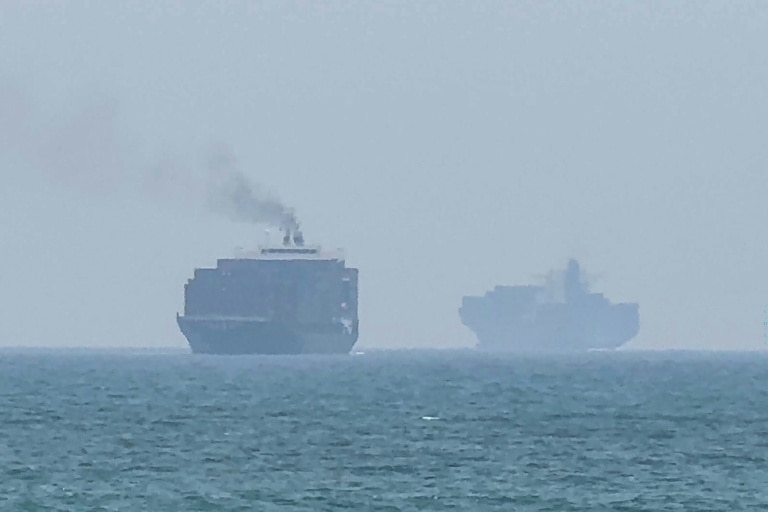
In a sudden announcement that has reignited tensions across the Middle East, former President Donald Trump revealed Monday that the United States is reimposing a targeted blockade on Iranian maritime traffic and formally claiming control over security operations at the Strait of Hormuz, one of the world’s most critical energy chokepoints. The move comes just days after the region saw the largest-scale exchanges of fire between U.S. and Iranian forces since a fragile April ceasefire, throwing new uncertainty into international efforts to reach a lasting end to the conflict that has already disrupted global energy shipping for months.
Breaking the news via his Truth Social platform, Trump clarified that the new blockade is targeted exclusively at Iranian vessels and their trading partners, rather than closing the waterway to all global shipping. “The Hormuz Strait is OPEN, and will remain OPEN, with or without Iran. We are reinstating the Iranian Blockade, so named because it is only stopping Iran’s ships or customers from entering or leaving,” he wrote. “All other countries will have fair and open use of the Strait. The U.S.A. will be, from this point forward, known as ‘THE GUARDIAN OF THE HORMUZ STRAIT.”
Beyond the reinstatement of shipping restrictions on Iran, Trump introduced a dramatic new policy: a 20% fee on all cargo passing through the strait, designed to offset U.S. costs of providing security in the volatile region. “The U.S. will be reimbursed, at the rate of 20% on all cargo shipped, for any and all costs necessary to do the job of providing safety and security to this very volatile section of the World. The process and formation will begin immediately,” he stated.
Speaking to Fox & Friends earlier that day, Trump justified the new fee structure, noting that the U.S. has long provided security at the strait without any financial compensation, putting American personnel at risk for the benefit of other nations. “We’ve been guarding the strait for ‘nothing,’ but now would be reimbursed by wealthy nations for doing all of this, for putting our people in danger,” he said. He also cited last-minute changes requested by Iranian negotiators to a tentative deal reached during 11 hours of weekend talks as a key trigger for his decision, though he did not detail the specific changes Iran sought.
The escalation traces back to late February, when Iran first closed the strait to commercial shipping in retaliation for joint U.S.-Israeli strikes on Iranian targets. In response, Washington initially imposed its own ban on all shipping to and from Iranian ports. Those restrictions were relaxed after Washington and Tehran reached a ceasefire-focused memorandum of understanding brokered in June, but the recent resumption of hostilities has undone that progress.
Iran has quickly pushed back against Trump’s announcement. The country’s military command insisted Monday it will not tolerate U.S. interference in the strategic oil and gas conduit, while also issuing a warning to Gulf Arab states — which have suffered heavy damage from Iranian retaliatory attacks in recent months — against cooperating with Washington. Following U.S. strikes that hit dozens of Iranian targets across the region on Monday, Iran’s Revolutionary Guards launched retaliatory strikes against targets in Bahrain, Jordan, Kuwait and Oman, and reaffirmed its claim that the strait is currently closed to commercial traffic.
Amid the rapidly escalating situation, Iran’s foreign ministry spokesperson confirmed that Tehran is currently engaged in diplomatic talks with mediators from Qatar, Pakistan and Oman to prevent further escalation of the conflict. The Strait of Hormuz remains one of the most geopolitically significant waterways on Earth, carrying roughly a fifth of the world’s daily oil consumption and a large share of global liquefied natural gas exports, meaning any prolonged disruption or conflict in the area could send global energy prices soaring and impact economies worldwide.