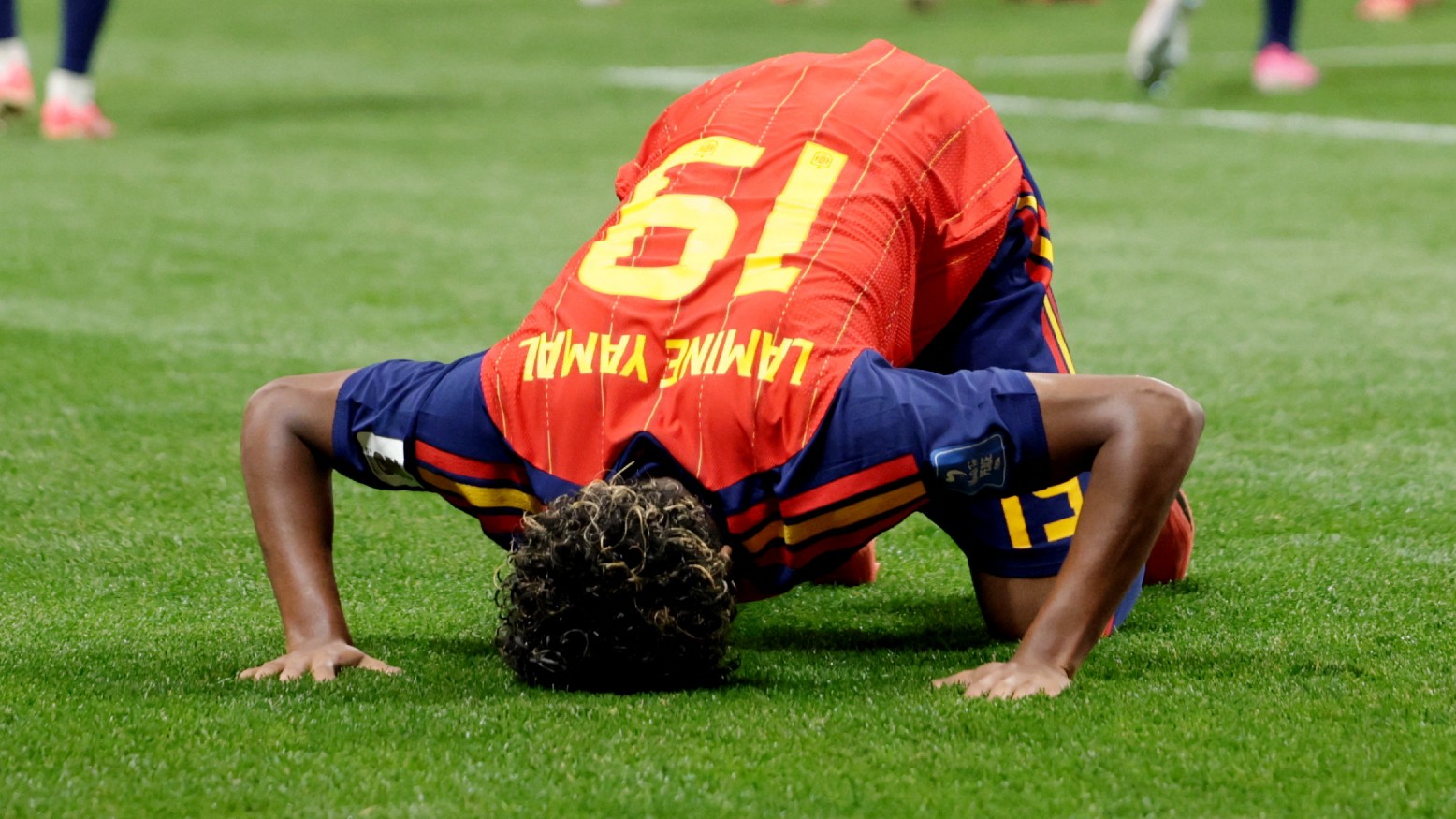
For generations, Islam has functioned as a divisive political flashpoint across European politics, weaponized by far-right movements and even mainstream factions to stoke anti-immigrant sentiment. But on the world’s biggest football platform, a new generation of Muslim players is quietly rewriting the narrative: proving that their faith is not a foreign import, but an integral, long-standing thread in the European social fabric.
With an estimated 2 billion Muslims across the globe, accounting for roughly one-quarter of the world’s total population, open expressions of Islamic faith at this World Cup – which hosted 13 nations with Muslim-majority populations – should have been unremarkable. What has caught global attention, however, is the number of high-profile faith displays coming from athletes representing European nations with majority-Christian populations, pushing back against the false narrative that Islam and European identity are incompatible.
Take 16-year-old Spanish prodigy Lamine Yamal, the dynamic FC Barcelona forward who became one of the breakout stars of the tournament. After scoring his first-ever World Cup goal against Saudi Arabia, Yamal performed sujood – the Islamic act of prostration in prayer – sending headlines across global sports media. This was not the first time the teenager’s faith had drawn controversy: earlier that year, during a friendly between Spain and Egypt held in his hometown of Barcelona, sections of the crowd launched a xenophobic chant: “Who doesn’t jump is Muslim.”
Yamal did not stay silent in the face of the provocation. Taking to social media, he wrote: “I am Muslim alhamdulilah… Football exists to entertain and lift people up, not to disrespect others for what they believe.”
That incident was far from an isolated case. It grew out of a long-running political trend across Europe, where far-right groups – and increasingly, segments of mainstream political parties – have pushed a false binary: framing a “Christian Europe” that must defend itself against the supposed foreign threat of Islam. This narrative overlooks a core historical fact: both Christianity and Islam emerged from the same Arabian Peninsula, with Islam arising just six centuries after the crucifixion of Jesus Christ.
Yamal is not the only European Muslim footballer who has been forced to push back against othering from political actors and fans. In 2024, Germany center-back Antonio Rüdiger, a practicing Muslim, shared an Instagram post marking the start of Ramadan, in which he raised his index finger in tawhid, the universal Islamic gesture symbolizing the oneness of God. What should have been a harmless, personal expression of faith instead prompted a scathing, false attack from Julian Reichelt, editor-in-chief of German tabloid *Bild Zeitung*, who falsely claimed the gesture was a symbol of support for the Islamic State group.
Rüdiger responded by filing a defamation lawsuit against Reichelt, accusing him of defamation and incitement to religious hatred, though public prosecutors later dropped the proceedings.
Just days before Yamal’s goal against Saudi Arabia, another European-based player celebrated a World Cup goal with sujood: Yasin Ayari, who scored the opening goal for Sweden against Tunisia. Ayari, who has Tunisian roots, had long been courted by the Tunisian Football Federation to switch his international allegiance. Out of respect for his father’s home country, he followed his celebration with a quiet gesture asking for forgiveness. Even so, his act of faith and muted celebration sparked fierce backlash, with Jimmie Åkesson, leader of the far-right Sweden Democrats, publicly refusing to recognize Ayari as a Swedish citizen. Social media was flooded with hostile criticism of both the player and his expression of faith.
In reality, Ayari’s journey tells a far different story than the one pushed by anti-immigrant politicians: it is proof that Islam is already part of modern Europe, and that the overwhelming majority of immigrants and their children integrate fully into their home societies. It was Ayari’s own Tunisian-born father, Azouz, who encouraged him to represent Sweden, telling Swedish outlet *Aftonbladet*: “My children are part of Sweden. They were born here, their friends are here. I’m an immigrant, but Yasin is Swedish with a Tunisian background. He has every right to play for this country. I really want him to play for Sweden. He should feel that he can give back to the nation that took care of him, that gave him schools, opportunities, that raised him. Why would I interfere? I’m so happy for him.”
While Ayari, Yamal and Rüdiger inherited their faith from their immigrant families, a growing number of European-based footballers have chosen to embrace Islam through conversion, adding another layer to the story of Islam’s place in modern Europe. Some of the biggest names in the sport count themselves among this group: four-time UEFA Champions League winner Clarence Seedorf, a former Netherlands midfielder; French-Malian striker Frédéric Kanouté; and 2018 World Cup-winning French midfielder Paul Pogba.
More recently, Djed Spence, a left-back who represented England at this World Cup, became the first openly Muslim player to earn a cap for the men’s senior national team, making his debut in World Cup qualifying against Serbia in 2022. “I was surprised because I didn’t know I was the first, so it’s a blessing,” he said after England’s 5-0 win. “It’s good to make history and hopefully inspire young kids around the world that they can make it as well. They can do what I am doing.”
The reach of European-based Islamic conversion even extends to this World Cup’s most surprising underdog story: Cape Verde, the tiny Atlantic archipelago nation that captured global hearts after pulling off incredible upsets against Spain and Uruguay to advance out of their group, nearly knocking out eventual champions Argentina. The overwhelmingly Roman Catholic nation drew heavily on its diaspora for its squad, with nearly half of its players born outside the country, many of them raised in Europe. Three members of the squad converted to Islam during their time playing professionally in Europe.
Jamiro Monteiro, the 32-year-old midfielder who first represented Cape Verde in 2016, converted to Islam five years ago while living in his native Rotterdam, Netherlands. French-born teammates Logan Costa and Steven Moreira followed similar spiritual paths, converting during their professional careers. “I was interested in religion from a young age and read about Islam, then later I was living with a fellow player that was Muslim and he encouraged me to start praying with him. That’s when I started to feel something inside me,” 25-year-old defender Logan Costa explained of his journey, which concluded with his formal conversion in 2020.
Moreira, 31, the 2024 MLS Defender of the Year, shared a similar origin story. “I was in an academy in Rennes and I used to room with one of my friends. We did something wrong and they separated us and they put me with an older player,” he recalled. That older player was Abdoulaye Doucouré, the former Everton midfielder and a practicing Muslim. Watching Doucouré pray five times a day and fast during Ramadan sparked Moreira’s curiosity. Before long, he was asking questions, exploring the faith, and eventually embracing it himself. “I could feel something was moving for me but you’re a bit scared because you weren’t raised with that. You don’t know how your family will react … but when I told them, they said: ‘You’re a better person now.’ Alhamdulillah.”
The three players celebrated Monteiro’s opening goal at the 2023 Africa Cup of Nations with a joint sujood, and their shared faith has only strengthened the unity of the Cape Verdean squad. “Whether we are Muslim or Christian our strength is that we are together – we are all Cape Verdean,” Costa said ahead of the team’s historic World Cup run. The squad has fully accommodated the three players’ faith, providing halal food throughout training camps and tournaments, and views their different religious identities simply as a natural outcome of their diaspora roots, raised across European communities.
Against a backdrop of rising anti-Muslim rhetoric across European politics, these players – through their performances, their courage, and their open expressions of faith – are building a new, more inclusive narrative of what it means to be European in the 21st century.