On a Friday evening in late sunset at Bridge Bay Campground, nestled along the shores of Yellowstone Lake in Wyoming’s Yellowstone National Park, a routine family photo opportunity turned into a terrifying wildlife attack that has underscored longstanding safety guidance for millions of annual visitors.
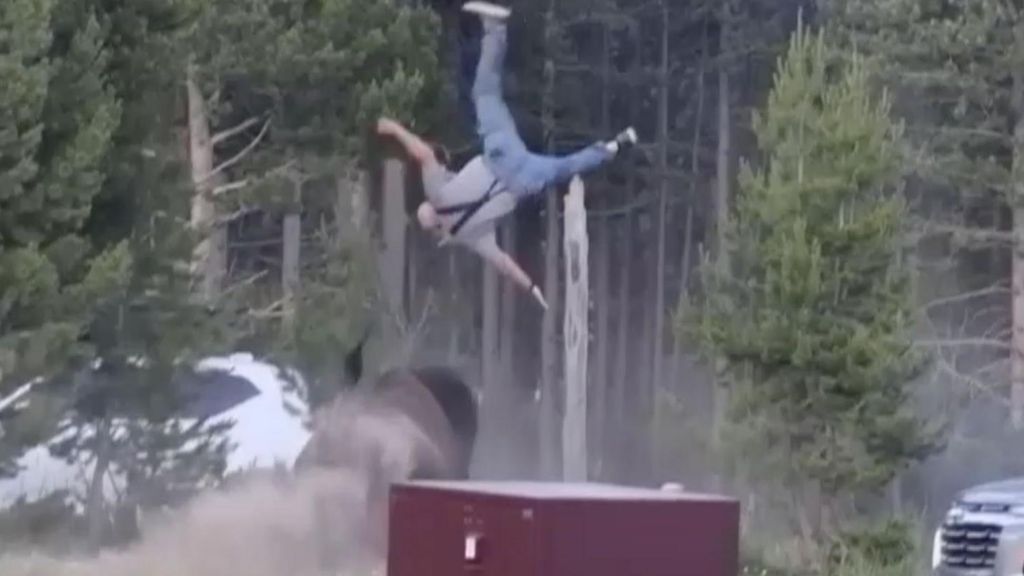
Viral footage captured by onlooker Mike MacLeod shows 65-year-old Carl Isom-McDaniel and his grandson pausing during a walk to snap pictures of a 2,000-pound (900-kilogram) bull bison resting in the grass. While the pair appeared to keep a moderate distance from the animal at first, the bison soon displayed clear signs of agitation: it flopped repeatedly onto its side before springing to its full, massive size. A white pickup truck that had slowly approached the scene sped off after the bison charged its front end, leaving the massive animal free to continue a thunderous charge toward Isom-McDaniel and his grandson, kicking up a cloud of loose dirt as it ran.
The two visitors attempted to outrun the bison by cutting through a dense thicket of trees, but the animal quickly closed the gap. According to MacLeod, who spoke to local outlet Cowboy State Daily after recording the incident, the bison hooked Isom-McDaniel’s hip with its left horn and tossed the 65-year-old fully into the air. “He made a perfect flip and landed on his side,” MacLeod described. Though Isom-McDaniel remained conscious throughout the immediate aftermath and even maintained good spirits by joking with witnesses, he sustained severe multiple injuries, particularly to his leg, and reported being in extreme pain. He was later transferred to a local hospital for treatment, the New York Times has confirmed.
As of press time, the National Park Service (NPS), which manages Yellowstone National Park, has not released an official statement on the attack, and the BBC has confirmed it has requested comment from the agency on the incident. This attack comes as the NPS has long warned visitors about the underappreciated danger bison pose in the park. On its official website, the agency notes that while bison often appear slow and calm to untrained visitors, they have injured more people in Yellowstone than any other native wildlife species. The animals can reach running speeds three times faster than the average human, making escape nearly impossible once a charge begins. To prevent attacks, the NPS requires all visitors to stay a minimum of 25 yards (23 meters) away from bison at all times, and explicitly warns against approaching the animals to take photographs.
Summer is the peak visitation season for Yellowstone, with NPS data showing nearly 60% of the park’s total annual visitors arrive during June, July and August. As crowds continue to flock to the iconic national park this summer, this incident has drawn renewed attention to the importance of following wildlife safety protocols to avoid dangerous human-wildlife encounters.