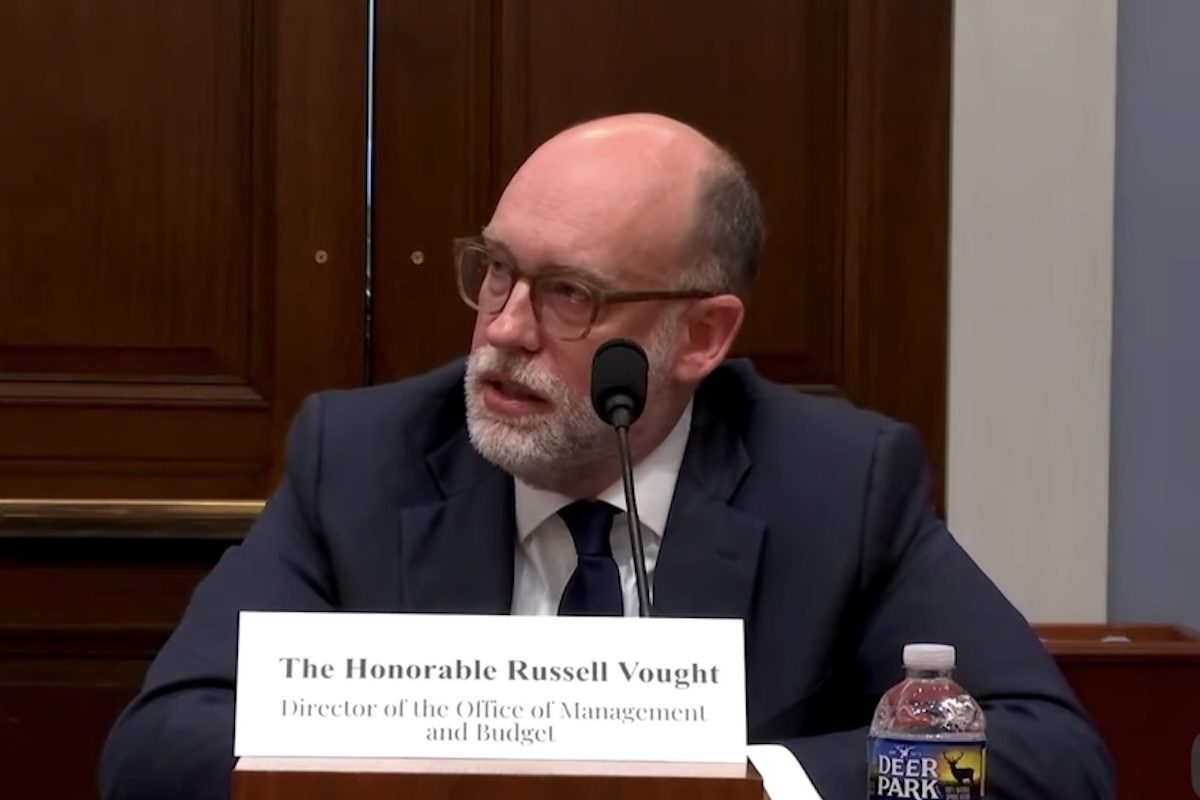
On Wednesday, during testimony before the House Budget Committee, White House Office of Management and Budget Director Russ Vought stood firm in defending the Trump administration’s controversial new fiscal year budget request, which calls for a 43 percent jump in defense spending paired with a 10 percent reduction across non-military domestic programs. Vought framed the imbalanced proposal as the most viable path forward for U.S. national security and fiscal priorities, but the plan drew fierce pushback from committee Democrats, and bipartisan skepticism over defense spending accountability leaves its full passage highly unlikely as lawmakers begin months of debate.
Top Democratic committee leaders slammed the proposal’s skewed priorities, arguing it abandons core domestic needs that matter most to American households. Ranking member Rep. Brendan Boyle of Pennsylvania pointed out that the dramatic defense expansion comes with no corresponding boost to critical public health programs including Medicare and Medicaid, and no new relief for families struggling with soaring child care costs. “This is a reflection of priorities that are out of whack” with what Americans actually need, Boyle stated.
In response to criticism, Vought characterized the large defense investment as a paradigm-shifting overhaul of the U.S. military industrial base, designed to break longstanding bureaucratic backlogs that have slowed production of critical military assets. “For instance, the president and his Department of Defense are exhibiting tremendous leadership to build ships, planes, drones, munitions and satellites faster without the backlog of status quo,” he explained during the three-hour hearing. To expand the nation’s defense production capacity enough to double or triple output through new facility construction, rather than just adding shifts to existing sites, Vought noted that multi-year forward purchasing agreements are required, and those upfront costs must be accounted for in the first year of the budget.
To advance the proposal, Vought outlined a two-track budget strategy for congressional Republicans: the plan would allocate roughly $1.15 trillion for defense in the regular annual appropriations bill, which needs bipartisan support to advance through the evenly divided Senate, and slot an additional $350 billion into a budget reconciliation package that Republicans can pass without Democratic votes. This structure, Vought argued, would avoid the longstanding rule that has seen Democrats demand every one-dollar increase in defense spending be matched by a one-dollar increase in domestic spending. “This Congress has changed the way we can spend money through the reconciliation process to avoid the pitfalls that really caused two decades of not being able to accomplish anything,” he said, noting the procedural change deserves credit. Republicans already leveraged reconciliation to pass major domestic legislation last year, and are currently preparing another reconciliation bill to expand funding for immigration enforcement in the coming months.
One key gap in the administration’s current request drew repeated questions from committee members: Vought confirmed that the White House cannot yet share even a rough estimate of additional defense funding that will be requested to support ongoing military operations related to the Iran war. “We’re not ready to come to you with a request. We’re still working on it,” Vought testified. “We’re working through to figure out what’s needed in this fiscal year versus next fiscal year.” The current 2025 fiscal year is set to end on September 30, ahead of the new fiscal year beginning October 1.
The proposed 43 percent defense increase also faced bipartisan pushback over longstanding issues with Pentagon financial accountability. Lawmakers from both parties noted that the Defense Department has consistently failed to complete full, clean audits of its sprawling spending portfolio, and questioned the wisdom of approving a massive funding hike before fixing transparency and fraud issues.
Washington Democratic Rep. Pramila Jayapal challenged whether the administration was genuinely committed to rooting out waste and fraud across all federal agencies, given its push to add more than half a trillion dollars to Defense Department funding. Vought countered that the department is continuing to make progress toward completing a full, comprehensive audit. Wisconsin Republican Rep. Glenn Grothman echoed that frustration, lambasting what he called pervasive arrogance within Defense Department leadership. “I keep holding my nose because defense is the most important thing. And they just say, ‘We don’t have to do an audit. We’re so damn important. We don’t care what Congress thinks,’” Grothman said, demanding that the full audit be completed by July 31, before lawmakers must advance final spending legislation. Vought sought to reassure skeptical lawmakers, stressing that the administration is committed to rooting out inefficiencies at the Pentagon, with any savings redirected to procurement and military research.
The House Budget Committee does not have the authority to draft the 12 annual government spending bills. That responsibility falls to the House Appropriations Committee, which will hold hearings with cabinet secretaries and agency leadership in the coming weeks to review the full presidential budget request for the 2026 fiscal year. Appropriations subcommittees will then draft and debate individual spending bills that make up the discretionary portion of the roughly $7 trillion total U.S. federal budget. The vast majority of annual federal spending — around $4.2 trillion — is allocated to mandatory entitlement programs including Social Security, Medicare and Medicaid, while another $970 billion goes to interest payments on the national debt.
According to nonpartisan Congressional Budget Office data, total defense spending for the 2025 fiscal year, which ended in September 2025, reached $893 billion, while non-defense domestic programs received a combined $980 billion. Under the administration’s proposal, defense spending would surpass domestic discretionary spending for the coming fiscal year, while 10 percent cuts would be spread across dozens of domestic agencies including Agriculture, Education, Health and Human Services, Homeland Security, Housing and Urban Development, Labor, Transportation, State, and Veterans Affairs, among smaller agencies.