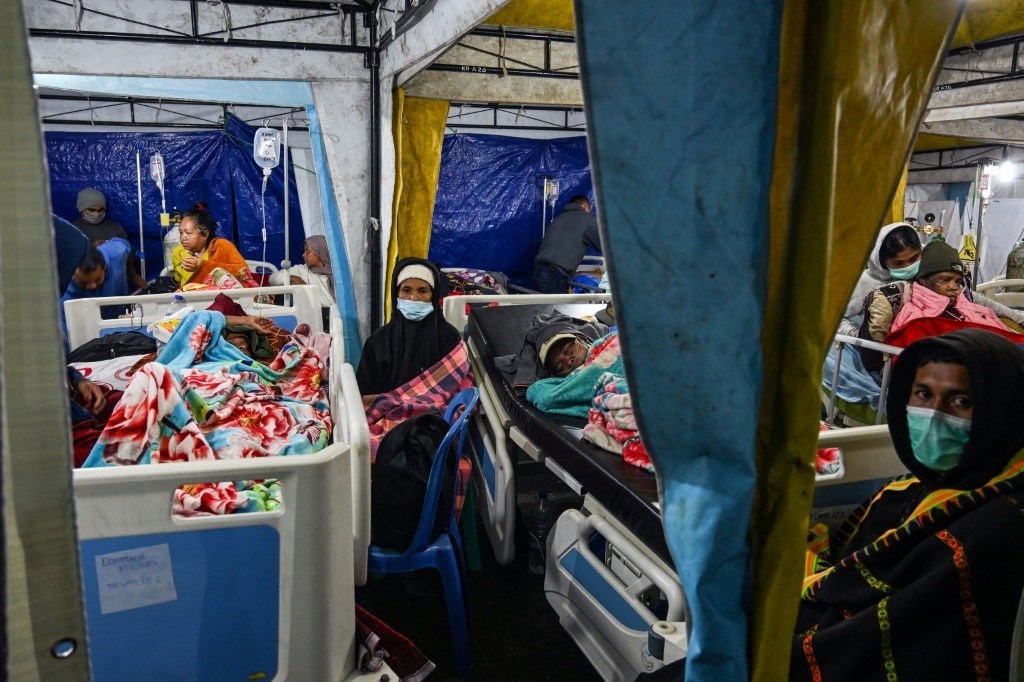
A powerful 7.7-magnitude earthquake that struck Indonesia’s Flores Island early Saturday has left 48 people dead, more than 100 injured, and thousands displaced, with emergency response teams and international partners scrambling to deliver life-saving aid to affected communities by Sunday.
According to Indonesia’s National Disaster Management Agency (BNPB) spokesman Berton Suar Pelita Panjaitan, roughly 5,000 residents have abandoned their damaged homes in the wake of the main tremor, which was followed by no fewer than 341 recorded aftershocks in the hours after the initial quake. Multiple communities have been cut off from basic services, with power and telecommunications down in hard-hit areas, and at least one key emergency access route remains blocked to relief convoys.
For survivors huddled in open-air hilltop shelters, the wait for aid has been fraught with fear, compounded by traumatic memories of a devastating 1992 quake of the same magnitude that hit Flores, triggering a tsunami that killed roughly 2,500 people. “I’m still terrified; my heart is pounding hard remembering yesterday’s tremor,” said 55-year-old Nurhidayati, who has camped on a hilltop with other displaced residents since Saturday. “We just ran up here yesterday. I’m very scared now, still traumatised by the quake in 1992. I don’t dare to go home.”
Local residents have outlined a long list of urgent unmet needs, including staple food, clean drinking water, emergency pharmaceuticals, and children’s diapers, along with temporary shelter, blankets, and power generators to replace downed electrical grids. BNPB head Suharyanto confirmed Sunday that a large-scale response force is en route, consisting of at least five helicopters, multiple fixed-wing supply planes, a naval vessel, and dedicated search and rescue craft.
Preliminary damage assessments show the extent of the destruction is far-reaching: at least 914 homes have been completely destroyed, hundreds more have sustained partial damage, and dozens of public facilities have been knocked out of service, including 93 education sites, 36 health care centers, and 38 local government offices. Notably, there have been no reports of residents trapped under rubble or still missing as of Sunday, local search and rescue official Fathur Rahman told reporters.
Geological surveys place the epicenter of the shallow quake just off Flores’ north coast, a region with few high-rise structures. Even so, key infrastructure like the main hospital in Ruteng, a town located around 120 kilometers from the hardest-hit zone, suffered severe damage, forcing staff to evacuate all patients to outdoor tents. In a remarkable display of emergency adaption, medical teams converted an undamaged storage room into a temporary operating theater to carry out an emergency C-section, with both mother and newborn emerging healthy and safe, hospital spokeswoman Yohana Raisita Damalia Mari confirmed.
International support has begun to mobilize alongside Indonesian government efforts. The International Federation of Red Cross and Red Crescent Societies announced Saturday it was prepositioning supplies to deliver aid to thousands of survivors in temporary shelters, while the Indonesian government has already shipped 50,000 pre-assembled aid packages totaling 275 tonnes to the impacted area. European Union Commission President Ursula von der Leyen offered access to the bloc’s Copernicus Earth observation satellite system to assist with search and rescue mapping, posting on X: “Europe stands ready to deploy Copernicus, our eyes in the sky, to support search and rescue efforts. Indonesia, we stand with you.”
In the immediate aftermath of Saturday’s quake, coastal residents fled to higher ground when seawater pulled back from shore—a classic warning sign of an impending tsunami. Indonesia’s Meteorology, Climatology and Geophysics Agency (BMKG) later issued the all-clear, lifting the tsunami warning after recording maximum waves of 1.6 meters in some coastal areas. Authorities have still urged displaced residents not to return to damaged structures, warning that ongoing aftershocks could trigger additional collapses. Herybertus Geradus Laju Nabit, mayor of the Manggarai regency, noted that there is no timeline for when aftershock activity will subside: “Therefore, our first appeal is: be vigilant. Stay alert.”
The earthquake is the latest deadly seismic event to impact Indonesia, which sits along the Pacific “Ring of Fire”—a geologically active arc that stretches from Japan across Southeast Asia and the entire Pacific basin, prone to frequent tectonic activity. One of the deadliest natural disasters in recorded history struck the country in 2004, when a 9.1-magnitude quake off the coast of Sumatra triggered a massive tsunami that killed more than 220,000 people across the region, 170,000 of whom were in Indonesia.