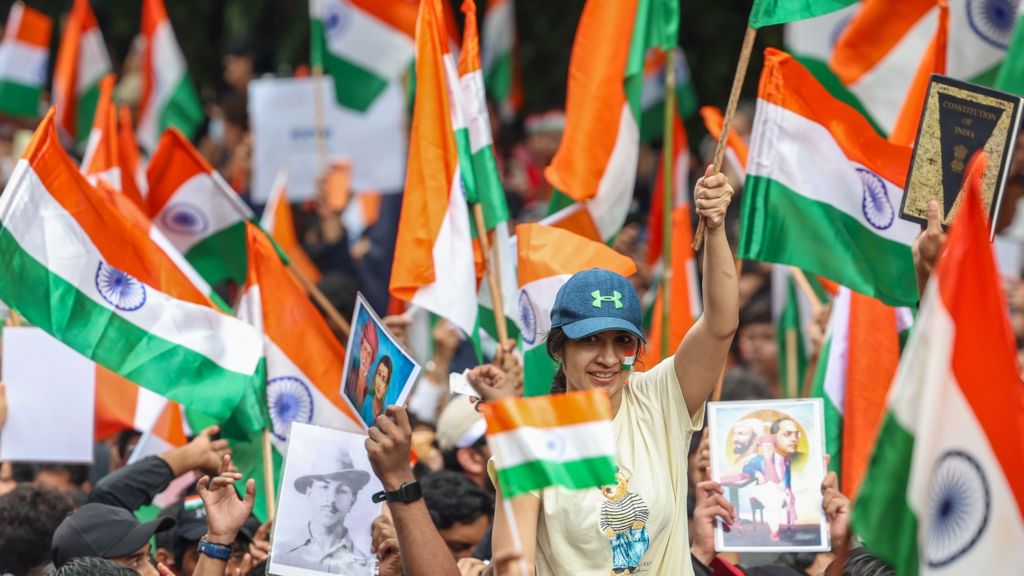
A 35-day education reform protest led by the Cockroach Janta Party (CJP) at Delhi’s iconic Jantar Mantar demonstration ground wrapped up on July 25, but a viral clip showing young female protesters using expletives has reignited a fierce national conversation about gender bias, double standards, and the state of India’s public discourse. Weeks after the protest concluded, opposition leader Rahul Gandhi has injected new energy into the debate by calling out Prime Minister Narendra Modi’s framing of the women’s language as a “culture shock” as a product of systemic patriarchy.
The protest, which spread to multiple Indian cities, was organized in response to widespread public anger over repeated exam paper leaks, with demands for sweeping education policy changes. During the weeks of demonstrations, a number of young female participants used aggressive, foul language targeting Prime Minister Modi, sparking swift outrage from the ruling Bharatiya Janata Party (BJP)’s base. Even some Modi opponents argued the women had crossed acceptable lines of political speech. Viral clips and images of the exchanges quickly spread across social media, drawing national attention and putting a 15-year-old female participant at the center of the controversy. The teen received violent online harassment, including rape threats, ultimately forcing her to release a public apology and remove her original post. Her single mother later told local media the ongoing harassment had forced the family to relocate multiple times to escape abuse.
After the protest ended, Modi addressed the incident in an Instagram selfie video, framing the young women’s language as a deeply upsetting “culture shock.” “Some naughty children used extremely abusive expletives which have no place in a civilised society,” he said, noting the language targeted him and even his late mother. While he extended forgiveness to the young protesters, saying childhood mistakes should be a learning opportunity rather than a cause for permanent condemnation, he did not address two key points: the violent police crackdown deployed against demonstrators, and the ongoing violent threats targeting women who participated in the protest.
Weeks later, during a student gathering in the western city of Pune, Gandhi – leader of the opposition Congress party in India’s lower parliamentary house – pushed back directly against Modi’s framing. Pointing out that male protesters also used foul language during the demonstration, Gandhi questioned why Modi only called attention to the language used by women. “If boys swear, there is no problem and it is allowed. But if a girl swears, it is a cultural shock,” he said, arguing that this selective criticism grows out of patriarchal mindsets that restrict women’s public speech while granting men full freedom to express anger. “We have to smash this patriarchy,” he added.
Leading gender journalists and activists have echoed Gandhi’s critique of double standards, pointing to longstanding cultural traditions that normalize women’s use of profanity in many parts of India. Namita Bhandare, a prominent gender columnist for the Hindustan Times, told the BBC that women using profanity is nothing new in Indian society: in many northern Indian rural communities, a traditional pre-wedding ritual sees women from the bride’s family sing songs full of expletives to welcome the groom’s party, a practice that is widely accepted and rarely considered offensive.
Bhandare also highlighted the hypocrisy of political leaders calling out women’s profanity, noting that politicians across the ideological spectrum – including Modi and senior BJP leaders – have a long history of misogynistic slurs and offensive language targeting women. This contradiction, she pointed out, comes as Modi has positioned himself as a champion of women’s empowerment: in his 2022 Independence Day address, he called on Indians to combat misogyny, and his government runs multiple high-profile programs aimed at advancing women’s social and economic status, with Modi holding strong popularity among many female Indian voters. Still, he has faced repeated criticism for misogynistic language, including offensive remarks made at political rallies in 2004 and 2012. Criticism for misogynistic speech is not limited to the BJP: senior leaders from Gandhi’s own Congress party have also faced public outrage for offensive comments targeting women in recent months.
“Women are treated so shabbily and it’s so easy to target them. And then when they use profanity, then everyone asks, how can our girls cuss and swear,” Bhandare said.
Not all observers frame the debate solely around gender. Social activist Sunil Jalan, who has run the national Gali Bandh Abhiyan campaign to curb public use of profanity since 2014, argues that the focus should be on reducing harmful expletive language across the board, regardless of who uses it. “we must focus on swearing, not on the gender of who uses it,” he said. A 2025 survey conducted by Jalan’s NGO, which included more than 70,000 participants across 28 Indian states and 8 union territories, found that 55% of respondents admitted to regular use of foul language, with particularly high prevalence in northern Indian states: 80% in Delhi, 78% in Punjab, and 74% in both Uttar Pradesh and Bihar. Rates were far lower in southern India, and between 15% and 18% in India’s northeast. Jalan noted that the current national conversation is the first widespread public dialogue about the normalization of profanity in Indian society, and he hopes it will lead to meaningful change, arguing that popular culture from comedy to films has normalized aggressive language that needs to be reined in.
For India’s Gen Z and the CJP organizers, however, profanity has long been a core tool of grassroots protest. CJP spokesperson Sourav Das told the BBC that “Profanity and protest have gone hand in hand for ages. There’s a shock-and-awe factor to it, which is fundamental to protest. It may be distasteful to some people and not to others. But it absolutely can’t be criminal.”
The incident also shines a light on a broader erosion of civility in India’s public discourse, where expletives and personal attacks have become increasingly common across every space, from street protests to television panels, courtrooms, and even parliament. Just this week, a viral video showed a public altercation on state-owned Doordarshan television, where a temple priest unleashed a volley of expletives at a Congress spokesperson, who retaliated with the same language. In 2023, sitting BJP MP Ramesh Bidhuri faced widespread national criticism after using Islamophobic slurs and threatening a Muslim opposition MP directly on the floor of parliament, only issuing an apology after sustained public outrage.
Sociologist Shiv Vishwanathan argues that the growing normalization of profanity in all spaces of public life is a symptom of a far deeper breakdown in India’s democratic culture. “the use of expletives is the symptom of a deeper breakdown of democracy, it shows there’s end of discussion and a lack of respect,” he explained. When expletives become common in institutions designed for deliberation, like parliament and the courts, “it shows there’s a breakdown of language, there’s a decline of argument and decline of democracy.” For grassroots protesters, he added, the turn to aggressive language is a natural response when marginalized groups are denied respect and a platform to be heard: “when there’s a weaker sense of respect, expletives become a response.”