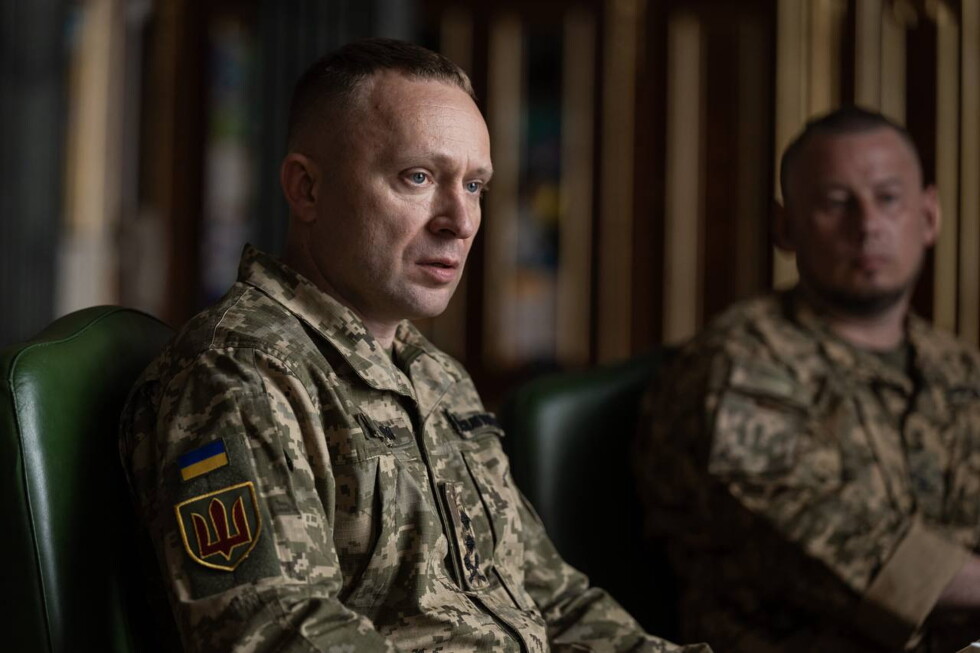
KYIV, Ukraine — In a major shakeup to Ukraine’s top military leadership that comes on the heels of widespread public unrest over stalled military reform, President Volodymyr Zelenskyy has tapped 43-year-old Maj. Gen. Mykhailo Drapatyi to serve as the country’s new commander-in-chief. The appointment Tuesday follows the dismissal of former chief Gen. Oleksandr Syrskyi, who was pushed out after days of mass demonstrations across Kyiv and other major Ukrainian cities.
Protesters took to the streets demanding Syrskyi’s removal and calling for the reinstatement of former Defense Minister Mykhailo Fedorov, a figure widely credited as a key catalyst for sweeping Ukrainian military modernization. Demonstrators framed Syrskyi as the face of the military’s outdated, Soviet-era top-down command culture, a system that many Ukrainians argue has hampered battlefield effectiveness and slowed much-needed structural reform.
In his first public statement following the appointment, Drapatyi extended recognition to his predecessor in a Facebook post, thanking Syrskyi for his work strengthening Ukraine’s armed forces. “I grew up in it,” Drapatyi said of the Ukrainian military, adding: “I will work responsibly, with focus and with respect for the people defending our state today.”
Unlike older generations of Ukrainian military leaders who cut their teeth in the Soviet-era armed forces, Drapatyi is a product of the 10-year-long war with Russia that began in 2014, and his entire professional career has been shaped by frontline combat experience. He most recently served as commander of Ukraine’s Joint Forces, the unified command structure that oversees daily cross-branch combat operations along all fronts of the war with Russia.
Widely described by peers and observers as intensely disciplined and extraordinarily effective in high-stakes combat scenarios, Drapatyi has a long track record of being deployed to stabilize the most unstable, pressure-cooker sectors of the frontline. Though he maintains a low public profile, he has built broad respect and growing popularity both within the armed forces and among the Ukrainian public for a string of notable battlefield victories stretching back a decade.
Drapatyi first made his name as a daring young officer in 2014, during the opening months of Russia’s incursion into eastern Ukraine. That May, then a major leading a battalion within Ukraine’s 72nd Brigade, he orchestrated a high-risk armored rescue mission into central Mariupol to extract a group of police officers and territorial defense leaders who had been trapped and besieged by pro-Russian militants, who had threatened to burn the captured group alive.
When the column’s path forward was blocked by a barricade standing more than a meter high, Drapatyi — riding in the lead vehicle — ordered his driver to accelerate directly at the obstacle. The armored vehicle cleared the barrier like a vehicle launching off a ramp, a dramatic moment captured on camera that quickly spread across social media and became one of the most iconic stories of Ukraine’s early resistance. The bold action stood out dramatically in 2014, when the Ukrainian military was still poorly equipped, largely untested in large-scale combat, and deeply hesitant to authorize decisive, independent actions by field commanders that could risk escalating tensions with Moscow.
Just months after the Mariupol rescue, Drapatyi led his battalion through another harrowing test of leadership when the unit was encircled by Russian-backed separatist forces near the Ukraine-Russia border for weeks. Rather than surrendering and agreeing to disarm to walk free, Drapatyi organized a nighttime breakout, successfully leading all 260 of his soldiers and more than 30 vehicles out of the encirclement to safety.
Over the decade that followed, Drapatyi climbed steadily through the ranks of field command, leading multiple brigades across eastern Ukraine before taking up the post of deputy commander of the Joint Forces when Russia launched its full-scale invasion of Ukraine in February 2022. In 2024, he led the force that halted a major Russian advance on Zelenskyy’s hometown of Kryvyi Rih, helped push Russian troops back from occupied territories in the Kherson region, and later organized the defensive line that blunted a renewed Russian offensive in the Kharkiv region later that same year. By the end of 2024, Zelenskyy appointed him to serve as commander of the Ukrainian Ground Forces.
His tenure in that role was cut short, however, after a Russian missile strike on a ground forces training center killed dozens of Ukrainian soldiers, the second deadly attack on the same facility in just a few months. Drapatyi resigned from the post immediately, taking personal responsibility for the tragedy and saying he had failed to ensure his orders for improved security were fully implemented. In his resignation letter, he alleged that attempts to reform the ground forces branch had been blocked by entrenched officials protecting one another from accountability.
Shortly after his resignation, Zelenskyy appointed Drapatyi to lead the Joint Forces command, setting the stage for his promotion to commander-in-chief this week.
Drapatyi’s reputation as an uncompromising advocate for military reform became public knowledge earlier this week, when former Defense Minister Fedorov claimed that Ukraine’s old military leadership had systematically pushed back against reform and pressured commanders who advocated for change — including Drapatyi, who Fedorov said received three formal reprimands from Syrskyi for his reform efforts.
Drapatyi later responded to the claims in a social media post, where he expressed backing for the current Defense Ministry leadership while also agreeing with Fedorov’s core critique: that many critical reforms have only been implemented “despite the system, rather than thanks to how it worked.” He added that a commander’s silence “has never been a form of responsibility.”
Born in 1982 in the western Ukrainian city of Kamianets-Podilskyi, located in the Khmelnytskyi region, Drapatyi grew up in a family of public school teachers. He trained as a tank officer at the Kharkiv Institute of Tank Troops, graduating in 2004 before receiving his first posting to the 72nd Separate Mechanized Brigade in Bila Tserkva — a unit that was then commanded by the now-dismissed Oleksandr Syrskyi.