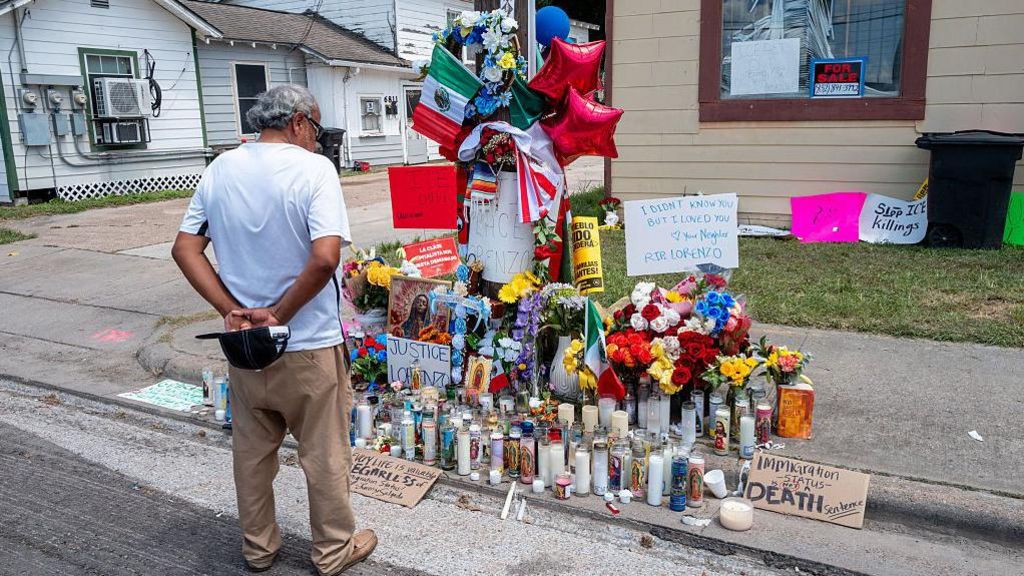
A fatal shooting of a 52-year-old Mexican man by U.S. federal immigration agents in Texas has sparked widespread public demands for transparency, prompting state officials to launch an independent investigation into the incident that has reignited national debates over immigration enforcement tactics.
Governor Greg Abbott announced Wednesday that the Texas Rangers, the state’s elite law enforcement unit, will partner with federal investigators to uncover the full circumstances surrounding the July 7 shooting death of Lorenzo Salgado Araujo, a resident of nearly 35 years who was en route to his job when agents pulled him over. Speaking to reporters, Abbott emphasized that effective border control and immigration enforcement do not require the use of lethal force.
“It is fully possible to enforce immigration laws and stem the flow of unauthorized crossing at our southern border without resorting to shooting people,” Abbott stated.
Initial details released by U.S. Immigration and Customs Enforcement (ICE) have already shifted and drawn sharp pushback from Salgado Araujo’s family and local elected officials. ICE first claimed agents opened fire in self-defense after Salgado Araujo “weaponized his vehicle” against officers. The Department of Homeland Security later corrected the account, confirming Salgado Araujo was never the intended target of the operation – agents stopped his white van simply because he matched the general description of the planned suspect.
Critical gaps in official documentation have further fueled calls for an outside probe. Representative Silvia Garcia, the Democratic congresswoman representing the Houston-area district where the shooting occurred, confirmed that none of the ICE agents involved were wearing body cameras during the stop, and no publicly available video footage of the shooting has emerged to date.
For the Salgado Araujo family, the official narrative does not align with what they know of the father of three, who had been in the process of securing legal permanent residency before his death. Ronaldo Salgado, one of his sons, told reporters he first learned of the shooting from graphic social media footage of the aftermath, identifying his father by his desperate cries for help as he lay wounded on the street, rather than by his physical appearance. He received confirmation of his father’s death from subsequent news reports. Three companions who were traveling with Salgado Araujo, including his uncle, were taken into immigration custody immediately following the shooting, the family confirmed.
This incident is not the first time ICE’s use of force accounts have been called into question amid former President Donald Trump’s hardline crackdown on unauthorized immigration. Earlier this year, the fatal shootings of Renee Good and Alex Pretti in Minneapolis by ICE agents saw official agency claims contradicted by eyewitness testimony and existing video evidence.
Federal authorities have already launched internal probes: the Department of Homeland Security’s Office of Inspector General, the agency’s internal watchdog, is leading an internal review, while the FBI’s Houston division is investigating potential assault claims against the involved officers. But local leaders have rejected internal federal investigations as insufficiently impartial. Houston Mayor John Whitmire joined growing calls for an independent probe, directing the Houston Police Department to formally request the Texas Rangers lead the state-level investigation.
The Texas shooting came on the heels of a second fatal ICE shooting that has added fuel to public outrage. Just days after Salgado Araujo’s death, ICE agents fatally shot 26-year-old Colombian national Joan Sebastián Durán Guerrero in Maine, prompting mass protests across the northeastern state.
These back-to-back lethal incidents have reignited a long-simmering national debate over ICE’s widespread use of traffic stops as a core enforcement tactic – a strategy that has drawn criticism for targeting immigrant communities and leading to unnecessary civilian deaths. After the shootings, White House border czar Tom Homan suggested the agency would temporarily suspend the practice, but Trump confirmed Tuesday that traffic stops would remain a central tool of his administration’s immigration enforcement agenda.
Salgado Araujo’s killing has become a flashpoint for critics who argue that current ICE use-of-force policies lack accountability, especially when investigations are limited to internal federal review. With the launch of the Texas Rangers probe, state officials have moved to meet growing public demands for a full and impartial accounting of the shooting.