标签: North America

北美洲

  • Moment two fighter jets collide mid-air at US air show

    Moment two fighter jets collide mid-air at US air show

    A dramatic mid-air collision between two fighter jets unfolded at a United States air show over the weekend, leaving onlookers stunned but avoiding what could have been a catastrophic loss of life. The two aircraft involved in the incident belonged to the US Navy, and each carried two crew members aboard at the time of the crash.

    In what emergency officials are calling a remarkable turn of events, all four crew members successfully ejected from their damaged aircraft before the jets crashed. Immediately following the collision, local emergency response teams rushed to the scene to provide medical care and secure the crash site.

    As of the latest official update from military authorities, all four ejected personnel are receiving medical treatment, and their conditions are listed as stable. Investigations are already underway to determine the root cause of the collision, with officials set to review air show footage, interview witnesses, and examine the wreckage of the two jets to piece together exactly what led to the mid-air incident. No injuries to spectators on the ground have been reported so far.

  • Fighter jet crews parachute safely after collision at US air show

    Fighter jet crews parachute safely after collision at US air show

    A shocking mid-air collision between two U.S. Navy EA-18G Growler fighter jets has disrupted the final day of a popular Idaho air show, leaving military officials and event attendees shaken but relieved after all four crew members escaped before the crash. The incident unfolded Sunday afternoon approximately two miles northwest of Mountain Home Air Force Base, on the second and closing day of the biennial Gunfighter Skies air show.

    Military spokespersons confirmed that all crew members on board both jets safely ejected from their aircraft immediately following the collision. In an official social media statement posted Sunday, Mountain Home Air Force Base Gunfighters confirmed that all aircrew involved are currently in stable condition, with responding emergency personnel transporting the team for mandatory medical evaluations. U.S. Navy Commander Amelia Umayam told CBS News that the crew remains in the care of on-base medical staff for routine checks, adding that it has not yet been confirmed whether any crew sustained injuries during the ejection or collision.

    The collision sparked a post-crash fire at the crash site, prompting base officials to enact a brief lockdown as emergency response teams worked to secure the area. Following the incident, event organizers made the immediate decision to cancel all remaining activities for the 2026 Gunfighter Skies air show. In their statement, base officials thanked attendees for their cooperation during the emergency response, noting that public patience allowed first responders to work quickly and effectively to contain the situation.

    The two aircraft involved in the crash are assigned to an electronic attack squadron based out of Washington state. According to U.S. Navy data, each EA-18G Growler carries an approximate price tag of $67 million, meaning the collision resulted in an estimated $134 million in military aircraft losses. Kim Sykes, a representative for Silver Wings of Idaho—the local organization that co-organized the event—confirmed that no base personnel, event staff or attendees on the ground suffered any injuries in connection with the crash.

    This is not the first fatal accident linked to the Gunfighter Skies air show: the event was last held in 2018, when a glider pilot lost their life in a separate accident during demonstration activities. As of Monday, military officials have launched a formal investigation to determine the root cause of Sunday’s collision, with no further details on potential contributing factors released to the public. The BBC has reached out to both Mountain Home Air Force Base and event organizers for additional comment on the incident.

  • Trump’s White House ballroom loses federal funding proposed by Senate Republicans

    Trump’s White House ballroom loses federal funding proposed by Senate Republicans

    In a high-stakes legislative win for congressional Democrats, the Senate’s nonpartisan rule-keeper has struck down a provision that would have allocated $1 billion in taxpayer funds for security upgrades tied to former President Donald Trump’s controversial White House East Wing overhaul, which includes a planned $400 million ballroom. The ruling delivered a major early blow to Republican efforts to advance the spending provision through the budget reconciliation process, a procedural tool that allows budget-related bills to move forward with a simple majority and avoid the Senate filibuster. The provision was tucked into a larger omnibus spending package that would fund immigration agencies under the Department of Homeland Security.

    The ruling came from Senate Parliamentarian Elizabeth MacDonough, the respected procedural referee who has overseen Senate rules compliance since 2012. On Saturday, Democrats confirmed that MacDonough had deemed the security funding provision out of order, finding it violated the Byrd Rule — a longstanding Senate regulation that bars extraneous, non-budgetary provisions from being included in reconciliation legislation. MacDonough determined the funding covered activities that fall outside the jurisdiction of the Senate Judiciary Committee, which has oversight over the package, and failed to meet the Byrd Rule’s requirements for provisions included in reconciliation.

    Republicans originally pushed for the taxpayer-funded security upgrades after a late April shooting at a Trump gala event that the former president attended. The incident prompted the Trump administration to accelerate timelines for the ballroom project, which was already underway after construction crews demolished the historic East Wing last October to clear space for the new facility, which Trump has billed as “the finest ballroom of its kind, anywhere in the world”.

    Following the ruling, Trump has confirmed that private donors will cover the $400 million cost of the ballroom itself, but Republicans had sought to draw on public funds to cover Secret Service security upgrades for the renovated space. Democrats had forcefully pushed back against the public funding allocation, arguing that taxpayer money should not be used to fund a personal vanity project for the former president.

    “Republicans tried to make taxpayers foot the bill for Trump’s billion-dollar ballroom. Senate Democrats fought back — and blew up their first attempt,” Senate Minority Leader Chuck Schumer wrote in a post on social media platform X Saturday. “Now Republicans say they’re going back to the drawing board to try again. And Senate Democrats will be ready to stop them again. Americans don’t want a ballroom. They don’t need a ballroom. And they sure as hell should not be forced to pay for one.”

    Oregon Senator Jeff Merkley, the ranking Democratic member of the committee overseeing the package, warned that Republicans are expected to revise the legislation to appease Trump and resubmit the provision, adding that Democrats are fully prepared to challenge any new attempt to include the funding.

    Ryan Wrasse, a spokesperson for Senate Majority Leader John Thune, pushed back on suggestions the maneuver was irregular, noting that revisions to provisions during reconciliation are common. “Redraft. Refine. Resubmit. None of this is abnormal during a Byrd process,” Wrasse wrote on X.

    The ballroom project has sparked controversy from its inception, with preservation advocates pushing back aggressively against the demolition of the historic East Wing. The National Trust for Preservation filed a lawsuit against the Trump administration to halt construction, arguing that the teardown and renovations violate federal law because they were carried out without formal congressional approval. While a federal appeals court ruled in April that construction could continue on both the underground and above-ground portions of the project, legal challenges remain ongoing.

    The ballroom project is part of a broader slate of changes Trump has pushed for in Washington D.C. during his second term, rooted in his background as a real estate developer. The former president has already added gold decorative finishes to the Oval Office, replaced part of the White House Rose Garden with a patio modeled after the one at his Mar-a-Lago resort in Florida, renamed multiple prominent D.C. institutions including the Kennedy Center and United States Institute of Peace to include his name, and unveiled plans for a 250-foot triumphal arch near Arlington National Cemetery.

  • New York rail strike continues as commuters brace for Monday chaos

    New York rail strike continues as commuters brace for Monday chaos

    As the first work stoppage on the Long Island Rail Road in three decades stretched into its second day Sunday, hundreds of thousands of daily commuters across the New York metropolitan region braced for crippling travel disruptions at the start of the workweek, after union and management officials failed to schedule new negotiations to resolve a bitter dispute over wages and working conditions.

    Around 3,500 unionized workers walking off the job at LIRR — the busiest commuter rail system in North America — launched the strike Saturday, when contract talks between labor leaders and the Metropolitan Transportation Authority, which oversees the rail line, collapsed without a resolution. It is the first full strike on the line since a two-day stoppage in 1994, ending a 30-year period of uninterrupted service.

    MTA officials have issued urgent warnings that there is no viable replacement for regular LIRR service, advising daily commuters to plan for remote work whenever possible to avoid gridlock. Limited shuttle bus service is being operated for passengers who have no alternative travel options, but the agency has cautioned that widespread severe congestion and lengthy delays are unavoidable throughout the affected region.

    The work stoppage has already upended travel plans and public events across the city and Long Island. The New York Mets, who play their home games at Citi Field in Queens adjacent to LIRR lines, issued an advance alert to ticket holders for weekend games warning of significant transit access challenges.

    Commuters already began feeling the impact within hours of the strike’s launch. Ramses Brye, a Queens resident, told CBS News — the US news partner of the BBC — that he learned of the walkout mid-trip on his way to an overnight work shift. “I took the train at midnight. That was the last time, and then I looked at the TrainTime app at like 12:30, and, like, yeah, they’re definitely on strike,” Brye said.

    Another regular commuter from Long Island reported that his usual daily trip into Manhattan took far longer Saturday, forcing him to take two connecting buses from Port Washington to reach the city center.

    New York Governor Kathy Hochul has publicly pushed both sides to return to the negotiating table, warning that a prolonged shutdown would spill over to impact local businesses and disrupt the routines of hundreds of thousands of residents who rely on the line for daily travel.

    Union representatives have framed the strike action as a last resort after years of frozen wages for their members. “To every LIRR passenger whose trip is disrupted, know that the MTA left us no choice but to strike,” said Gil Lang, General Chairman of the LIRR General Committee at the Brotherhood of Locomotive Engineers and Trainmen, one of the unions participating in the walkout. “After three years without raises, we cannot make any more compromises to cover for the MTA’s mismanagement,” Lang added.

    MTA chair and CEO Janno Lieber pushed back on the union’s demands in his public comments, arguing that the agency cannot responsibly approve a contract that would destabilize its operating budget. “And we refuse to make a deal that puts it on riders and taxpayers to fund outsized wage increases – far beyond what anyone else at the MTA is getting – and for folks who are already the highest-paid railroad workers in the country,” Lieber said.

    With no formal talks scheduled for Sunday, the prospect of the strike continuing into Monday’s morning rush hour — the busiest travel period of the workweek for the line — grows increasingly likely.

  • Trump warns ‘clock is ticking’ for Iran as peace progress stalls

    Trump warns ‘clock is ticking’ for Iran as peace progress stalls

    Negotiations aimed at ending the ongoing conflict between the United States and Iran have hit a major deadlock, after former President Donald Trump publicly rejected Tehran’s counter-offer to Washington’s initial peace framework, dismissing the proposal as completely unacceptable. The standoff has intensified tensions, with Trump issuing a stark time-sensitive warning to Iranian leadership ahead of a scheduled call with Israeli Prime Minister Benjamin Netanyahu.

    In a post published to his Truth Social platform over the weekend, Trump emphasized that the “clock is ticking” for Iran to adjust its position. “They better get moving, FAST, or there won’t be anything left of them,” he wrote, adding, “TIME IS OF THE ESSENCE!” The harsh public warning came hours before Trump’s scheduled Sunday discussion with Netanyahu, a key US ally in the Middle East, to discuss the stalled negotiation process.

    Iranian state media has pushed back against Trump’s criticism, framing Tehran’s proposal as a constructive, good-faith effort to reach a lasting ceasefire. Semi-official Iranian outlet Mehr News Agency reported Sunday that Washington had failed to offer any tangible concessions in its response to Tehran’s counter-proposal, warning that this lack of flexibility from the US side would cement the current impasse in talks. This is not the first public split between the two sides: earlier this week, Trump already claimed that the ceasefire that has held since early April was on “massive life support” after rejecting Tehran’s core demands, calling its counter-offer to US initial peace proposals “totally unacceptable” garbage.

    Iranian foreign ministry spokesperson Esmail Baghaei has pushed back against this characterization, defending Tehran’s proposal as both “responsible” and “generous”. According to semi-official Iranian news agency Tasnim, the counter-offer lays out several core non-negotiable demands for Tehran. First, it calls for an immediate full cessation of hostilities across all regional fronts — a stipulation that explicitly references ongoing Israeli military operations against the Iran-aligned militant group Hezbollah in Lebanon. The proposal also demands an end to the US naval blockade of Iranian ports, formal international guarantees that no further military attacks will be launched against Iranian territory, payment of compensation for damage sustained during the recent conflict, and formal recognition of Iran’s full sovereignty over the strategically critical Strait of Hormuz.

    The conflict escalated into open military confrontation on February 28, when joint US-Israeli forces launched large-scale air strikes across Iranian territory. A fragile ceasefire designed to create space for diplomatic negotiations went into effect on April 8, and the truce has mostly held in the weeks since, with only sporadic exchanges of fire reported across front lines. Pakistan has stepped in to serve as a neutral mediator between Washington and Tehran throughout the negotiation process, but after weeks of talks, the two sides remain far apart on core sticking points.

    In a notable shift of position announced Friday, Trump indicated that the US would be willing to accept a 20-year suspension of Iran’s nuclear program, a longstanding core point of contention between the two nations. The announcement confirmed a reported policy shift for the Trump administration, which had previously demanded a complete permanent end to Iran’s nuclear activities.

    This is a developing breaking news story, and additional details are expected to be released as more information becomes available.

  • With North America’s largest commuter rail system shut down, NY governor begs unions to resume talks

    With North America’s largest commuter rail system shut down, NY governor begs unions to resume talks

    As North America’s busiest commuter rail network remained locked down for a second day on Sunday, New York Governor Kathy Hochul issued an urgent public plea to striking Long Island Rail Road (LIRR) unions to return to the bargaining table, warning that both workers and hundreds of thousands of daily commuters would face deep harm if the work stoppage drags into the workweek.

    This work stoppage, the first shutdown of the LIRR in 30 years, began just after midnight on Friday, when five unions representing roughly half of the railroad’s total workforce walked off the job after months of stalled contract talks with the Metropolitan Transportation Authority (MTA), the state-run agency that manages the system. Legally permitted to strike starting at 12:01 a.m. Saturday, the action has already upended travel across the New York region, with a critical weekday rush hour now looming.

    Speaking at a Sunday press conference alongside MTA CEO Janno Lieber, Hochul extended an open invitation to union leaders to restart negotiations ahead of Monday’s morning commute. “This is my official invitation. We didn’t want you to leave. You left. You’re welcome to come back. I’ll provide refreshments, whatever you like. Just c’mon back,” the governor said, emphasizing the LIRR’s outsize role in regional daily life. “We all know that the railroad is the lifeblood of Long Island. Without it, life as we know it is simply not possible. The bottom line is, no one wins in a strike. Everyone is hurt.”

    In a joint statement released after the press conference, two of the major striking unions — the International Association of Machinists and Aerospace Workers and the Transportation Communications Union — pushed back on framing the strike as an unnecessary action, noting that their members have gone years without a raise and are only fighting to keep pace with the New York area’s skyrocketing cost of living. Disagreements over salary increases and healthcare premiums have been the core sticking point in the months-long negotiations, with the Trump administration having previously attempted to broker a compromise before talks fell apart.

    Union leaders have confirmed that no new bargaining sessions have been scheduled, with the two sides still far apart on core demands. “We’re far apart at this point,” Kevin Sexton, national vice president of the Brotherhood of Locomotive Engineers and Trainmen, said Saturday. “We are truly sorry that we are in this situation.”

    Lieber, for his part, has countered that the MTA already met the unions’ stated demands on pay, and claimed that union leaders always intended to walk out rather than reach a deal. The MTA has warned that the unions’ original salary demands would force steep fare hikes for commuters and create unsustainable pressure in upcoming contract talks with other MTA worker unions. Unions, which represent locomotive engineers, machinists, signalmen and other on-the-ground rail staff, argue that significant pay increases are a necessity to offset decades of stagnant wages and years of high inflation that has driven up housing, food and utility costs across the region.

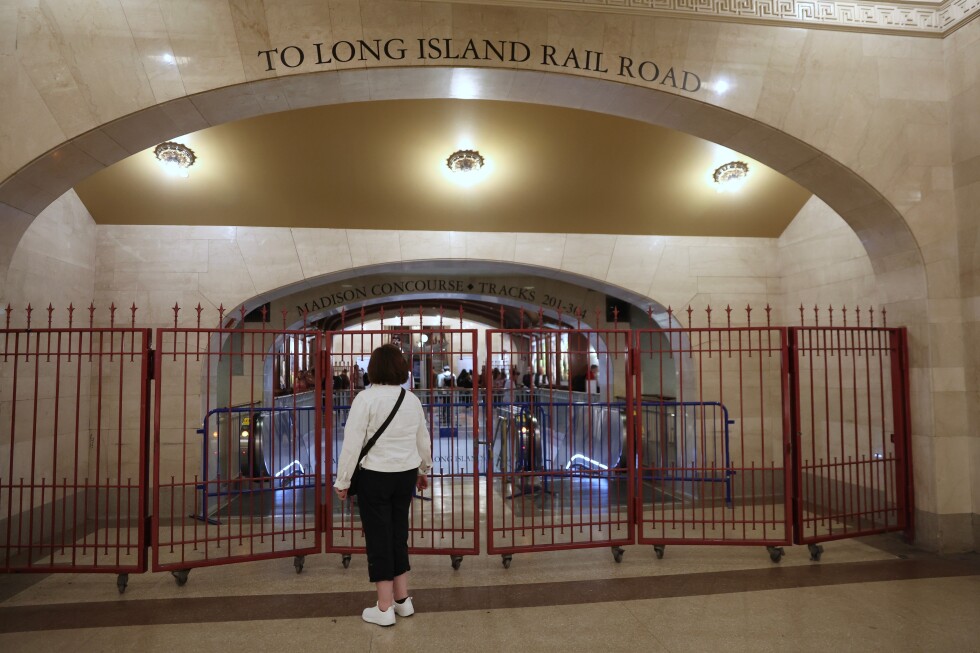
    The shutdown has already transformed one of Manhattan’s busiest transit hubs: Penn Station, the LIRR’s central terminal located directly beneath Madison Square Garden, was eerily quiet over the weekend, stripped of its usual bustling crowds. Departure boards that usually list upcoming LIRR trips instead displayed entries for “ghost trains” marked “No Passengers,” barricades blocked access to LIRR platforms, and MTA police officers were posted throughout the concourse to direct displaced travelers to alternate transit options. Only a handful of travelers, most connecting to unaffected Amtrak intercity trains, moved through the usually crowded main hall Saturday afternoon. The strike also disrupted weekend leisure plans, throwing off travel for sports fans coming into Manhattan for New York Yankees and New York Mets baseball games and the New York Knicks’ playoff run at Madison Square Garden.

    As policymakers and negotiators remain deadlocked, attention has already turned to the impact of a prolonged shutdown on weekday commutes. Roughly 250,000 passengers rely on the LIRR for daily travel between Long Island suburbs and New York City, and a continued shutdown would force most of these travelers onto the region’s already notoriously congested highways. The MTA has only been able to arrange limited shuttle bus service connecting Long Island communities to New York City subway stations, which officials acknowledge cannot come close to matching the LIRR’s regular capacity. To reduce crowding on alternate transit and roads, Hochul has called on all employers with LIRR-commuting staff to allow remote work starting Monday if at all possible. “It’s impossible to fully replace LIRR service. So effective Monday, I’m asking that regular commuters who can work from home, should. Please do so,” she said.

    The shutdown has also sparked a high-profile political fight between incumbent Democratic Governor Kathy Hochul and former President Donald Trump. Hochul has blamed the Trump administration for cutting off mediation efforts early and pushing the talks toward a strike. Trump, who has already endorsed Republican-leaning Long Island politician Bruce Blakeman in his challenge to Hochul’s 2022 reelection bid, pushed back on his Truth Social platform, claiming he had no involvement in the lead-up to the strike. “No, Kathy, it’s your fault, and now looking over the facts, you should not have allowed this to happen,” Trump wrote. “If you can’t solve it, let me know, and I’ll show you how to properly get things done.”


  • Veteran Rodgers says he will retire after 2026 season

    Veteran Rodgers says he will retire after 2026 season

    After inking a fresh one-year deal with the Pittsburgh Steelers, 42-year-old future Hall of Fame quarterback Aaron Rodgers has made his long-awaited career announcement official: the 2026 NFL season will be his last in professional football.

    The 22-year NFL veteran closed out negotiations on the new contract this week, locking in his return to the Steelers for one final run that kicks off this coming September. When pressed by reporters during a recent press conference on whether this campaign would mark the end of his decorated playing career, Rodgers answered definitively: “Yes, this is it.”

    Rodgers’ resume stands among the most impressive in league history: he captured a Super Bowl title with the Green Bay Packers in 2011 and has earned league Most Valuable Player honors four times across his career. He currently ranks fourth on the NFL’s all-time list for career touchdown passes and fifth for total passing yards, cementing his status as one of the greatest quarterbacks to ever play the game.

    Last year, Rodgers joined the Steelers on a one-year deal worth $13.65 million, a salary that landed far below the average for starting NFL quarterbacks around the league. His latest contract tells a different story, however: reports confirm the new deal includes $22 million in guaranteed compensation, with the potential to push total earnings up to $25 million through performance-based incentives.

    Pittsburgh’s quarterbacks coach Tom Arth praised Rodgers’ enduring passion and edge for the game in comments following the contract announcement. “Aaron has a ferocious competitive spirit, but he still has so much fun playing,” Arth said, adding, “He plays the game like he’s still 10 years old running around in the backyard.”

    Rodgers’ NFL journey began back in 2005, when the Green Bay Packers selected him in the first round of the annual NFL Draft. He spent 18 seasons with the Packers, pairing with current Steelers head coach Mike McCarthy to win that 2011 Super Bowl. McCarthy took over the Steelers job this offseason after previous head coach Mike Tomlin ended his 19-year tenure with the team, reuniting the former championship duo in Pittsburgh.

    After leaving Green Bay for the New York Jets in 2023, Rodgers suffered a devastating torn Achilles injury on his debut with the team, forcing him to miss the entire remainder of that season. A disappointing second campaign with the Jets followed, leading to his release from the organization before he signed with the Steelers last year.

    Father time has inevitably brought physical changes for Rodgers: he is no longer the mobile scrambler he was in his prime, and he missed one game for Pittsburgh during the 2025 season after suffering a broken wrist. Even amid an up-and-down season for the Steelers as a whole, however, Rodgers delivered when it mattered, guiding the franchise to a 10-7 regular season record and their first AFC North division title since 2020. The team’s run ended with a post-season loss to the Houston Texans, but Rodgers’ performance silenced many critics who questioned whether he still had enough left to compete at the highest level.

    Back in April, with Rodgers’ future still up in the air, the Steelers addressed the quarterback position in the NFL Draft, selecting young prospect Drew Allar in the third round as a potential successor, a move that sets the stage for a smooth transition at the position once Rodgers retires at the end of the coming season.

  • Republican senator who voted to convict Trump battles for re-election

    Republican senator who voted to convict Trump battles for re-election

    As Louisiana voters head to the polls Saturday for a pivotal Republican Senate primary, one of the last remaining Senate Republicans who broke with former President Donald Trump over the 2021 Capitol riot impeachment faces a make-or-break fight to keep his seat.

  • Canadian from hantavirus-hit cruise ship tests positive

    Canadian from hantavirus-hit cruise ship tests positive

    A new presumptive positive case of hantavirus has been detected in a Canadian passenger who traveled on the MV Hondius, the Dutch cruise ship that experienced a deadly viral outbreak among passengers in April, British Columbia provincial health officials announced this week.

    The infected individual, a resident of Yukon who is one of four Canadian passengers currently isolating on Vancouver Island after disembarking from the vessel, has only developed mild symptoms so far, according to provincial authorities. Dr. Bonnie Henry, British Columbia’s senior provincial health officer, confirmed that all four isolating passengers have had zero interactions with members of the general public since they returned to Canadian soil.

    This new case pushes the total number of confirmed hantavirus infections linked to the MV Hondius voyage to 11, with all cases tied to passengers who were on board the trip. To date, three passengers who sailed on the cruise have died, and two of those fatalities have been officially confirmed to be caused by the virus. Dr. Henry noted that the Yukon passenger’s test returned a presumptive positive result on Friday, meaning official confirmation is still pending from Canada’s national microbiology laboratory.

    “Clearly, this is not what we hoped for, but it is what we planned for,” Dr. Henry told reporters, according to comments published by Canada’s national public broadcaster CBC. She went on to clarify key differences between hantavirus and the more widely known respiratory viruses that global health systems have managed in recent years, adding, “I want to emphasise that hantavirus is a very different virus than the other respiratory viruses that we’ve been dealing with – like Covid, like influenza, like measles – and it remains one that we do not consider to have pandemic potential.”

    Of the six Canadian citizens who were on the MV Hondius when the outbreak unfolded, two are currently self-isolating in private homes in Ontario. The remaining four are staying in isolation on Vancouver Island: one couple from British Columbia, and the other couple from Yukon, the group that includes the presumptive positive case. As of the latest update, the other five Canadian passengers have all tested negative for the virus.

    The outbreak began after the cruise set sail from Argentina on 1 April, with early cases of the virus emerging mid-voyage. The ship was held at sea for multiple weeks while global health authorities coordinated a response, and it finally docked in Tenerife, part of Spain’s Canary Islands, earlier this month. All 147 passengers and crew members, who hail from 23 different countries, were allowed to disembark and enter mandatory isolation once the ship reached port.

    On 10 May, all Canadian passengers were flown back to Canada from Tenerife to complete their isolation periods. The World Health Organization currently recommends a 42-day isolation period for anyone exposed to the outbreak. Canadian protocols initially required a 21-day isolation period for returning passengers, but Dr. Henry confirmed that this timeline is now under review and may be extended to align with global guidance.

    Hantaviruses are most commonly carried by wild rodent populations, and human-to-human transmission is rare for most strains. However, the Andes strain of hantavirus — which the WHO has confirmed is the variant that infected at least some passengers during the voyage, which traveled through South America — can spread between humans.

    Common symptoms of hantavirus infection include high fever, extreme exhaustion, body and muscle aches, abdominal pain, vomiting, diarrhea, and difficulty breathing. Canadian public health officials have reiterated that despite the new positive case, the risk of a large community outbreak of hantavirus linked to this cruise remains extremely low.

  • Democratic governor under fire over clemency for 2020 election denier

    Democratic governor under fire over clemency for 2020 election denier

    A controversial decision by Colorado Democratic Governor Jared Polis to cut short the prison sentence of former Mesa County clerk Tina Peters, a convicted 2020 election denier, has ignited fierce political backlash across party lines in the United States.

    Peters, a Republican, made national headlines as one of the highest-profile figures prosecuted for efforts to cast doubt on the 2020 presidential election results. In August 2024, a jury found her guilty on seven felony counts connected to a 2021 breach of local election computer systems. The scheme allowed an unauthorized outsider to access sensitive voting equipment and voter records, carried out to support unproven claims that widespread voter fraud cost Donald Trump the 2020 election – a false conspiracy theory Trump has pushed repeatedly since his loss.

    Polis announced the commutation Friday, confirming that Peters will be released on parole in June. The governor had previously characterized her original nine-year prison sentence as excessively harsh, and defended his decision in a detailed public Facebook post. He stressed that he was not issuing a full pardon and never considered one, acknowledging that Peters had clearly broken state law, violated public trust, lied to state election officials, and imposed significant financial costs on Mesa County through her illegal actions.

    “It’s one of my bedrock beliefs that our laws should be applied fairly, and I simply do not believe that was what happened in this case,” Polis wrote. “For a first-time, non-violent offender, this sentence is simply disproportionate.”

    But the move immediately drew harsh condemnation from most of Polis’ fellow Democrats, who argue the commutation undermines American democracy and the rule of law. Colorado Secretary of State Jena Griswold, the state’s top election official, called the decision “an affront to our democracy,” with other leaders warning it could embolden future efforts to undermine public confidence in U.S. elections.

    Senator John Hickenlooper, a Colorado Democrat, posted on X saying he strongly opposed the call to reduce Peters’ sentence, arguing it sends a dangerous message to bad actors seeking to erode election trust and does nothing to stop Trump’s ongoing illegal attacks on Colorado’s election system. Colorado Attorney General Phil Weiser, also a Democrat, described the move as “truly mind-boggling,” adding that “this commutation decision is wrong and is an affront to the rule of law.” The criticism extended to other top congressional Democrats including Senator Michael Bennet, New York Representative Joe Morelle, and Colorado Representative Jason Crow, among others.

    Unusually, the decision also drew anger from some Republicans. Matt Crane, executive director of the Colorado County Clerks Association and a registered Republican, said he was “furious, disgusted, and deeply disappointed by the Governor’s decision.” He accused Polis of capitulating to extremist political factions and conspiracy movements that actively work to weaken trust in U.S. democratic institutions.

    Not all Republicans condemned the move, however. Two high-profile conservative congressional Republicans – Marjorie Taylor Greene and Lauren Boebert – praised Polis’ action, calling it “great news” and a “long-overdue step toward justice” respectively. Former President Donald Trump, who had publicly pushed for Peters’ release for months, celebrated the announcement within minutes on social media with a simple, triumphant message: “FREE TINA!”

    On Saturday, Peters released a statement through her attorney to the BBC, expressing public remorse for her actions. “I made mistakes, and for those I am sorry,” she said. “I have learned and grown during my time in prison and going forward I will make sure that my actions always follow the law, and I will avoid the mistakes of the past.”

    The high-profile controversy comes as false 2020 election conspiracy theories continue to shape U.S. political discourse, with Trump again the leading Republican presidential candidate heading into the 2024 general election.