As North America’s busiest commuter rail network remained locked down for a second day on Sunday, New York Governor Kathy Hochul issued an urgent public plea to striking Long Island Rail Road (LIRR) unions to return to the bargaining table, warning that both workers and hundreds of thousands of daily commuters would face deep harm if the work stoppage drags into the workweek.
This work stoppage, the first shutdown of the LIRR in 30 years, began just after midnight on Friday, when five unions representing roughly half of the railroad’s total workforce walked off the job after months of stalled contract talks with the Metropolitan Transportation Authority (MTA), the state-run agency that manages the system. Legally permitted to strike starting at 12:01 a.m. Saturday, the action has already upended travel across the New York region, with a critical weekday rush hour now looming.
Speaking at a Sunday press conference alongside MTA CEO Janno Lieber, Hochul extended an open invitation to union leaders to restart negotiations ahead of Monday’s morning commute. “This is my official invitation. We didn’t want you to leave. You left. You’re welcome to come back. I’ll provide refreshments, whatever you like. Just c’mon back,” the governor said, emphasizing the LIRR’s outsize role in regional daily life. “We all know that the railroad is the lifeblood of Long Island. Without it, life as we know it is simply not possible. The bottom line is, no one wins in a strike. Everyone is hurt.”
In a joint statement released after the press conference, two of the major striking unions — the International Association of Machinists and Aerospace Workers and the Transportation Communications Union — pushed back on framing the strike as an unnecessary action, noting that their members have gone years without a raise and are only fighting to keep pace with the New York area’s skyrocketing cost of living. Disagreements over salary increases and healthcare premiums have been the core sticking point in the months-long negotiations, with the Trump administration having previously attempted to broker a compromise before talks fell apart.
Union leaders have confirmed that no new bargaining sessions have been scheduled, with the two sides still far apart on core demands. “We’re far apart at this point,” Kevin Sexton, national vice president of the Brotherhood of Locomotive Engineers and Trainmen, said Saturday. “We are truly sorry that we are in this situation.”
Lieber, for his part, has countered that the MTA already met the unions’ stated demands on pay, and claimed that union leaders always intended to walk out rather than reach a deal. The MTA has warned that the unions’ original salary demands would force steep fare hikes for commuters and create unsustainable pressure in upcoming contract talks with other MTA worker unions. Unions, which represent locomotive engineers, machinists, signalmen and other on-the-ground rail staff, argue that significant pay increases are a necessity to offset decades of stagnant wages and years of high inflation that has driven up housing, food and utility costs across the region.
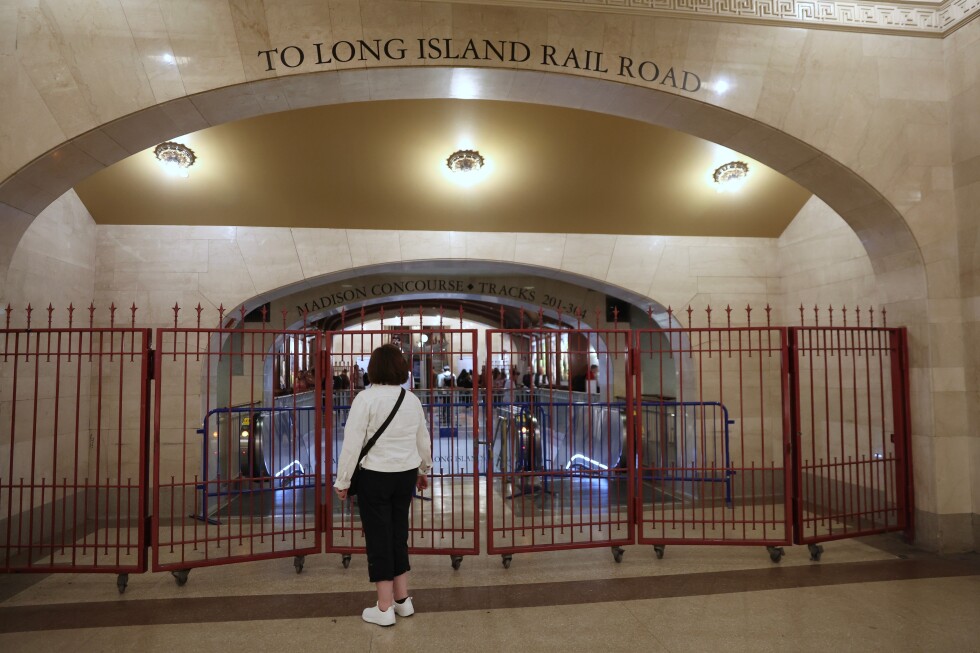
The shutdown has already transformed one of Manhattan’s busiest transit hubs: Penn Station, the LIRR’s central terminal located directly beneath Madison Square Garden, was eerily quiet over the weekend, stripped of its usual bustling crowds. Departure boards that usually list upcoming LIRR trips instead displayed entries for “ghost trains” marked “No Passengers,” barricades blocked access to LIRR platforms, and MTA police officers were posted throughout the concourse to direct displaced travelers to alternate transit options. Only a handful of travelers, most connecting to unaffected Amtrak intercity trains, moved through the usually crowded main hall Saturday afternoon. The strike also disrupted weekend leisure plans, throwing off travel for sports fans coming into Manhattan for New York Yankees and New York Mets baseball games and the New York Knicks’ playoff run at Madison Square Garden.
As policymakers and negotiators remain deadlocked, attention has already turned to the impact of a prolonged shutdown on weekday commutes. Roughly 250,000 passengers rely on the LIRR for daily travel between Long Island suburbs and New York City, and a continued shutdown would force most of these travelers onto the region’s already notoriously congested highways. The MTA has only been able to arrange limited shuttle bus service connecting Long Island communities to New York City subway stations, which officials acknowledge cannot come close to matching the LIRR’s regular capacity. To reduce crowding on alternate transit and roads, Hochul has called on all employers with LIRR-commuting staff to allow remote work starting Monday if at all possible. “It’s impossible to fully replace LIRR service. So effective Monday, I’m asking that regular commuters who can work from home, should. Please do so,” she said.
The shutdown has also sparked a high-profile political fight between incumbent Democratic Governor Kathy Hochul and former President Donald Trump. Hochul has blamed the Trump administration for cutting off mediation efforts early and pushing the talks toward a strike. Trump, who has already endorsed Republican-leaning Long Island politician Bruce Blakeman in his challenge to Hochul’s 2022 reelection bid, pushed back on his Truth Social platform, claiming he had no involvement in the lead-up to the strike. “No, Kathy, it’s your fault, and now looking over the facts, you should not have allowed this to happen,” Trump wrote. “If you can’t solve it, let me know, and I’ll show you how to properly get things done.”