标签: Europe

欧洲

  • UK government faces weeks of uncertainty over the prime minister’s future

    UK government faces weeks of uncertainty over the prime minister’s future

    LONDON – The United Kingdom has entered a period of prolonged political uncertainty, as embattled Prime Minister Keir Starmer confronts an open, high-stakes leadership challenge that has shaken the governing Labour Party just months after the party took power. The challenge is being led by Andy Burnham, the widely popular Greater Manchester mayor, who has laid out his intention to contest the top job but faces a critical barrier: he cannot formally launch his leadership bid until he secures a seat in the UK Parliament.

    Burnham’s path back to Westminster is anything but guaranteed. A Labour lawmaker from Northern England, Josh Simons, stepped down from his Makerfield constituency seat on Thursday specifically to clear a path for Burnham’s return. But the upcoming by-election will test Burnham’s political strength: the anti-immigrant Reform UK party delivered unexpectedly strong performances in last week’s local elections across the country, and the party is expected to mount a fierce campaign to seize the Makerfield seat.

    In a statement confirming his plan to run in the by-election, Burnham acknowledged the uphill battle ahead. “I truly do not take a single vote for granted and will work hard to regain the trust of people in the Makerfield constituency, many of whom have long supported our party but lost faith in recent times,” he said.

    The brewing leadership crisis has already sent ripples through global financial markets. On Friday, British government borrowing costs jumped, and the pound sterling weakened against the U.S. dollar, as investors reacted to fears of sustained political gridlock at the core of the UK government. For the week, the pound has fallen 1.4% against the greenback, marking one of its worst weekly performances this year.

    What began as weeks of behind-the-scenes speculation about Starmer’s future erupted into open rebellion within the Labour Party on Thursday. After Starmer led the party to disastrous results in last week’s local elections – losing right-leaning votes to Reform UK and left-leaning support to the Green Party – pressure for his resignation reached a breaking point. Burnham publicly confirmed his intention to seek the party leadership, and two other senior Labour figures have also begun positioning their own potential bids.

    The crisis deepened Thursday when Wes Streeting, the UK’s Health Secretary, became the first sitting Cabinet minister to resign in protest of Starmer’s leadership. In a scathing resignation letter, Streeting praised Starmer’s work on international affairs but said he had lost confidence in his ability to lead on domestic policy. “Where we need vision, we have a vacuum. Where we need direction, we have drift,” Streeting wrote. He added that Starmer’s heavy-handed crackdown on internal dissent had weakened the party, and that the prime minister had too often forced junior lawmakers to take blame for policy missteps instead of accepting responsibility himself. Streeting stopped short of declaring his own candidacy, instead calling on Starmer to step aside to allow a full, open contest for the leadership.

    Senior party moderates have now issued urgent calls to halt the leadership challenge, warning a divisive contest will derail the government’s policy agenda and hand a major political advantage to Reform UK. Housing Secretary Steve Reed, a close ally of Starmer, urged party members to pause the push for a leadership vote during an interview with the BBC on Friday. He argued that a drawn-out contest would prevent the government from addressing urgent national issues, most notably the ongoing cost of living crisis that remains the top concern for British voters.

    “This weekend people just need to take a breath, look at what’s gone wrong this week, and come back next week ready to do what we said we’d do — country first, party second — and focus on delivering the change we were elected to deliver,” Reed said.

    His appeal comes after a full week of relentless political jockeying that overshadowed all other government business in Westminster. Dozens of backbench Labour lawmakers have already publicly called for Starmer to step down, leaving the prime minister fighting to hold onto his position as the country faces economic uncertainty and growing political fragmentation across the ideological spectrum.

  • Claudine Longet, singer and actor at center of a notorious manslaughter trial, dies at 84

    Claudine Longet, singer and actor at center of a notorious manslaughter trial, dies at 84

    Claudine Longet, the Paris-born singer and actor whose life and career became intertwined with one of the most sensational public trials of the 20th century, has passed away at the age of 84. Her death was first announced Thursday in a heartfelt social media tribute from her nephew, Bryan Longet, who remembered her as a lasting personal inspiration, calling her “another star in the sky” when sharing the news. When contacted by The Associated Press via phone, Bryan Longet confirmed the death but declined to share any details about the cause of her passing.

    Longet began her performance career as a child performer in her native France before building a public profile in Hollywood and the American entertainment industry. Over the course of her career, she guest-starred on dozens of popular television series, released multiple studio albums including the charted hit LP *Claudine*, and earned widespread recognition for her bossa nova ballad “Nothing to Lose”—a standout track from the 1968 comedy film *The Party*, where she starred opposite legendary actor Peter Sellers.

    In the early 1960s, Longet met iconic American singer Andy Williams while performing as a dancer in a Las Vegas stage revue. The pair married and raised three children together before divorcing in the mid-1970s. Following her split from Williams, Longet relocated to a community near Aspen, Colorado, where she began a relationship with Vladimir “Spider” Sabich, a celebrated American alpine skier who had competed for the United States at the 1968 Winter Olympic Games.

    It was in that Aspen home that the event that would define Longet’s public legacy unfolded on March 21, 1976. Longet fatally shot Sabich, 31, in the abdomen with a vintage Luger pistol; she maintained from the beginning that Sabich had been showing her the weapon when the shot fired accidentally, and she accompanied Sabich in the ambulance to the local hospital as he received emergency care.

    The subsequent trial held in Aspen drew intense global media attention, turning a local criminal case into a worldwide tabloid sensation. Notably, Longet’s ex-husband Andy Williams stood by her throughout the proceedings: he escorted her to and from the courthouse every day, covered all her legal expenses, and publicly maintained his belief that the case against her was unjust and the shooting was an accidental tragedy, a position he reaffirmed in a 2009 interview with *CBS This Morning*.

    Longet was originally charged with reckless manslaughter, but a major procedural error by law enforcement—collecting a blood sample from Longet without a required search warrant—weakened the prosecution’s case. After four days of deliberation in January 1977, the jury found Longet guilty on the lesser charge of negligent homicide. Her sentence included two years of probation, a $250 fine, and a 30-day jail term that she was allowed to serve on a flexible schedule of her choosing.

    Despite the relatively lenient sentence, the trial and its surrounding media frenzy effectively ended Longet’s entertainment career. For years after the verdict, she became a target of public mockery in mainstream American pop culture: she was parodied in a sketch on *Saturday Night Live*, and the Rolling Stones even recorded an unreleased taunting track titled *Claudine* with the refrain “Claudine’s back in jail again.”

    After the trial, Longet married her lead defense attorney Ron Austin and remained a private resident of Aspen for the rest of her life. In 1977, Sabich’s family filed a $1.3 million wrongful death civil suit against Longet; the two parties reached an out-of-court settlement that included a permanent gag order, barring Longet from ever publicly discussing the 1976 shooting or the subsequent trial.

  • Death toll in attack on Kyiv apartment building now stands at 24

    Death toll in attack on Kyiv apartment building now stands at 24

    In a sharp escalation of hostilities that derails recent optimistic rhetoric of an impending end to the Russia-Ukraine war, Moscow has launched one of its largest aerial barrages since the full-scale invasion began, killing 24 civilians in a Kyiv apartment building strike and triggering reciprocal deadly drone attacks across Russian territory.

    Ukrainian President Volodymyr Zelenskyy confirmed the civilian death toll from Thursday’s cruise missile strike on a nine-story residential corner block in Kyiv on Friday, noting that three of the victims were teenagers. Two children were among the 48 people wounded in the attack, which came as part of Russia’s multi-day wave of large-scale assaults. After more than 24 hours of exhaustive search and rescue operations, emergency crews completed clearing the rubble of the destroyed building, according to an update Zelenskyy posted to the social platform X.

    The latest Russian offensive follows a three-day ceasefire initiative announced by former U.S. President Donald Trump, who claimed he had secured agreement from both Zelenskyy and Russian President Vladimir Putin to observe a halt to fighting between May 9 and 11. While active fighting did scale back during that 72-hour window, hostilities never fully paused. Within days of the ceasefire’s end, Russia renewed large-scale aerial attacks across Ukraine, contradicting recent public statements from both Trump and Putin that the nearly five-year-old war was moving toward a negotiated conclusion.

    Zelenskyy reported that between Wednesday and the end of Thursday, Russia had launched more than 1,560 drones targeting Ukrainian populated areas, with strikes damaging roughly 180 sites nationwide — more than 50 of which were civilian residential buildings. This barrage surpasses the previous record for the largest single Russian drone attack, which saw nearly 1,000 missiles and drones fired against Ukraine between March 23 and 24 this year. The missile that destroyed the Kyiv apartment block was manufactured in the second quarter of 2025, Zelenskyy added, citing preliminary analysis of missile wreckage by Ukrainian weapons experts. This new production, he emphasized, proves Russia continues to bypass international sanctions to import critical components, raw materials and manufacturing equipment for its weapons programs. “Stopping Russia’s sanctions evasion schemes must be a genuine priority for all our partners,” Zelenskyy wrote in a separate X post Thursday night.

    Kyiv declared an official day of mourning on Friday for the victims of the apartment strike, and Zelenskyy visited the blast site to meet with first responders and surviving residents.

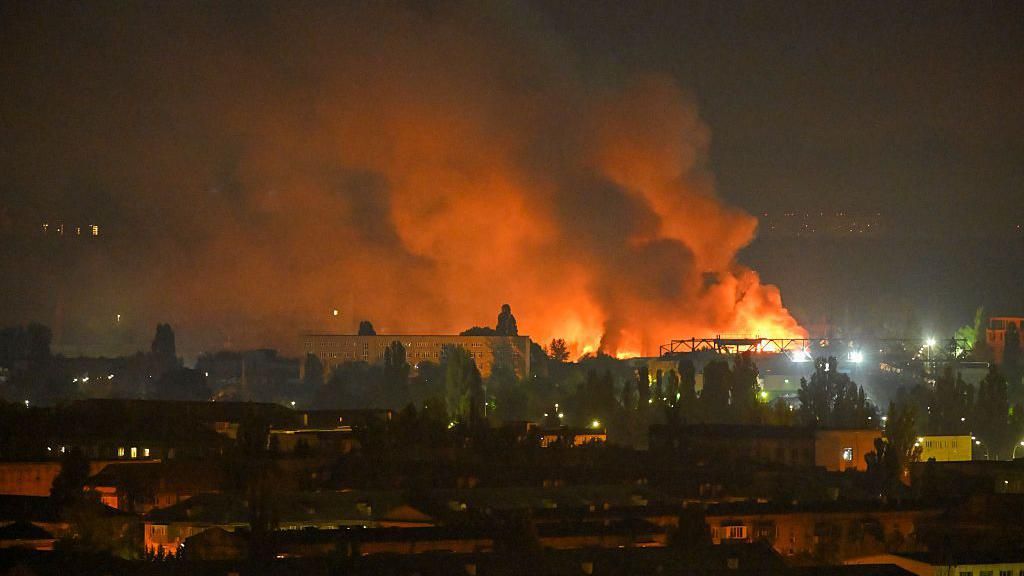
    The escalation has not been one-sided: Ukraine has significantly expanded its long-range strike capabilities in recent months, and overnight Friday Russia’s Ministry of Defense announced its air defense systems had intercepted 355 Ukrainian drones in a single night — marking one of the largest single drone attacks launched by Kyiv since the start of the full-scale invasion. The attack forced temporary flight suspensions at multiple Russian airports, and a Ukrainian drone strike on the city of Ryazan, located roughly 60 miles southeast of Moscow, left four people dead including one child, according to Ryazan Governor Pavel Malkov. The strike ignited a large fire at a local oil refinery that sent thick plumes of black smoke billowing into the air, consistent with Ukraine’s recent strategy of targeting Russian energy infrastructure to cut off critical export revenue that funds Moscow’s war effort and increase domestic pressure on the Kremlin. Ukrainian officials have not issued any immediate public comment on the Ryazan strike.

    Amid the spiraling violence, a rare diplomatic breakthrough brought a measure of positive development Friday: both countries confirmed a large prisoner of war exchange brokered with the assistance of the United Arab Emirates. A total of 205 prisoners from each side returned to their home countries Friday, in what Zelenskyy described as the first phase of a planned 1,000-for-1,000 swap. Many of the released Ukrainian prisoners had been held in Russian captivity since 2022, having fought in some of the war’s bloodiest and most protracted battles. Russia’s Defense Ministry officially confirmed the exchange and publicly thanked the UAE for its mediation work.

    This reporting is part of ongoing comprehensive coverage of the Russia-Ukraine war from the Associated Press, with additional contributions from correspondent Lorne Hatton reporting out of Lisbon, Portugal.

  • Animal welfare group finds systemic neglect at public dog shelters in Romania

    Animal welfare group finds systemic neglect at public dog shelters in Romania

    Across a network of publicly funded stray dog shelters scattered across Romania, an undercover investigation has pulled back the curtain on widespread abuse, neglect, and systemic failure that has left tens of thousands of animals suffering in life-threatening conditions. The probe, conducted between January 8 and 18 by Four Paws — the global animal welfare organization also known by its original name Vier Pfoten — sent hidden-camera investigators to nine shelters in different regions of the country, uncovering grim conditions that leaders of the investigation describe as a national crisis.

    Graphic footage captured inside one eastern Romanian compound shows a confined space enclosed by steel mesh: one dog struggles to lick ice from a frozen metal water bucket, while another chews apathetically on dried feces scattered across the unforgiving hard packed ground. Across all nine sites, investigators documented overcrowded kennels, dogs with untreated open festering wounds, and packs left exposed to subzero winter temperatures without insulation or heating. The report’s findings detail enclosures constantly caked in waste, overcrowding that sparks violent aggression and inter-dog fighting, and such extreme chronic stress that one dog was observed self-mutilating by biting off sections of its own tail.

    Even at one of the highest-quality facilities visited, a public shelter in western Romania’s Arad County, investigators found only cold concrete floors, no heated bedding, and no enrichment or toys for the hundreds of dogs held there. The organization did note that frontline staff at the facility worked diligently to improve outcomes and boost adoption rates, despite the systemic shortcomings that left them without resources to meet even basic animal welfare standards.

    Romania is home to an estimated 500,000 stray dogs, one of the largest unhoused canine populations in the entire European Union. Public and private shelters across the country hold thousands of these strays, where animals wait for potential adoption — or, in many cases, legal euthanasia. Four Paws’ investigation, however, found that most public shelters act as little more than holding facilities where dogs are confined to wait for death, with no access to the minimum standards of care required by international norms.

    Manuela Rowlings, a stray animal specialist with Four Paws, told the Associated Press that the problematic conditions uncovered are not isolated incidents of mismanagement, but the result of broken national policy that demands full systemic reform. “Public shelters are horrible places in Romania,” Rowlings said. “It’s simply places where dogs are locked up and where they wait to die, and they do not even receive the minimum care or minimum standards.”

    Beyond poor living conditions, the report also criticized most participating shelters for actively blocking adoption efforts, and freedom of information requests submitted by the organization revealed profound a lack of transparency around public funding, stray intake numbers, and official euthanasia statistics. To illustrate the scale of unreported mortality, Four Paws shared data from a northeastern Galati County shelter: of 644 strays admitted in 2024, only 134 were adopted, 28 were legally euthanized, and 412 died from what are listed as “other causes” — largely neglect and untreated illness.

    Worryingly, current Romanian law does not criminalize the poor conditions documented in the investigation, leaving activists with little recourse to hold facility operators accountable. “There is nothing that can be reported to the authorities, because it is not illegal to keep dogs in very, very poor conditions in the shelters,” Rowlings explained.

    The roots of Romania’s stray dog crisis stretch back more than a decade. In 2013, after a four-year-old boy was killed by a pack of strays in the capital city of Bucharest, national lawmakers passed a sweeping law that ordered mass roundups of stray dogs, requiring that any unadopted animal be euthanized 14 days after being taken into custody. But animal welfare advocates have long argued that targeted mass neutering is the only sustainable long-term solution to reduce the stray population humanely.

    So far, large-scale sterilization programs have failed to gain traction nationwide, and some insiders say that is no accident. Hilde Tudora, Director of Animal Protection at Ilfov County Council, told AP that the stray dog industry has become a profitable enterprise for private operators funded by public money, giving stakeholders an incentive to keep the population high rather than solving the crisis.

    “Private companies have swelled up with public money, and then it turned into a business,” Tudora said. “There must be dogs, because if you castrate en masse, there’s no more merchandise … No one really wants to solve the problem.”

    Recent legislative efforts aim to upend this status quo. A bill introduced to parliament in November 2024 would formally recognize animals as “living beings with rights and freedoms” and shift national policy away from mass euthanasia toward expanded sterilization and mandatory microchipping. Andrei Baciu, a National Liberal Party parliamentarian backing the bill, noted that Romania has spent more than 1.3 billion euros ($1.5 billion) on stray dog euthanasia over the past three decades. He pointed out that a single unsterilized pair of dogs can produce more than 67,000 puppies in just six years; capturing and euthanizing that entire resulting litter would cost roughly 13.4 million euros, a sum that could instead fund sterilization for more than 268,000 adult dogs.

    As of Tuesday, Romania’s National Sanitary Veterinary and Food Safety Authority, the government body that oversees animal welfare and shelter regulation, had not responded to AP requests for comment on the investigation’s findings.

  • How Eurovision pioneered transnational broadcasting

    How Eurovision pioneered transnational broadcasting

    As millions of music fans across the globe make their final preparations for the 2026 iteration of the Eurovision Song Contest, a brand new exhibition in the United Kingdom is pulling back the curtain on the seven-decade history of technical breakthroughs that transformed this iconic singing competition from a risky broadcast experiment into one of the world’s most watched live annual events.

    The very first Eurovision, held back in 1956 at Switzerland’s Teatro Kursaal in Lugano, was far from a simple production. In an era long before high-speed digital communications, engineers faced the unprecedented challenge of transmitting live video footage across Western Europe, navigating rugged mountain terrain, crossing multiple national borders, and working around incompatible domestic broadcasting systems using nothing more than microwave relay towers and early terrestrial transmission links.

    “It really was groundbreaking, because it was a really early example of a live simultaneous broadcast across Europe,” explained Sarah Rawlins, public programme developer at Bradford’s National Science and Media Museum and curator of the new exhibition. “Everyone in France and West Germany, Italy, they were all watching the same thing at the same time. When you think that was happening in 1956, that is actually remarkable that they had the technology to pull that off.”

    The foundational work for this cross-continental broadcast had already been laid years earlier, when the 1953 coronation of Queen Elizabeth II was transmitted across multiple European countries, Rawlins noted. That successful large-scale experiment proved both that there was widespread public appetite for shared pan-European television content and that transnational live broadcasting was technically achievable, clearing the way for the launch of Eurovision.

    Over the 70 years since that first contest, Eurovision has expanded dramatically from its original lineup of just 7 competing nations to the 35 countries that take part today. Alongside this growth, broadcast technology for the event has evolved continuously, adapting to rising global audience demand through shifts from early microwave transmission to satellite broadcasting, and more recently to high-speed digital fibre optic connections. That evolution has cemented Eurovision’s status as one of the world’s largest live broadcast events, with the 2025 contest drawing a global audience of more than 166 million viewers.

    The exhibition, titled *Setting the Stage: 70 Years of the Eurovision Song Contest*, traces this steady technological evolution step by step. Visitors can explore everything from the first satellite-broadcast contest in 1969 to behind-the-scenes time-lapse footage showing the rapid construction of the 2021 contest stage at Rotterdam Ahoy Arena in the Netherlands. The display also highlights Eurovision’s long history of driving industry-wide broadcast innovation: the contest hosted the first widespread color television broadcasts for a pan-European audience, launched the global career of iconic pop group ABBA with its 1974 competition, and pioneered the large-scale public televoting systems that remain a core part of the event today. That 1997 televoting trial also cemented one of Eurovision’s most iconic cultural phrases: “nul points.”

    While the exhibition’s central focus is the engineering and technology behind Eurovision’s global broadcast, it also dedicates space to the passionate global fan community that has sustained the competition for seven decades. “When you are talking about why it has been going for 70 years, a lot of it is down to the fans,” Rawlins said. “A lot of the time when we speak to fans, they talk a lot about their love of the competition, but also how it brings them together. I have spoken to a lot of people who have essentially made friends for life, and the community around Eurovision is a really big part of what they enjoy.”

    *Setting the Stage: 70 Years of the Eurovision Song Contest* will run at the National Science and Media Museum in Bradford until February 2027. Visitors can access additional related content on BBC Sounds and the BBC’s Look North regional news programme.

  • Finland’s hotly tipped Eurovision performance features flames, a valuable violin and a safety plan

    Finland’s hotly tipped Eurovision performance features flames, a valuable violin and a safety plan

    VIENNA — For every act competing at the Eurovision Song Contest, only 180 seconds stand between a relative unknown and global stardom. When 25 acts take the grand final stage in rapid succession on Saturday night, competitors need to pull out every creative trick — both musically and visually — to etch their performance into the memory of millions of watching viewers. This year, one of the clearest pre-contest favorites embodies this high-stakes approach: Finnish duo Pete Parkkonen, a chart-topping pop vocalist, and Linda Lampenius, a world-renowned classical violinist, have built a buzzy, ambitious entry that pairs genre-bending music with pyrotechnics, a priceless 18th-century instrument, and a secret team of backstage “ninjas” tasked with preventing disaster.

    The pair’s competing entry, *Liekinheitin* (translated as “Flamethrower”), has climbed to the top of fan polls and betting odds alike, winning over audiences with its seamless blend of catchy pop structure and virtuosic classical performance, paired with one of the most elaborate staging concepts of this year’s contest. To pull off the vision they set out to create, however, the duo had to overcome a major hurdle set by Eurovision’s official rules.

    Parkkonen and Lampenius describe their unique sound as “new pop with a classical touch.” Centered on a theme of all-consuming burning love, the track is a nonstop burst of energy: Parkkonen’s gritty, passionate vocals weave around Lampenius’ fast-paced, fiery violin playing, with each instrument acting as an equal narrative counterpoint to the other. To achieve that dynamic, the pair insisted that Lampenius play her violin live during the performance — a request that required special exception from Eurovision organizers.

    Eurovision’s standard rules mandate that all lead vocals must be performed live, but all instrumental tracks are pre-recorded to streamline quick changeovers between the 25 competing acts. Lampenius argued that the track was written as a true vocal-instrumental duet, where both performers carry equal narrative weight. “It’s a woman and a man, it’s a female voice and a male voice. So I do all my lyrics through my violin, by playing, and you [Parkkonen] are singing it with words. But we are talking. We are equally as important, both of us,” she explained.

    The Finnish delegation entered the contest in Vienna with no guarantee that organizers would approve their exception request. It was only after a successful live public rehearsal that the European Broadcasting Union (EBU), the governing body that oversees Eurovision, granted final approval. The EBU noted that contest rules explicitly allow for “live audio capture of instruments may exceptionally be permitted where artistically justified,” a provision that cleared the way for the duo’s vision.

    To prepare for all possible outcomes, Lampenius brought two violins to Vienna. The first is a coveted 1781 Gagliano violin, a rare, valuable antique that delivers the warm, rich tone needed for a perfect live performance. The second is an affordable, expendable backup instrument that would be used if the request was denied, eliminating any risk of damaging the priceless Gagliano during the performance’s pyrotechnic stunts.

    Months of rigorous rehearsal have prepared the duo for the grand final spotlight. They began preparing the act immediately after winning Finland’s national Eurovision selection contest in February, and have now run through the full performance hundreds of times, working out every detail of the high-risk choreography and staging.

    The performance builds to a dramatic climax: jets of flame burst from the central stage, where Lampenius stands in a flowing, billowing dress, the fabric fanned by a hidden leaf blower for extra visual drama as she plays her antique violin. Lampenius admits that the setup carries a small element of risk: “It’s a bit scary when you think of it,” she says. But what home viewers never see is the team of black-clad backstage stagehands the duo calls their “ninjas,” who are positioned offstage to keep Lampenius’ flowing dress clear of the open flames and guide her through the dynamic choreography.

    “They’re running with me — first one guy carrying my dress when I’m running, then the other one catching me during my run,” Lampenius explained. “And he helps me also when I jump up on the stage and do the pirouette.” Even Parkkonen takes on a hidden safety role: during the dramatic final pose, where Lampenius perches on stacked chairs in high heels with her violin held high, the pop singer keeps a close watch ready to catch her if she loses her balance and topples. “That’s my work,” Parkkonen said.

  • Brutal raid on woman’s birthday party highlights rise of Russian vigilante group

    Brutal raid on woman’s birthday party highlights rise of Russian vigilante group

    It was meant to be a celebration: Katya, a 30-year-old events organizer from the northern Russian city of Arkhangelsk, was moments away from blowing out the candles on her birthday cake at a rented nightclub when the attackers arrived. Dressed in masks, the group stormed the venue, launching a violent physical and verbal assault on Katya and her guests. “They called us faggots and lesbians. I could hear violence from every corner,” Katya recalled in an interview with BBC World Service’s investigative team. Her own mother, she added, was forced to get down on all fours during the attack.

    The raid was not the work of random thugs. It was coordinated by Russkaya Obshina, the largest and most active nationalist vigilante network in Russia, which operates to advance President Vladimir Putin’s political agenda of erasing Western liberal influences and cementing so-called traditional family values across the country. In a striking pattern documented by the investigation, local law enforcement officers joined the vigilantes during the operation.

    The group claimed the raid was carried out to search for evidence of illegal LGBT “propaganda,” a criminalized offense under Russian law. No such evidence was ever found, but Katya was still taken into custody for interrogation. Nine months after the attack, she was convicted of blasphemy, with the prosecution pointing to a single red neon light shaped like a crucifix hanging on the nightclub wall as evidence of her crime. She was sentenced to 200 hours of court-ordered community service.

    During her interrogation, Katya says a law enforcement officer told her she did not align with traditional Russian values and that there was “something wrong with her.” The case was amplified by local media and the group’s social media channels, triggering waves of severe online harassment that have left Katya living in constant fear. “For 10 years, I lived in a certain rhythm. It made me happy, it was my life. What do you feel when a part of you is taken away? You feel loss,” she told the BBC. Despite the risk of further targeting, Katya chose to share her story to expose the group’s tactics.

    Over 12 months of reporting, the BBC World Service spoke to six current and former members of Russkaya Obshina, as well as dozens of people harmed by the group’s actions. The investigation, which also incorporated analysis of more than 21,000 social media posts from the group’s public channels between 2020 and 2025, paints a clear picture of a rapidly expanding movement of ideologically driven nationalist and religious activists who carry out coordinated raids on private businesses, event venues, migrant communities, abortion clinics and other spaces they claim violate their strict traditional worldview. After launching their raids, the group pressures law enforcement to prosecute their targets.

    Migrants are among the group’s most frequent targets: the BBC’s analysis found that one in four of the group’s social media posts focus on migrants, and often include virulent racist language. In videos posted online, group members can be seen confronting migrants at their workplaces and public spaces, publicly accusing them of criminal activity.

    When contacted by the BBC for comment, Russkaya Obshina did not directly respond to the investigation’s specific claims, instead disputing the BBC’s ability to contact current and former members. “Even though Russkaya Obshina is an informal community of people, with no legal entity and no formal membership, the BBC’s great thinkers have somehow ‘found’ former and current members of the Obshina… If you grab anyone off the street and call them a member of the Obshina, you can put any nonsense you like into their mouth,” the group said in a social media post addressing the investigation.

    One former member, a wounded ex-soldier who left the group just two months before the BBC’s interview and asked to be identified only as Dimitry, fits the profile of many members. After returning from the front lines in Ukraine, he said he joined the group to find a new sense of purpose, channeling his military training into what he frames as defending Russian culture from “foreign intrusion.” “People from other cultures come in and Russkaya Obshina responds like an antibody, stopping them harming the organism. You could say Russkaya Obshina is like a kind of doctor,” he explained.

    The group has received explicit backing from influential Russian institutions. Last year, the Russian Orthodox Church, a close political ally of the Putin government, formally advised all of its bishops to build partnerships with Russkaya Obshina, codifying existing informal ties and granting the unregistered vigilante group greater public legitimacy.

    Political analysts broadly agree that the group could not operate at its current scale without implicit approval from the Kremlin. For years, the Russian government has framed the country as a guardian of traditional conservative values in contrast to Western liberalism, a policy that hardened dramatically after Putin launched the full-scale invasion of Ukraine in February 2022. In November 2022, Putin signed a formal decree dedicated to preserving “traditional Russian spiritual and moral values” nationwide. Russkaya Obshina has been a vocal supporter of the war in Ukraine, and in December 2024, the group formed a joint military unit deployed to the front lines alongside the far-right Espanola brigade, which has already been sanctioned by the UK government.

    Contrary to the group’s claims that it operates without formal financial backing, documents reviewed by the BBC’s investigative unit BBC Eye link the network to funding from two high-profile figures with close ties to the Kremlin, routed through multiple charitable foundations. The first major funder identified in the documents is a foundation run by Igor Khudokormov, a Russian sugar magnate whose agriculture conglomerate Prodimex is a leading Russian food producer and a major trading partner with the European Union, according to U.S. trade data. Khudokormov has close personal ties to Deputy Prime Minister Dmitry Patrushev, son of former Federal Security Service director Nikolai Patrushev, a core member of Putin’s inner circle.

    Tom Keatinge, a finance and security expert at the UK-based Royal United Services Institute, said that Khudokormov’s backing of a group engaged in human rights abuses and military activity in Ukraine raises urgent questions for European companies and governments that trade with his firm. “Do you want… a Russian company providing critical materials into the food chain, especially [one run by someone]… funding the sort of activity he’s funding? That’s a question governments and companies have to answer,” Keatinge said. Khudokormov did not respond to the BBC’s request for comment.

    The second funder named in the documents is Sergei Mikheev, a prominent pro-Kremlin media commentator who has reportedly collaborated with the Kremlin and Russian intelligence on election campaigns across former Soviet states. Mikheev denied the claim, telling the BBC, “The charitable foundation I established, the ‘Sergei Mikheev Charity Foundation,’ has never transferred any funds to Russkaya Obshina. Any documents allegedly confirming this are fake.”

    The BBC’s analysis of the group’s social media content found that the first recorded raid was carried out in May 2023. Between that date and the end of 2025, the group documented more than 900 raids across Russia, with local law enforcement joining roughly 300 of those operations. Reporters note the total number is almost certainly an undercount, as the group does not publicize all of its activity on public channels. To map the activity of Russian nationalist groups, the BBC built a custom multi-agent AI system, which cross-analyzed social media content from more than 10 similar nationalist networks, finding that Russkaya Obshina maintains a far larger street-level presence than any comparable group.

    While Russkaya Obshina has attempted to frame itself as part of Russia’s official network of registered civilian patrol groups that assist police with public order, the group remains unregistered, despite police participation in its raids. Sergei Ognerubov, who leads a registered civilian patrol in St. Petersburg that has allowed some Russkaya Obshina members to join his organization, criticized the group for its unregulated, extralegal tactics. “If you want to tackle migration, join us and do it legally. Simply running into some market in masks isn’t fighting migration – that’s more like petty hooliganism,” he said.

    Alexander Verkhovsky, a Moscow-based researcher focused on Russia’s far right, noted that the group’s extralegal intimidation tactics themselves violate Russian law, despite its claims to uphold order. “Russkaya Obshina – which claims to uphold law and order – mainly operates through intimidation which is itself illegal” in this context, he said.

    In response to the BBC’s investigation, the Russian Embassy in London defended the group, saying “The broad public support [Russkaya Obshina] enjoys reflects the… growth of interest in national culture and historical traditions” and “it would appear that… civic engagement in Russia provokes irritation among those who seek to denigrate and discredit our country.”

    For Katya, the consequences of the raid have been irreversible. She has stopped hosting the alternative community events that defined her career and personal life for a decade, and her daily routine remains upended by the harassment and conviction. Today, she lives with constant fear of further targeting, but remains one of the few voices willing to publicly speak out about the vigilante network’s growing power.

  • UK Eurovision act: The BBC gave me a stress test to check I could cope under pressure

    UK Eurovision act: The BBC gave me a stress test to check I could cope under pressure

    As the 70th Eurovision Song Contest prepares to crown its 2026 winner in Vienna this Saturday, all eyes are turning to the United Kingdom’s unorthodox representative: inventor and cult musician Sam Battle, better known by his stage name Look Mum No Computer. Where many contestants enter the global competition hungry for a win, Battle brings a laid-back, devil-may-care attitude that defies the typical pressure of Eurovision’s spotlight.

    With bookmakers placing Battle at 150/1 odds of taking home the trophy, the 37-year-old creative says he is fully prepared for any outcome, leaning into the adage that confidence means being comfortable with losing. “It could go well or completely wrong – I’m just here for the ride,” he says. Even in the worst-case scenario of a zero-point finish, he has already leaned into the joke, joking that he’s got a “Look mum, no points” t-shirt ready to go.

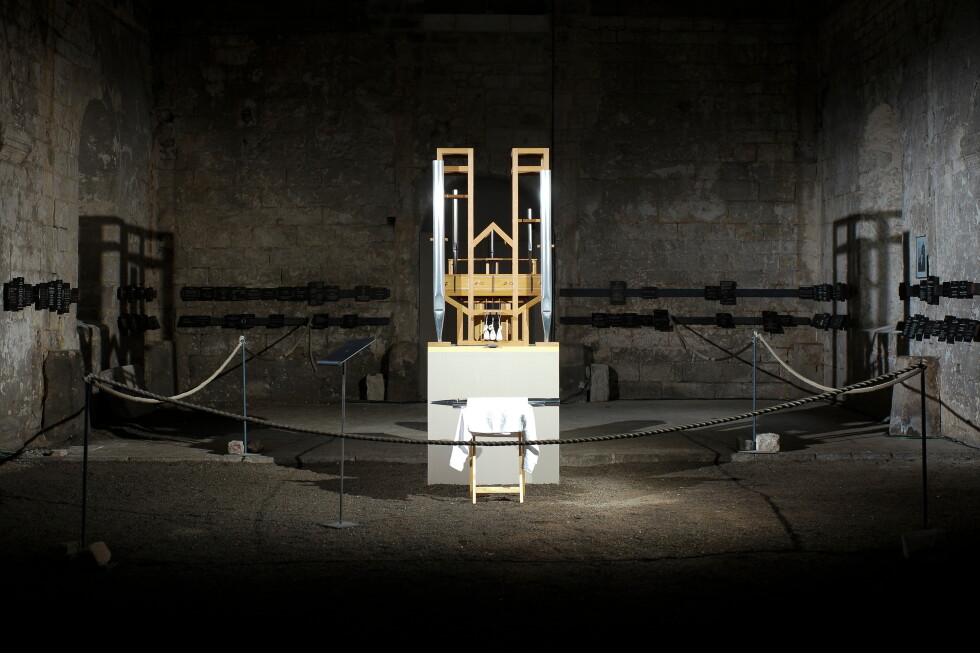
    For Battle, Eurovision is far from a make-or-break career milestone. Long before he was tapped to represent the UK, he had built a thriving, eccentric creative career centered on his passion for repurposed audio technology. A cult favorite in experimental electro-pop circles, he is known for building functional synthesisers out of unexpected objects ranging from old bicycles to retro Speak-and-Spell machines. His YouTube channel boasts 700,000 loyal subscribers who tune in to watch his madcap projects: everything from modifying vintage cars to restoring decaying 19th-century church organs, all delivered with the manic, infectious energy that has drawn comparisons to Back to the Future’s eccentric inventor Doc Brown. Off-camera, Battle runs a unique museum in Ramsgate, Kent, dedicated to restoring and exhibiting forgotten vintage audio gear. Just four weeks before the Eurovision grand final, he added a new role to his packed resume: first-time dad to a baby boy named Max.

    What many fans don’t know is that Battle’s Eurovision journey started as a random pub joke with a friend. “We were sitting in a pub saying, wouldn’t it be hilarious if we tried to get into Eurovision?” he recalls. The throwaway joke quickly snowballed: his manager emailed the BBC to ask about the application process, and producers, intrigued by Battle’s one-of-a-kind persona, asked him to submit an original track.

    Battle agreed to join a songwriting writing camp on one non-negotiable condition: he had to be allowed to bring Kosmo, his custom-built synthesiser and drum machine that requires six separate flight cases to transport. It was a casual moment while moving furniture that ultimately gave birth to his entry: a cheeky, 1980s-inspired pop anthem titled *Eins, Zwei, Drei*. As he shifted a sofa to make space for Kosmo, he counted out “Eins, Zwei, Drei” to coordinate the lift – and the team immediately knew they had their song title. Twelve hours later, the track was finished: a playful, high-energy number about quitting a boring office job to take a spontaneous mini-break in Germany. “We all thought it would never get picked,” Battle says. The very next morning, the BBC called to say they loved the track’s zany, unapologetic charm, and after a final audition to confirm he could perform live, Battle was officially named the UK’s 2026 representative.

    During rehearsals in Vienna, Battle’s boundless curiosity for all things mechanical was on full display during a visit to the city’s Museum of Science and Technology, where he wandered through an exhibition of early synthesisers and mechanical instruments like a kid let loose in a candy factory. He impressed museum staff with his deep, encyclopedic knowledge of the obscure gear, pointing out the Mellotron organ that created the iconic texture on The Beatles’ *Strawberry Fields Forever*, and demonstrating the Roland CR-78 drum machine that kicks off Blondie’s *Heart of Glass*. “He’d be a fantastic tour guide – he knows more about these machines than we do,” the museum’s curator said. It took a spontaneous detour to a Eurovision karaoke booth, where Battle ripped through a falsetto version of ABBA’s *Waterloo* and did the full choreography for 2025’s viral hit *Espresso Macchiato*, before the pair could sit down to discuss his upcoming performance.

    Battle is the first to admit he’s no polished Eurovision performer: “I’m literally not a dancer. I’ve got two left feet,” he laughs, but says he’s fully embracing the challenge. His performance, choreographed by Fredrik “Benke” Rydman – the creative mind behind 2024 winner Nemo’s winning staging – leans into Battle’s hyperactive, chaotic energy. The set opens with Battle trapped in the monotony of a soul-crushing office job, before he breaks free and transforms the drab set into a flashing, buzzing electronic carnival, with dancers wearing fur-lined television sets as headgear. Battle built most of the stage props himself, including oversized custom synth panels, drilling hundreds of holes in the process. He had to scrap one idea – adding a real car to the set – when he learned the stage’s glass LED floor had a strict 500kg weight limit for all props.

    Battle is well aware of the UK’s poor recent track record at Eurovision: outside of Sam Ryder’s surprise second-place finish in 2022, the UK has not placed in the top 10 for more than 15 years, and earned exactly zero points in both 2024 and 2025. The BBC, he says, prepared him for the potential public scrutiny that comes with the role, even putting him through a stress test to make sure he could handle the pressure.

    Right now, the only thing keeping him up at night is the fear he’ll trip on stage and embarrass himself. Still, when pressed, he admits there’s a small part of him hoping the audience connects with his unconventional act. “What we’re doing is Marmite – you either love it or hate it – but I think there’s a slot open for our sort of thing,” he says.

    But even if the contest doesn’t go his way, Battle has already lined up his next priority: immediately after the grand final wraps up Saturday night, he’s flying straight home to resume his new favorite job: changing nappies for his newborn son Max. For Sam Battle, no matter what the scoreboard says, Eurovision is already a win.

  • Australia soars into Eurovision final as UK song debuts

    Australia soars into Eurovision final as UK song debuts

    The 2026 Eurovision Song Contest’s second semi-final wrapped up in Vienna Thursday night, with Australian pop superstar Delta Goodrem delivering a show-stopping performance that secured her spot in the grand final and catapulted her to the top of the competition’s odds rankings. Now the second most likely contender to take home the Eurovision trophy, Goodrem is quickly closing the gap on long-standing favorite Finland, raising the prospect of a historic first win for the non-European nation that has become a beloved staple of the annual contest.

    Australia first joined Eurovision in 2015 as a one-off wildcard invite, but the contest’s massive popularity Down Under—where more than one million viewers tune in annually—turned the guest appearance into a permanent spot. A win on Saturday would mark an unprecedented milestone for the country. Goodrem, one of Australia’s best-selling female artists who earned early fame for her role on the long-running soap opera *Neighbours* familiar to UK audiences, signed her first recording contract at 15 and has already notched four number-one studio albums. Reflecting on her Eurovision journey after the semi-final, she told the BBC, “This experience has been surprisingly beautiful. To see people flying flags for music and standing with us has been an absolutely awesome thing to witness.”

    Goodrem’s semi-final staging leaned into understated sophistication rather than the over-the-top gimmicks many Eurovision acts embrace: she performed her power ballad *Eclipse* against a minimalist backdrop centered on a glowing crescent moon, saved only one subtle surprise for the performance’s closing moment. The show-stopping turn has already shifted contest dynamics, with bookmakers now ranking her just behind Finland in win odds.

    Goodrem was one of 10 acts to advance from the second semi-final to the 25-act grand final, which will air live Saturday night. The full list of second semi-final qualifiers joining her are Albania’s Alis with *Nân*, Bulgaria’s Dara with *Bangaranga*, Cyprus’s Antigoni with *Jalla*, Czechia’s Daniel Zizka with *Crossroads*, Denmark’s Søren Torpegaard Lund with *Før Vi Går Hjem*, Malta’s Aidan with *Bella*, Romania’s Alexandra Căpitănescu with *Choke Me*, Ukraine’s Leléka with *Ridnym*, and Norway’s Jonas Lovv with *Ya Ya Ya*. Five nations—Azerbaijan, Luxembourg, Armenia, Switzerland, and Latvia—were eliminated from contention in the 2026 contest, and will return to compete in 2027.

    The semi-final was packed with memorable, and in some cases controversial, performances from across the continent. Opening the night, Bulgarian singer Dara delivered a high-energy set brimming with dynamic chair choreography and fierce performance energy for her track *Bangaranga*. Though the title may read like playful nonsensical Eurovision fare, the 27-year-old artist explained the song explores “being bold” and opening up about her personal battle with anxiety. Her energetic staging has already positioned her as a potential top 10 contender for the grand final.

    Romania’s Căpitănescu entered the semi-final already facing controversy over her brooding rock track *Choke Me*. Campaigners had previously criticized the song for allegedly glorifying sexual violence, but Căpitănescu clarified the lyrics actually address the feeling of suffocating under unforgiving societal expectations. She visualized this struggle in her staging, straining against two oversized neon ropes tied to her bodice. In an unexpected coincidence, rope became a recurring theme of the night: Azerbaijan’s Jiva portrayed escaping a toxic relationship by fighting against physical restraints during her performance, while Switzerland’s Veronica Fusaro was entangled in a web of blood-red rope for *Alice*, her track confronting the trauma of stalking and abuse. Despite strong critical reception for both sets, neither accumulated enough votes to advance to the final. Fusaro did earn widespread praise for a blistering guitar solo that capped off her performance.

    The UK’s 2026 entry, Look Mum No Computer, automatically qualified for the grand final as part of the “Big Five” — the UK, France, Germany, and Italy (the Big Four) plus host nation Austria, all of whom receive automatic final spots due to their largest financial contributions to the European Broadcasting Union, which organizes Eurovision. The UK act delivered a dynamic, high-concept set, opening at an office desk before moving into a surreal, colorful landscape of exposed circuit boards and robotic dancers. The performance split opinion on social media: “UK might actually get some points this year,” Threads user Dan wrote, with commentator Karen Robinson agreeing, “He brought so much energy and real personality to the stage.” But other critics were less impressed, with a Reddit user deriding the staging as a man “huffing and puffing around an exam hall,” and Bluesky user C Grinbergs lamenting, “I don’t think it’s our year.”

    More upbeat, lighter moments came from other contestants: Antigoni, a London-based artist representing Cyprus, brought a danceable party anthem *Jalla* (translated “And More”) that blended belly dancing choreography with traditional Cypriot instrumentation, drawing obvious comparisons to global pop star Shakira. Malta’s Aidan brought warm Mediterranean energy to his tender love ballad *Bella*, while France’s Monroe offered a reflective operatic chanson *Regarde!* that encouraged audiences to pause and appreciate the beauty of the world around them. Closing out the semi-final was Norway’s Lovv with *Ya Ya Ya*, a raucous, foot-stomping rock track that echoes the sound of 2021 Eurovision champions Måneskin. The track has already become a streaming hit, racking up more than four million plays across YouTube and Spotify. Lovv made headlines earlier in the week after contest organizers asked him to tone down what they described as overly sexualized choreography during rehearsals. Laughing off the criticism, he said, “I don’t know what they are talking about! I’m the least sexual person in the whole delegation.” For the semi-final, he compromised by swapping his original hip thrust choreography for a playful cheeky wiggle, much to the audience’s amusement.

    The 10 second semi-final qualifiers will join 10 acts that advanced from the first semi-final earlier this week—Belgium, Croatia, Finland, Greece, Lithuania, Moldova, Poland, Serbia, and Sweden—in the grand final. They will be joined by automatic qualifiers the UK, Italy, Germany, France, and host nation Austria, for a total of 25 competing acts. UK audiences can tune into the grand final live starting at 8pm BST on Saturday via BBC One, BBC iPlayer, Radio 2, and BBC Sounds, with full live coverage and analysis available on the BBC News website. Fans can also download a printable Eurovision score card from the website to track their own rankings of the finalists ahead of the winner announcement.

  • The Eurovision final lineup is confirmed after 5 more countries are sent packing

    The Eurovision final lineup is confirmed after 5 more countries are sent packing

    VIENNA — The final lineup for the 2025 Eurovision Song Contest has been locked in, following the conclusion of the second semi-final that saw five competing nations eliminated from the pan-continental pop competition on Thursday night.

    Fifteen competing acts took the stage in the second semi-final, fighting for 10 remaining spots in the 25-act grand final scheduled for Saturday. Advancement to the final was determined by a combined vote of national juries and public viewers from across participating countries.

    Qualifiers advancing to the grand final include Denmark’s Søren Torpegaard Lund with his soulful, moody entry “Før Vi Går Hjem” (Before We Go Home), Australian global star Delta Goodrem with her soaring power ballad “Eclipse”, and Bulgarian pop artist Dara with the upbeat, infectious track “Bangaranga.” Rounding out the second semi-final’s qualifying acts are Daniel Žižka of Czechia, Leléka of Ukraine, Alis of Albania, Aidan of Malta, Antigoni of Cyprus, Alexandra Căpitănescu of Romania, and Jonas Lovv of Norway. Eliminated acts from the semi-final represent Azerbaijan, Luxembourg, Armenia, Switzerland and Latvia.

    The 10 remaining finalists secured their spots in the competition during the first semi-final held on Tuesday. This group includes Finnish performers Pete Parkkonen and Linda Lampenius, Greek rapper Akylas, Serbian goth metal outfit Lavina, Moldovan folk-rap fusion artist Satoshi, and Israeli singer Noam Bettan. Like all past winners and the largest financial backers of the contest, the 2024 champion Austria automatically claims a spot in the final as this year’s host nation, alongside the so-called “Big Five” funders: the United Kingdom, France, Germany and Italy, who also bypass the semi-final round.

    While the competition’s official 2025 motto is “United by Music”, with a stated mission to bring European nations together through art beyond political divides, the event has once again become the center of heated political tensions that have overshadowed much of the lead-up to Saturday’s final. The contest has a long history of navigating geopolitical friction: Russia was fully expelled from the competition in 2022 following its full-scale invasion of Ukraine, a move that mirrored growing global condemnation of the Kremlin’s military campaign.

    The 2024 contest hosted in Malmo, Sweden and the 2023 event in Basel, Switzerland were both disrupted by large pro-Palestinian protests demanding Israel’s expulsion from the contest over its ongoing military campaign against Hamas in Gaza. Organizers confirm a new demonstration against Israel’s participation is planned to take place ahead of Saturday’s grand final in the Vienna arena.

    This year, five nations — Spain, Ireland, the Netherlands, Slovenia and Iceland — have launched a full boycott of the 2025 contest in direct protest of Israel’s inclusion. This boycott has delivered a tangible financial and audience hit to the iconic event. Last year, Eurovision organizers reported a global viewership of 166 million people, and the absence of five major national broadcasters means both reduced revenue from participation fees and lower overall viewership this year. While Bulgaria, Moldova and Romania have returned to the competition after sitting out recent editions for artistic or financial reasons, 2025 still has the smallest number of participating countries since 2003.

    Beyond the protests, Israel has also faced formal accusations of violating contest rules with an organized off-platform marketing campaign designed to coordinate mass votes for its entrant. In response to the allegations, the European Broadcasting Union (EBU), the governing body that oversees Eurovision, updated and tightened contest voting rules ahead of this year’s event. The new rules cut the maximum number of votes per viewer in half to 10, and added enhanced monitoring systems to flag and disqualify “suspicious or coordinated voting activity.”

    When Israeli entrant Noam Bettan performed during Tuesday’s first semi-final, his set was interrupted by scattered protest chants from audience members. In a break from past event protocols, Austrian host broadcaster ORF has confirmed Palestinian flags will be permitted inside the competition arena, and the network will not mute audience booing for broadcast, a policy designed to preserve the live nature of the event even amid tension.

    Despite the ongoing challenges and boycotts, Eurovision leadership remains focused on long-term growth and reconciliation. The contest is already scheduled to launch its first official Asian spin-off, Eurovision Song Contest Asia, which will hold its inaugural edition in Bangkok this coming November. Contest director Martin Green also shared Thursday that he is optimistic about the return of Hungary, which has not participated in Eurovision since 2019, following the replacement of nationalist-populist former Prime Minister Viktor Orbán by new Prime Minister Péter Magyar.

    Green emphasized that the competition remains open to the five boycotting nations, adding that organizers are eager to welcome them back to future editions of the contest. “We’ve made it very clear to them we can’t wait for them to come back,” Green said.