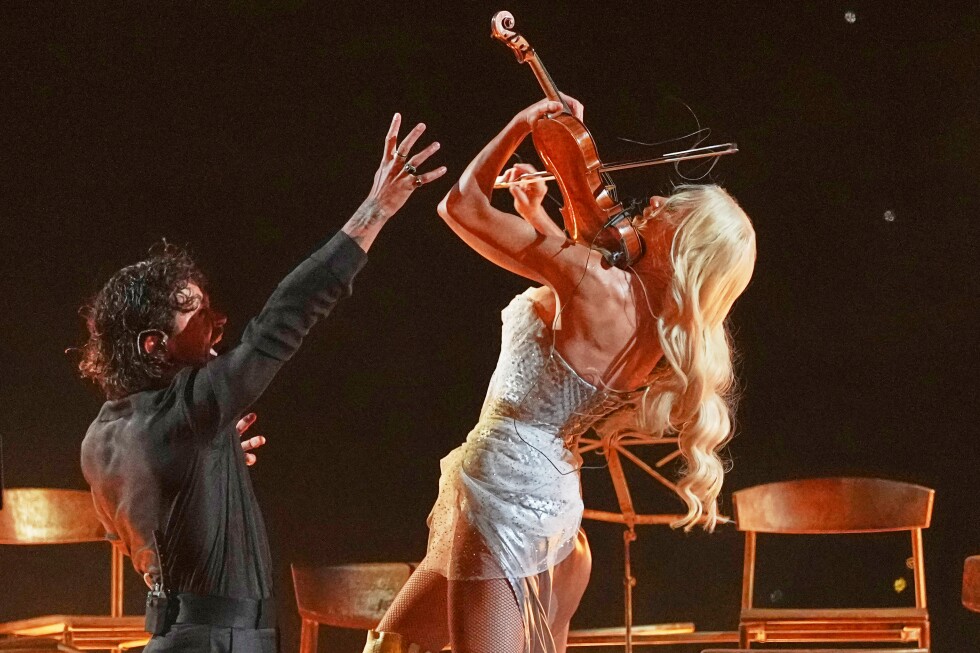
VIENNA — For every act competing at the Eurovision Song Contest, only 180 seconds stand between a relative unknown and global stardom. When 25 acts take the grand final stage in rapid succession on Saturday night, competitors need to pull out every creative trick — both musically and visually — to etch their performance into the memory of millions of watching viewers. This year, one of the clearest pre-contest favorites embodies this high-stakes approach: Finnish duo Pete Parkkonen, a chart-topping pop vocalist, and Linda Lampenius, a world-renowned classical violinist, have built a buzzy, ambitious entry that pairs genre-bending music with pyrotechnics, a priceless 18th-century instrument, and a secret team of backstage “ninjas” tasked with preventing disaster.
The pair’s competing entry, *Liekinheitin* (translated as “Flamethrower”), has climbed to the top of fan polls and betting odds alike, winning over audiences with its seamless blend of catchy pop structure and virtuosic classical performance, paired with one of the most elaborate staging concepts of this year’s contest. To pull off the vision they set out to create, however, the duo had to overcome a major hurdle set by Eurovision’s official rules.
Parkkonen and Lampenius describe their unique sound as “new pop with a classical touch.” Centered on a theme of all-consuming burning love, the track is a nonstop burst of energy: Parkkonen’s gritty, passionate vocals weave around Lampenius’ fast-paced, fiery violin playing, with each instrument acting as an equal narrative counterpoint to the other. To achieve that dynamic, the pair insisted that Lampenius play her violin live during the performance — a request that required special exception from Eurovision organizers.
Eurovision’s standard rules mandate that all lead vocals must be performed live, but all instrumental tracks are pre-recorded to streamline quick changeovers between the 25 competing acts. Lampenius argued that the track was written as a true vocal-instrumental duet, where both performers carry equal narrative weight. “It’s a woman and a man, it’s a female voice and a male voice. So I do all my lyrics through my violin, by playing, and you [Parkkonen] are singing it with words. But we are talking. We are equally as important, both of us,” she explained.
The Finnish delegation entered the contest in Vienna with no guarantee that organizers would approve their exception request. It was only after a successful live public rehearsal that the European Broadcasting Union (EBU), the governing body that oversees Eurovision, granted final approval. The EBU noted that contest rules explicitly allow for “live audio capture of instruments may exceptionally be permitted where artistically justified,” a provision that cleared the way for the duo’s vision.
To prepare for all possible outcomes, Lampenius brought two violins to Vienna. The first is a coveted 1781 Gagliano violin, a rare, valuable antique that delivers the warm, rich tone needed for a perfect live performance. The second is an affordable, expendable backup instrument that would be used if the request was denied, eliminating any risk of damaging the priceless Gagliano during the performance’s pyrotechnic stunts.
Months of rigorous rehearsal have prepared the duo for the grand final spotlight. They began preparing the act immediately after winning Finland’s national Eurovision selection contest in February, and have now run through the full performance hundreds of times, working out every detail of the high-risk choreography and staging.
The performance builds to a dramatic climax: jets of flame burst from the central stage, where Lampenius stands in a flowing, billowing dress, the fabric fanned by a hidden leaf blower for extra visual drama as she plays her antique violin. Lampenius admits that the setup carries a small element of risk: “It’s a bit scary when you think of it,” she says. But what home viewers never see is the team of black-clad backstage stagehands the duo calls their “ninjas,” who are positioned offstage to keep Lampenius’ flowing dress clear of the open flames and guide her through the dynamic choreography.
“They’re running with me — first one guy carrying my dress when I’m running, then the other one catching me during my run,” Lampenius explained. “And he helps me also when I jump up on the stage and do the pirouette.” Even Parkkonen takes on a hidden safety role: during the dramatic final pose, where Lampenius perches on stacked chairs in high heels with her violin held high, the pop singer keeps a close watch ready to catch her if she loses her balance and topples. “That’s my work,” Parkkonen said.