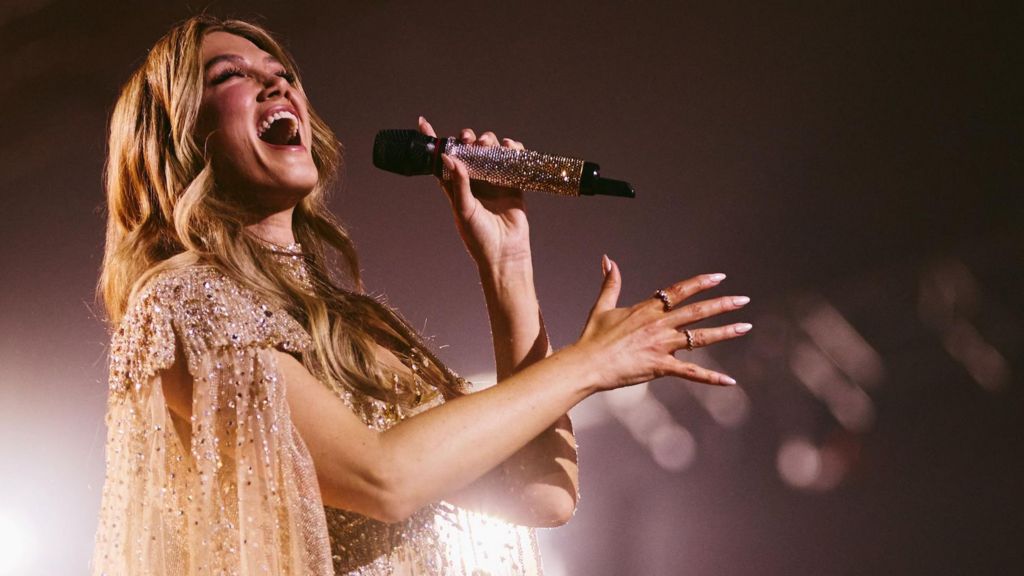
The 2026 Eurovision Song Contest’s second semi-final wrapped up in Vienna Thursday night, with Australian pop superstar Delta Goodrem delivering a show-stopping performance that secured her spot in the grand final and catapulted her to the top of the competition’s odds rankings. Now the second most likely contender to take home the Eurovision trophy, Goodrem is quickly closing the gap on long-standing favorite Finland, raising the prospect of a historic first win for the non-European nation that has become a beloved staple of the annual contest.
Australia first joined Eurovision in 2015 as a one-off wildcard invite, but the contest’s massive popularity Down Under—where more than one million viewers tune in annually—turned the guest appearance into a permanent spot. A win on Saturday would mark an unprecedented milestone for the country. Goodrem, one of Australia’s best-selling female artists who earned early fame for her role on the long-running soap opera *Neighbours* familiar to UK audiences, signed her first recording contract at 15 and has already notched four number-one studio albums. Reflecting on her Eurovision journey after the semi-final, she told the BBC, “This experience has been surprisingly beautiful. To see people flying flags for music and standing with us has been an absolutely awesome thing to witness.”
Goodrem’s semi-final staging leaned into understated sophistication rather than the over-the-top gimmicks many Eurovision acts embrace: she performed her power ballad *Eclipse* against a minimalist backdrop centered on a glowing crescent moon, saved only one subtle surprise for the performance’s closing moment. The show-stopping turn has already shifted contest dynamics, with bookmakers now ranking her just behind Finland in win odds.
Goodrem was one of 10 acts to advance from the second semi-final to the 25-act grand final, which will air live Saturday night. The full list of second semi-final qualifiers joining her are Albania’s Alis with *Nân*, Bulgaria’s Dara with *Bangaranga*, Cyprus’s Antigoni with *Jalla*, Czechia’s Daniel Zizka with *Crossroads*, Denmark’s Søren Torpegaard Lund with *Før Vi Går Hjem*, Malta’s Aidan with *Bella*, Romania’s Alexandra Căpitănescu with *Choke Me*, Ukraine’s Leléka with *Ridnym*, and Norway’s Jonas Lovv with *Ya Ya Ya*. Five nations—Azerbaijan, Luxembourg, Armenia, Switzerland, and Latvia—were eliminated from contention in the 2026 contest, and will return to compete in 2027.
The semi-final was packed with memorable, and in some cases controversial, performances from across the continent. Opening the night, Bulgarian singer Dara delivered a high-energy set brimming with dynamic chair choreography and fierce performance energy for her track *Bangaranga*. Though the title may read like playful nonsensical Eurovision fare, the 27-year-old artist explained the song explores “being bold” and opening up about her personal battle with anxiety. Her energetic staging has already positioned her as a potential top 10 contender for the grand final.
Romania’s Căpitănescu entered the semi-final already facing controversy over her brooding rock track *Choke Me*. Campaigners had previously criticized the song for allegedly glorifying sexual violence, but Căpitănescu clarified the lyrics actually address the feeling of suffocating under unforgiving societal expectations. She visualized this struggle in her staging, straining against two oversized neon ropes tied to her bodice. In an unexpected coincidence, rope became a recurring theme of the night: Azerbaijan’s Jiva portrayed escaping a toxic relationship by fighting against physical restraints during her performance, while Switzerland’s Veronica Fusaro was entangled in a web of blood-red rope for *Alice*, her track confronting the trauma of stalking and abuse. Despite strong critical reception for both sets, neither accumulated enough votes to advance to the final. Fusaro did earn widespread praise for a blistering guitar solo that capped off her performance.
The UK’s 2026 entry, Look Mum No Computer, automatically qualified for the grand final as part of the “Big Five” — the UK, France, Germany, and Italy (the Big Four) plus host nation Austria, all of whom receive automatic final spots due to their largest financial contributions to the European Broadcasting Union, which organizes Eurovision. The UK act delivered a dynamic, high-concept set, opening at an office desk before moving into a surreal, colorful landscape of exposed circuit boards and robotic dancers. The performance split opinion on social media: “UK might actually get some points this year,” Threads user Dan wrote, with commentator Karen Robinson agreeing, “He brought so much energy and real personality to the stage.” But other critics were less impressed, with a Reddit user deriding the staging as a man “huffing and puffing around an exam hall,” and Bluesky user C Grinbergs lamenting, “I don’t think it’s our year.”
More upbeat, lighter moments came from other contestants: Antigoni, a London-based artist representing Cyprus, brought a danceable party anthem *Jalla* (translated “And More”) that blended belly dancing choreography with traditional Cypriot instrumentation, drawing obvious comparisons to global pop star Shakira. Malta’s Aidan brought warm Mediterranean energy to his tender love ballad *Bella*, while France’s Monroe offered a reflective operatic chanson *Regarde!* that encouraged audiences to pause and appreciate the beauty of the world around them. Closing out the semi-final was Norway’s Lovv with *Ya Ya Ya*, a raucous, foot-stomping rock track that echoes the sound of 2021 Eurovision champions Måneskin. The track has already become a streaming hit, racking up more than four million plays across YouTube and Spotify. Lovv made headlines earlier in the week after contest organizers asked him to tone down what they described as overly sexualized choreography during rehearsals. Laughing off the criticism, he said, “I don’t know what they are talking about! I’m the least sexual person in the whole delegation.” For the semi-final, he compromised by swapping his original hip thrust choreography for a playful cheeky wiggle, much to the audience’s amusement.
The 10 second semi-final qualifiers will join 10 acts that advanced from the first semi-final earlier this week—Belgium, Croatia, Finland, Greece, Lithuania, Moldova, Poland, Serbia, and Sweden—in the grand final. They will be joined by automatic qualifiers the UK, Italy, Germany, France, and host nation Austria, for a total of 25 competing acts. UK audiences can tune into the grand final live starting at 8pm BST on Saturday via BBC One, BBC iPlayer, Radio 2, and BBC Sounds, with full live coverage and analysis available on the BBC News website. Fans can also download a printable Eurovision score card from the website to track their own rankings of the finalists ahead of the winner announcement.