The long-running brutal civil conflict in Sudan took a sharp new turn this week, after Rapid Support Forces (RSF) commander Mohamed Hamdan Daglo ordered his fighters to operate with full freedom, just days after the Sudanese army reclaimed control of a strategic highway connecting the capital Khartoum to the contested city of El-Obeid in North Kordofan.
Daglo, whose paramilitary force has already been formally accused of carrying out genocide in Sudan’s western Darfur region, announced the new order in a pre-recorded video address released to the public on Monday. “From today, I no longer hold the reins, I have released the reins to you,” he told frontline RSF fighters, a declaration that came just 24 hours after the Sudanese army pushed RSF fighters off the critical 400-kilometer highway after a multi-day offensive.
For weeks, United Nations officials have issued urgent warnings that the RSF was preparing a large-scale assault to encircle and seize El-Obeid, the largest city in the Kordofan region, raising fears of widespread mass atrocities against the civilian population. The ongoing conflict between Daglo’s RSF and Sudanese army chief Abdel Fattah al-Burhan, which broke out in April 2023 between the two former coup allies, has already triggered what the United Nations describes as the world’s worst humanitarian catastrophe. Aid worker estimates place the total death toll from the conflict at more than 200,000 people, with millions more displaced and facing acute hunger across the country.
The RSF traces its origins back to the notorious Janjaweed militia, which carried out widespread mass killings and ethnic cleansing in Darfur during the early 2000s. Last year, the RSF completed its full takeover of Darfur, an offensive that UN investigators confirmed bears all the “hallmarks of genocide”. After consolidating control over Darfur, the RSF turned its attention to neighboring Kordofan, where it has been locked in a deadly stalemate with the Sudanese army for months. Both sides have carried out relentless drone strikes in the region, which have killed more than 1,000 civilians since the start of 2024.
Two anonymous Sudanese army sources confirmed to Agence France-Presse on Monday that after days of steady advances across North Kordofan, army forces successfully pushed RSF fighters west of the Khartoum-El-Obeid highway over the weekend. El-Obeid, a critical crossroads hub that currently hosts around one million people including hundreds of thousands of displaced people from other conflict zones, sits at the intersection of two key trade and military routes: a north-south highway connecting Khartoum to Sudan’s southern border, and an east-west corridor linking RSF-held Darfur to army-controlled central and eastern Sudan. For months, both factions have fought to cut off the other’s supply lines around the city.
On Monday, the Sudanese army released footage showing Burhan visiting Jabrat al-Sheikh, one of the last RSF strongholds along the recaptured highway, flanked by the top leaders of the two main allied militias that supported the army’s offensive: Darfur governor and Joint Forces commander Minni Minawi, and Sudan Shield Forces commander Abu Aqla Kaykal.
For civilians trapped in El-Obeid, where hundreds of thousands of people are already in desperate need of life-saving humanitarian aid, the reopening of the highway has raised tentative hopes of improved access to food and basic goods. Sabreen Mohamed, a long-time El-Obeid resident, told AFP that “the highway opening means goods can flow” into the besieged city. For most of the war, civilians have been forced to rely entirely on a single eastern route leading to the White Nile, a road that is regularly targeted by deadly RSF drone attacks, and remains closed to large-scale civilian movement.
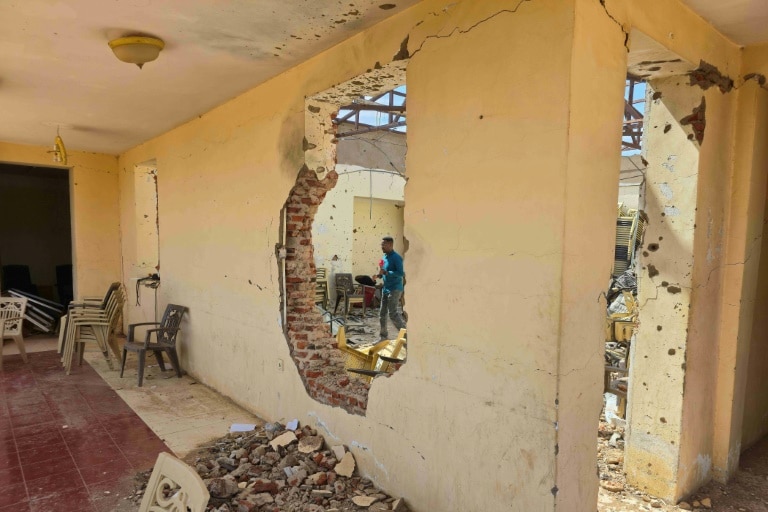
Early on Tuesday, RSF drone strikes hit multiple locations inside El-Obeid, destroying the local branch of the Agricultural Bank of Sudan and the headquarters of the local lawyers’ association. No casualties were reported in the attack, but the damage to key public infrastructure underscores the ongoing risk to civilian life in the city. Mohamed dismissed the strikes as the “death throes” of the retreating RSF, noting that retaliatory attacks on civilian targets have become a predictable pattern after every army advance. “We’re used to it, every time the army advances, they retaliate against North Kordofan,” she said.
While both the army and the RSF have been credibly accused of committing war crimes, including indiscriminate bombing of civilian areas, the army is broadly viewed more favorably by civilians in regions that have born the brunt of RSF atrocities. El-Obeid was fully besieged by the RSF from the start of the war in April 2023 until February 2024, when the army first broke the siege. Since then, repeated RSF attacks on roads, residential neighborhoods and critical infrastructure including power stations have deepened the humanitarian crisis, with the UN confirming that only a small fraction of the city’s population has consistent access to enough food.