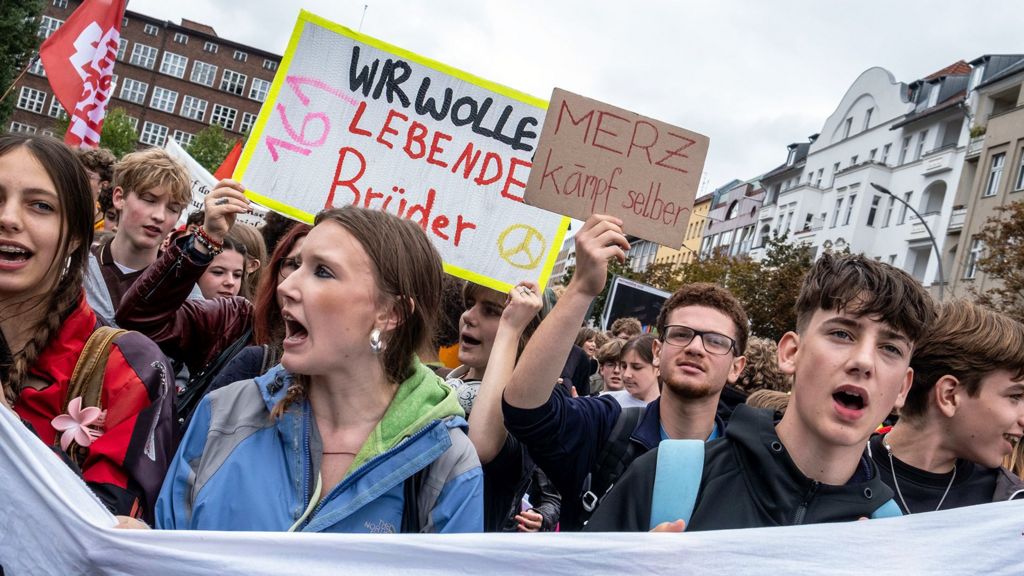
A wave of coordinated school strikes has spread across Germany, as young demonstrators rally in major cities and towns to oppose the federal government’s potential gradual reintroduction of compulsory military service, a policy shift driven by shifting European security dynamics following Russia’s full-scale invasion of Ukraine.
Organizers behind the movement, which carries the name School Strike Against Compulsory Military Service, confirm the protests were sparked by recent official actions that exposed the path toward mandatory service. Bela Breitner, one of the strike’s lead coordinators, emphasized that German federal leadership is actively advancing plans to bring back compulsory service incrementally. At a large rally in Hamburg, hundreds of young protesters filled city streets, waving placards and holding towering banners emblazoned with the uncompromising message: “We won’t take part in your wars.”
The push to expand Germany’s military capacity comes as Chancellor Friedrich Merz has made strengthening the Bundeswehr, Germany’s national armed forces, his top national security priority. In January of this year, a new framework law establishing a voluntary military service scheme went into effect, designed to boost recruitment numbers to meet expanded defense goals. But the legislation leaves the door open for the Bundestag, Germany’s federal parliament, to approve a form of mandatory service if volunteer recruitment falls short of targets or the regional security situation deteriorates further.
Under the current law, all 18-year-old German residents are sent an official questionnaire to gauge their interest in joining the armed forces. For men, completing the questionnaire and attending a mandatory fitness medical exam is required by law, regardless of whether they express interest in serving; for women, participation in the process is fully voluntary.
Protesters say the trigger for mass action came when dozens of 18-year-olds in the northern German towns of Kiel and Flensburg received official summonses for mandatory medical exams, even after they explicitly marked on their questionnaires that they had no interest in enlisting. A 16-year-old protester from Hamburg, Elias Bernhard, told reporters on the ground that survey responses already make clear young Germans overwhelmingly reject mandatory military service. “That is why I am out on the streets today,” Bernhard said. “That is why we are serious about striking until compulsory military service is off the table. We will carry on.”
In a statement to the BBC, a spokesperson for Germany’s Federal Ministry of Defense clarified that the legal obligation for medical exams applies to all men liable for military service born after December 31, 2007 – even those who have stated they have no desire to serve. As of July, roughly 1,000 18-year-old men who declined to express interest in military service have already completed the mandatory exams, the spokesperson confirmed. Organizers of the current strike movement report that more than 100 separate demonstrations are scheduled across the country in the coming days, with major actions planned in Berlin, Frankfurt, Kiel, and Hamburg, in addition to the rallies already held.
The current debate marks a dramatic reversal of decades of post-Cold War defense policy in Germany. During the Cold War, Germany maintained a large standing conscript army, similar to many other Western European nations. After the collapse of the Iron Curtain and German reunification, the country gradually downsized its armed forces, and former Chancellor Angela Merkel fully abolished compulsory military service in 2011.
Today, the shift back toward expanded conscription stems from two key pressures: heightened perceptions of Russian security threats following the 2022 invasion of Ukraine, and persistent pressure from Germany’s long-standing ally the United States to increase European defense spending and capacity. Merz has publicly pledged to transform the Bundeswehr into the most capable conventional land force in Europe, with a target of growing active-duty troop numbers from the current 186,700 to 260,000 by the early 2030s, supported by an additional 200,000 reservists. The expansion is designed to meet new NATO collective defense force requirements and shore up Germany’s position as a leading security provider in Central Europe.