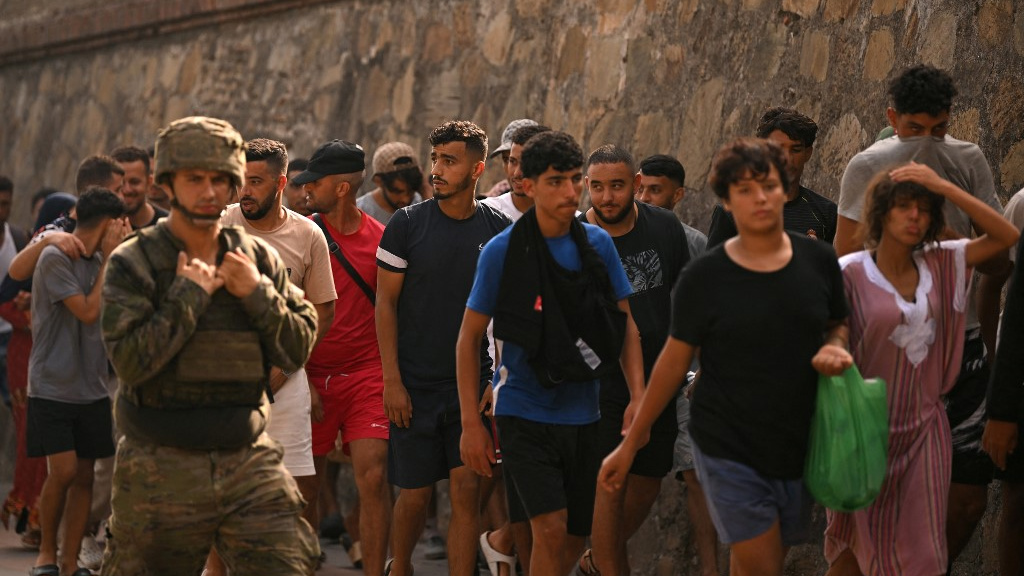
A massive unexpected wave of migration into Spain’s North African enclave of Ceuta has ignited not just a humanitarian emergency, but also a sharp diplomatic spat that has pulled Israel into the center of escalating accusations of foreign interference. Over the course of this week, roughly 60,000 migrants, including more than 8,000 children, crossed from Morocco into Ceuta — a small Spanish territory that, alongside the nearby autonomous city of Melilla, forms the only contiguous land border between the European Union and the African continent. Video footage shared widely on social media captured migrants navigating dangerous coastal waters around Ceuta’s border barrier, many clad only in swimsuits and relying on basic flotation devices to complete the risky crossing.
As of Saturday, Spanish authorities reported that roughly 48,000 of the new arrivals have already been escorted back to Morocco by Spanish military personnel, though lingering tensions remain. Migrants have been spotted hiding in underground tunnels and moving through Ceuta’s residential streets, and humanitarian officials confirm at least 67 people have died attempting the crossing so far. The situation has already sparked ripple effects across the EU: France has moved to ramp up border checks with Spain, while Italy has floated the possibility of suspending Spain from the bloc’s Schengen Area open-border arrangement.
While the root cause of the sudden migration surge remains unconfirmed, parallels are already being drawn to a 2021 incident, when 8,000 Moroccans entered Ceuta amid a diplomatic breakdown between Rabat and Madrid over the Western Sahara conflict. At that time, Spain accused Morocco of weaponizing migration to gain diplomatic leverage, a claim Rabat implicitly acknowledged by noting it had relaxed border controls in response to the diplomatic dispute. This year, many analysts and political figures point to another recent diplomatic shift: Spanish Prime Minister Pedro Sánchez’s high-profile visit to Algeria, Morocco’s long-standing regional rival and Spain’s largest natural gas supplier, which has left Rabat frustrated with Madrid. Lorenzo Gabrielli, a senior migration researcher at Barcelona’s Pompeu Fabra University, told the New York Times that the scale of the crossing makes Moroccan tacit involvement inevitable. “It is impossible for nearly 50,000 people to cross the border between Morocco and Spain in a single day without Morocco having a hand in it,” Gabrielli said. Morocco’s ambassador to Spain, Karima Benyaich, has pushed back against these claims, insisting Rabat has always prioritized “legal, orderly and safe migration” and that the crossings ran counter to the government’s policy goals.
What has elevated this local migration crisis into an international diplomatic controversy are widespread claims from Spanish political figures and commentators that Israel and the United States are quietly orchestrating the chaos to punish the current Spanish government for its vocal opposition to Israel’s military campaign in Gaza and US-backed actions against Iran. Spanish Transport Minister Óscar Puente became the first sitting Spanish government official to hint at this narrative after responding to a post on X by Danny Danon, Israel’s ambassador to the United Nations. Danon had used the crisis to mock Spain, which has repeatedly criticized Israeli policy in recent months: “Spain, which never misses an opportunity to lecture Israel, has declared a state of emergency in Ceuta following the crisis over its immigration policy. Maybe before it continues lecturing us, it’s time it explained to the world why it still maintains colonial enclaves in Africa,” Danon wrote. In reply, Puente wrote simply: “Well, it all seems to be becoming quite clear” — a line widely interpreted as confirmation of the interference claims.
Other Spanish political figures have gone further. Gabriel Rufián, parliamentary spokesperson for the left-wing Catalan Republican Left party, argued publicly that the crisis directly serves American and Israeli strategic interests. Spanish journalist José Vizner also resurfaced a 2019 social media post from Yair Netanyahu, son of Israeli Prime Minister Benjamin Netanyahu, that referenced alleged Israeli support for separatist movements in Ceuta. Even former Portuguese minister and political commentator Bruno Maçães added weight to the claims, noting: “whether or not the US and Israel were involved before the fact, they were deeply involved and intensely active after the fact, especially trying to use it against the current Spanish government.”
The crisis has even drawn comment from former US President Donald Trump, who framed the Ceuta emergency as a warning of what could come to the United States if he is not returned to office. Calling the situation a “catastrophe,” Trump added that “if we’re not in office our country will be invaded at levels that will make Spain look small time.”
For the local government in Ceuta, the migration wave is first and foremost a threat to Spanish sovereignty. Ceuta President Juan Jesús Vivas condemned the crossings as a “violation of Spain’s territorial integrity,” as authorities work to bring the emergency under control and address the growing humanitarian toll of the disaster.