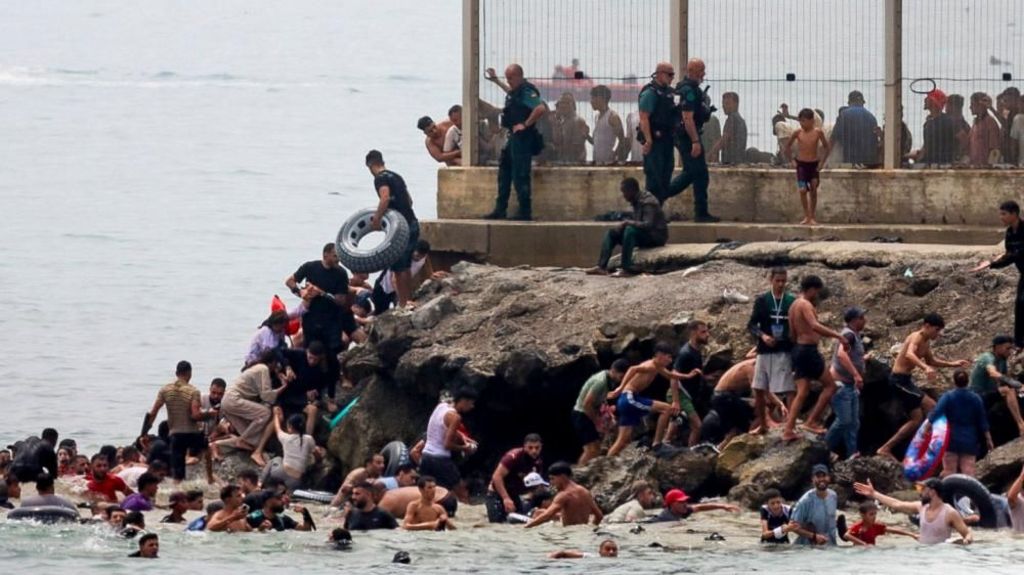
In the wake of an unprecedented mass influx of some 60,000 migrants crossing from Morocco into Spain’s North African enclave of Ceuta on July 30, the European Union has been forced into urgent diplomatic action, scheduling emergency talks for Tuesday to address the escalating migration crisis that has already sparked sharp divisions between member states. By early August, Spanish officials confirmed that nearly all of the migrants who entered the territory have returned to Morocco, but the human cost of the mass crossing has already climbed to at least 67 dead.
The crisis has laid bare deep rifts within the bloc over migration policy. Twenty-two EU member states have signed a joint letter addressed to European Council President Antonio Costa, European Commission President Ursula von der Leyen, and Irish Taoiseach Michael Martin – as Ireland holds the rotating Council presidency – calling for coordinated bloc-wide action and stricter security at the EU’s external borders. The letter warns that what unfolded in Ceuta risks creating a dangerous perception that illegal entry into the EU is achievable, a narrative that could fuel further attempted crossings, erode public trust in the bloc’s common migration framework, and create ripple effects across all member states. It also frames the incident as a potential hybrid threat targeting EU border stability.
Spain, for its part, has pushed back against harsh criticism from several member states, condemning what it calls a “selfish, polarising and unlawful” response. Shortly after the surge, Italian Prime Minister Giorgia Meloni announced a one-month suspension of Italy’s participation in the EU’s Schengen border-free arrangement with Spain, a move that received public backing from Finland and Denmark. A handful of other states, including France and Portugal, have also announced they are reviewing or considering reinstating internal border checks, while Danish Prime Minister Mette Frederiksen has called on the bloc to evaluate all possible responses, including a broader suspension of Schengen cooperation.
Spanish Prime Minister Pedro Sánchez has hit back at critics, noting that Ceuta has never been part of the Schengen Area, and confirming that his government regained full control of the border and blocked any unauthorised movement of migrants toward mainland Europe in less than 48 hours. In a separate letter to von der Leyen, Sánchez expressed deep concern over the actions of some European governments, arguing that while most member states extended solidarity and support to Spain, others opted to launch attacks driven by prejudice, misinformation, ignorance, or narrow domestic political interests.
On Friday, Sánchez pointed to migrant smuggling networks as the main culprits behind the surge, noting that traffickers exploited a recent ruling from Spain’s Supreme Court that limited the government’s authority to carry out immediate deportations of migrants who arrive by sea. By Saturday, Spanish Interior Minister Fernando Grande-Marlaska told reporters that the situation in Ceuta had returned almost entirely to normal, with local businesses having reopened their doors. To prevent future mass crossings, the government is currently developing an inflatable water barrier to block irregular maritime entry routes into the enclave.
Top EU officials have echoed growing concern over the incident. Von der Leyen described images of the mass crossing as unacceptable, writing on social media that “We cannot allow anyone to come to our Union without abiding by our rules.” German Chancellor Friedrich Merz has called on Moroccan authorities to immediately take back all irregular migrants that crossed into Ceuta, while the United Kingdom, which left the EU in 2020, has offered assistance to Spain: UK Prime Minister Andy Burnham confirmed he had spoken with Sánchez over the weekend and that the country was providing all possible support to address the aftermath of the crisis.
Long a key flashpoint for irregular migration toward Europe, Ceuta – along with the neighboring enclave of Melilla – forms the EU’s only land border with Africa. Many migrants attempt to reach the enclave by swimming short distances from the Moroccan coast, and large-scale crossing attempts are a common occurrence during the summer months, often organized via social media platforms. The 2026 surge is far larger than the last major incident in 2021, when roughly 8,000 migrants entered Ceuta over several days, sparking a major diplomatic rift between Spain and Morocco. Contextual factors including recent anti-government protests led by Gen Z in Morocco, driven by demands for better economic opportunities and improved public services, have also contributed to greater migration pressure in the region.
Spain has maintained one of the more liberal approaches to migration within the EU in recent months: in April this year, the government approved a sweeping regularization plan that grants legal status to 500,000 undocumented migrants already residing in the country, allowing them to integrate formally into the Spanish workforce.