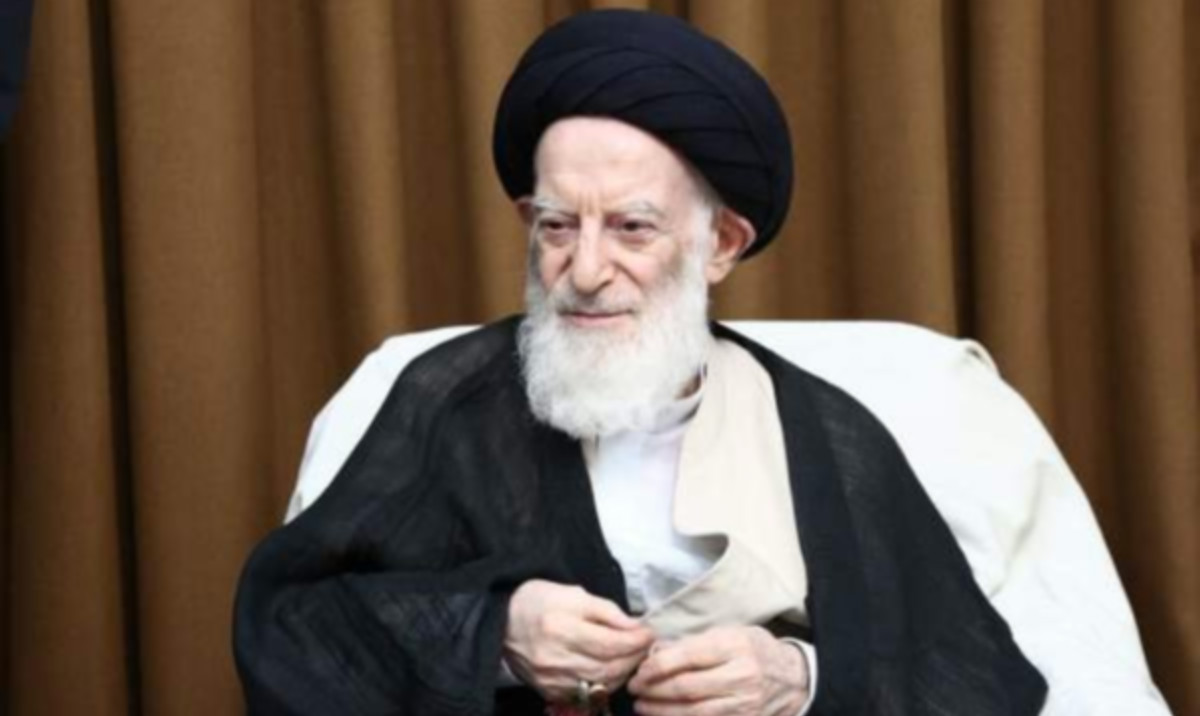
On September 20, one of the most uniquely positioned religious figures in modern Iranian history, Grand Ayatollah Mousa Shobeiri Zanjani, passed away at the age of 98, leaving behind a legacy of rare political independence that transcended the deep ideological divides shaping the Islamic Republic’s politics.
Shobeiri Zanjani carved out an unparalleled role in Iran’s clerical ecosystem: a senior religious scholar who intentionally held himself apart from formal state political power, yet commanded respect and influence that stretched across every faction of the country’s political and religious landscape. His student body included figures from opposite ends of Iran’s political spectrum: former reformist president Mohammad Khatami, and according to a senior source at the influential Qom Seminary, Mojtaba Khamenei, son of Iran’s current supreme leader Ali Khamenei. For generations, politicians and clerics from competing factions turned to Shobeiri for credibility and mediation precisely because his moral and religious authority was never tied to partisan or state interests.
That deliberate political detachment made him a critical go-between at moments when Iran’s religious and state institutions collided. In the 1990s, the Qom Society of Seminary Scholars named Shobeiri one of just seven senior clerics qualified to serve as a marja – the highest rank of Shia religious authority, whose rulings on Islamic law are followed by believers around the world.
Shobeiri belonged to a longstanding strand of Iranian traditional clerical thought that holds senior religious leaders should not seek direct involvement in political office or state power. This camp, which also includes another highly respected Qom-based cleric Ayatollah Vahid Khorasani, prioritizes three core missions: protecting the institutional independence of Iran’s seminaries from state interference, preserving the centuries-old marjaʿiyyah system of independent religious authority, and addressing religious and social issues rather than holding or exercising formal political power.
Throughout his career, Shobeiri openly argued that excessive political entanglement by clerics erodes their religious standing and weakens public faith in Islam. In a 2017 gathering of clerics and scholars, he laid out his core philosophy clearly: “Some clerics believe that by becoming more involved in political matters, they can better preserve the standing of the clergy or the position of the mosque. We, however, believe that excessive politicisation, along with the emergence of differences of opinion – which are inevitable – can harm the standing of the clergy and the mosque and lead to a weakening of religious faith.”
He also stressed that clerics without specialized expertise in governance should avoid overstepping into political debate. “Those who do not have expertise in this field would be better off refraining from getting too deeply involved in political matters,” he said. “If someone has expertise, there is no problem with them expressing views on broader issues. But when someone who has no expertise in political science speaks without studying the subject, it creates problems.”
Even as he rejected direct political power, Shobeiri emphasized that religious leaders have a stake in the health of the Islamic Republic and the well-being of the Iranian people. “The Islamic Republic was established in the name of religion and is associated with religion, and preserving it is a religious duty. However, we must consider what contributes most to the survival of the government,” he noted at the same 2017 meeting. “The satisfaction of the people is, first and foremost, one of the things that can contribute to the survival of a government, and we must all work toward this.”
Shobeiri’s reputation for scholarly rigor in Islamic fiqh (jurisprudence) and unwavering political independence drew students from across Iran’s ideological divides to his Qom lectures. In the late 1960s, Khatami, who would later lead Iran’s reformist movement, studied advanced jurisprudence under Shobeiri. The ayatollah once famously praised his young student in correspondence, writing: “Just as Christopher Columbus discovered the American continent, I too discovered Seyyed Mohammad Khatami in the seminary.” Mohammad Reza Khatami, the former president’s brother, later described the bond between the two as far more than teacher and student – it was a decades-long spiritual and personal friendship.
According to the Qom Seminary source who spoke to Middle East Eye, two of Supreme Leader Khamenei’s sons, Mostafa and Mojtaba, also attended Shobeiri’s classes. Khamenei himself once told Shobeiri: “When my sons decided to become seminary students, I did not tell them to do so; they chose it themselves, and of course I was happy with their choice. When one of them came to Qom, I did not tell him to attend your classes; he chose your classes himself, and I was also happy with that choice.”
Shobeiri’s influence as a cross-factional mediator took center stage during the 2009 disputed presidential election, a watershed moment that remains one of the most divisive events in modern Iranian history. After incumbent president Mahmoud Ahmadinejad, backed by Khamenei, was declared the winner over reformist candidates Mir Hossein Mousavi and Mehdi Karroubi, the opposition alleged widespread vote rigging, triggering mass nationwide protests that were met with a harsh state crackdown that saw thousands of demonstrators arrested.
As tensions boiled over, many Iranians across factions turned to Shobeiri, leveraging his longstanding personal relationship with Khamenei to push for de-escalation. A group of 70 prominent political and academic figures, including Mousavi, Karroubi and Khatami, issued an open letter to senior Shia clerics raising alarms about reports of repeated torture of detained protesters and calling on religious leaders to intervene. In response, Shobeiri gathered with two other senior dissident clerics – Grand Ayatollah Hossein-Ali Montazeri and former chief justice Ayatollah Mousavi Ardabili – to discuss the unfolding political and religious crisis.
Years later, prominent religious researcher and dissident Mohsen Kadivar revealed that Shobeiri held private meetings with Supreme Leader Khamenei during the protests in an effort to pressure the state to reduce its use of violence against demonstrators. After the crackdown, Shobeiri repeatedly intervened to secure the release of imprisoned political activists. Kadivar confirmed that Shobeiri once reached out directly to Khamenei’s office to successfully secure the release of Ali Shakouri-Rad, a leading reformist politician close to Mousavi.
When Khamenei ordered Mousavi and Karroubi placed under house arrest in 2011, the ayatollah made multiple personal attempts to persuade the supreme leader to reverse the decision, though these efforts ultimately failed. This was not the first time Shobeiri pushed back against state political actions: Kadivar also confirmed that Shobeiri met with Khamenei at least twice before 2009 to call for the lifting of house arrest imposed on Montazeri, one of the most prominent critics of Khamenei’s rule.
Shobeiri’s commitment to cross-factional engagement drew public criticism from hardline conservative clerics in 2018, after photos emerged of him meeting with Khatami, former interior minister Abdollah Nouri, and a group of other leading reformist figures. Senior conservative cleric Ayatollah Mohammad Yazdi sent a sharply worded public letter to Shobeiri, urging him to uphold the dignity of his clerical position and show proper respect for the ruling Islamic system. Yazdi chastised Shobeiri for failing to respond to two previous private letters, writing that “your position and standing are grounded in respect for the Islamic system in power, the Leader, and the status of religious authority.” He demanded Shobeiri take steps to prevent similar meetings from happening in the future.
The letter sparked immediate backlash from clerics and public figures across Iran. One senior cleric, Ayatollah Mohammad Andalib Hamadani, resigned from his position on the board of the Society of Seminary Teachers, which Yazdi chaired, in protest of the attack on Shobeiri. Kadivar, speaking out against what he called the threatening tone of Yazdi’s letter, summarized the core of Shobeiri’s independent legacy: “Mousa Shobeiri does not owe his religious authority to the political system or to Mr Khamenei, so that the Leader’s agents can threaten him. His standing and respect are the result of his scholarly precision and practical piety. Yazdi conveyed a message from the Leader: if you make a mistake and act differently from the Leader’s wishes, you will lose the respect due to your scholarship and the status of religious authority, because, from the system’s perspective, the dignity of religious authority means conformity with the wishes of the supreme leader.”