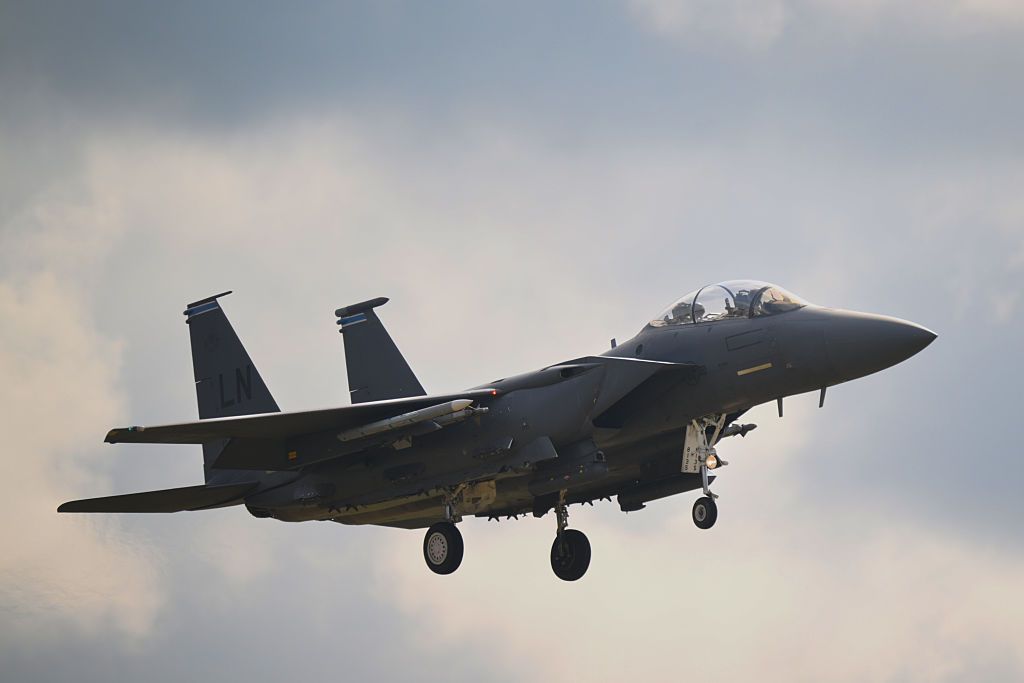
The recent downing of a U.S. F-15 Eagle fighter jet over Iranian territory has upended weeks of bold claims from the Trump administration about American military dominance in the region, leaving one of the two crew members unaccounted for and throwing the already volatile conflict between Washington and Tehran into a dangerous new phase.
Prior to the incident, President Donald Trump insisted Iran’s air defense capabilities had been so severely degraded that it could not effectively challenge American aircraft operating in its airspace. Defense Secretary Pete Hegseth doubled down on this assertion, declaring the U.S. had secured total air superiority over Iran. Friday’s shootdown, however, delivers a major setback to these claims, proving that Iran retains at least limited capacity to defend its sovereign airspace against incursions.
The situation grew increasingly tense after it emerged that the U.S. national security team spent much of Thursday briefing the president in the White House West Wing on a search-and-rescue mission that itself came under fire from Iranian forces. While U.S. media reports indicate both crew members sustained injuries but managed to escape Iranian territorial airspace, one remains missing, and both U.S. and Iranian forces are now locked in a urgent race to locate him.
According to BBC sourcing, Iran’s Islamic Revolutionary Guard Corps (IRGC) has launched a widespread search operation, deploying military troops and enlisting local communities with a $66,000 reward offered for capturing the missing weapons systems officer alive.
Publicly, President Trump has sought to downplay the incident, arguing it will not derail ongoing negotiations with Tehran aimed at ending the conflict that began with joint U.S. and Israeli strikes on Iran on February 28. Privately, however, U.S. officials are said to view the missing airman’s fate as a major strategic and political risk.
If Iranian forces capture the American service member, the implications for the conflict could be far-reaching. At a minimum, it would represent a significant political embarrassment for the Trump White House. Iran could also choose to parade the captured airman for propaganda purposes, echoing the traumatic 1979-1981 Iran hostage crisis that saw 52 American diplomats held captive for 444 days. That crisis left deep, lasting political scars on the United States, and was only resolved after Washington lifted key sanctions and unfroze nearly $8 billion in Iranian assets.
Decades later, the legacy of past hostage crises continues to shape U.S. policy. Successive U.S. administrations have gone to extreme lengths to secure the release of detained Americans, sometimes through tactics that sparked fierce political backlash. In 2014, for example, the Obama administration exchanged five Taliban detainees held at Guantanamo Bay for U.S. Army Sergeant Bowe Bergdahl, who had been captured by the Taliban in Afghanistan five years earlier. Critics of the deal argued it created a dangerous incentive for future militant groups to take American hostages.
The possible capture of the missing F-15 crew member presents the Trump administration with two starkly different paths forward. On one hand, political pressure would almost certainly mount on the president to order aggressive new military escalation in response to the capture. On the other hand, the situation could also create an opening to pause ongoing strikes and pursue quiet backchannel diplomacy to secure the airman’s release. Either way, if Iran gains custody of the American and uses him as a bargaining chip, it will amount to one of the most serious tests of the Trump administration’s handling of the conflict to date.
On Capitol Hill, lawmakers have offered prayers for the missing airman and voiced support for U.S. forces, but new political divides have already emerged. Republican Congresswoman Nancy Mace reiterated her call for a full withdrawal of U.S. troops from the region, arguing “it is far past time we bring troops home.” Democratic Senator Tim Kaine, meanwhile, called on Iran to comply with international law in its treatment of any captured U.S. service member.
Across the U.S. political spectrum, there is growing anxiety over the safety of American personnel deployed to the region, especially amid growing speculation about a potential full-scale ground invasion of Iran. Broad public and political opposition to another open-ended “forever war” and further American casualties has been a consistent undercurrent of the conflict, a dynamic that is only amplified by the current crisis.
The incident comes as President Trump has repeated his ultimatum that Iran must agree to a new deal and reopen the Strait of Hormuz by Monday, April 6, or face devastating new strikes targeting Iranian energy infrastructure, which he has described as bringing “hell” to Tehran. The president’s deadlines have shifted repeatedly in recent weeks, even as he has claimed ongoing talks with Tehran are “very good” and “productive” — claims Iranian officials have flatly denied.
With the U.S. continuing to build up its military presence in the Persian Gulf, Trump openly warning of more American casualties in coming weeks, and new strikes already being promised, all indicators point to a significant escalation of the conflict that is already well underway. The fate of the missing airman has only added a new, unpredictable variable to what is already one of the most dangerous confrontations in the Middle East in decades.