Along the sun-baked southern fringe of the Taklimakan Desert, China’s largest shifting sand desert, a sweeping, vibrant green barrier stretches far beyond the visible horizon. Hardy sand-fixing trees stand tall as resilient sentinels holding back encroaching dunes, while fruit orchards and medicinal plantations have taken firm root in what was once barren, inhospitable sand. This dramatic transformation is the result of the region’s ambitious Taklimakan Desert sand-blocking green belt initiative, which is delivering dual wins: reversing advancing desertification and unlocking new sustainable economic opportunity for local communities in southern Xinjiang, Northwest China.
What began as an ecological restoration project has evolved into a model of balanced development that pairs environmental protection with inclusive economic growth. Rather than treating desert management as a purely conservation effort, regional planners designed the green belt to support commercially viable, sand-adapted industries that benefit local households. Today, medicinal herbs such as Cistanche deserticola — a valuable traditional Chinese medicine — are grown among sand-fixing shrubs, while drought-tolerant fruit tree plantations produce high-quality crops for markets across China and beyond.
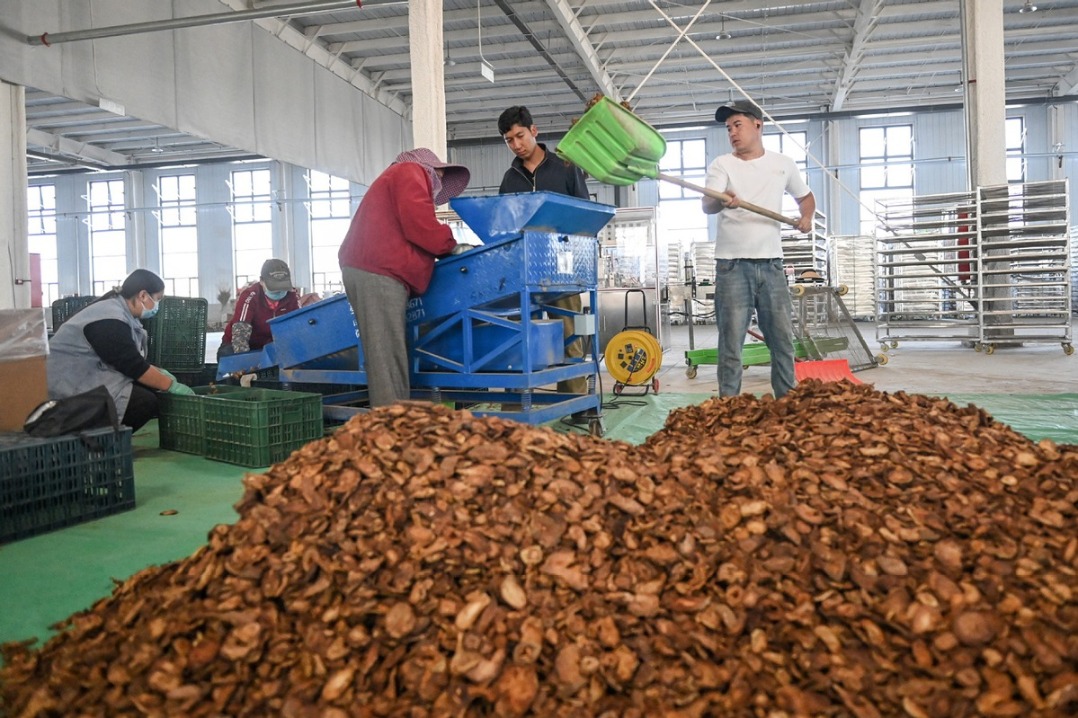
Official project data shows that the expansion of these sand-based sustainable industries now covers 10.83 million mu, equivalent to roughly 722,000 hectares, of former desert land. The sector generates an annual output value of 28.975 billion yuan, approximately $4.25 billion, injecting much-needed vitality into the regional economy and creating stable local jobs for rural residents. Photographs from mid-April 2026 captured workers at an agricultural technology firm in Aksu, a key prefecture along the desert’s edge, sorting processed slices of harvested Cistanche deserticola ahead of distribution to pharmaceutical and wellness markets.
Ecological monitoring data confirms the project’s environmental impact: the green belt has significantly slowed the southward advance of Taklimakan’s dunes, reduced regional sandstorm frequency, and improved overall soil retention across southern Xinjiang. For local stakeholders, the initiative stands as a proof of concept that arid desert landscapes do not have to be economic wastelands — with strategic planning and sustainable management, they can be turned into productive, vibrant lands that support both people and the planet.