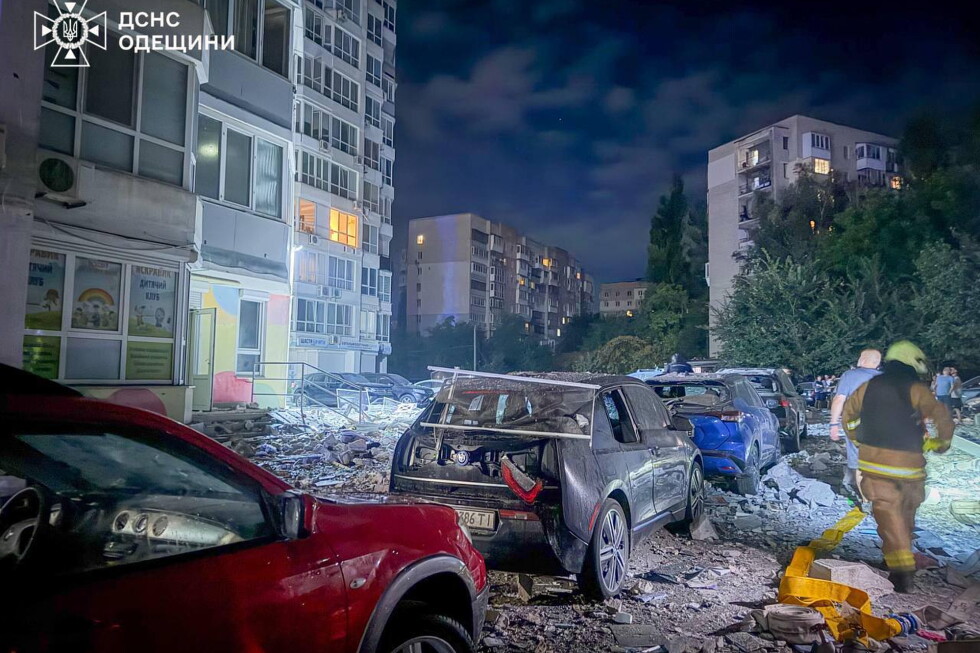
The ongoing Russia-Ukraine conflict has entered its fifth year following Moscow’s full-scale 2022 invasion, and the air dimension of the war has reached new levels of intensity amid a largely deadlocked ground front in eastern and southern Ukraine. A new wave of overnight and early Wednesday Russian aerial attacks targeted residential and civilian infrastructure across Ukraine’s Kyiv and Odesa regions, leaving at least eight civilians wounded, local Ukrainian officials confirmed.
According to Ukraine’s Air Force, the two regions bore the overwhelming majority of the latest assault. The service detailed that Russia launched a total of 174 attack drones, two ballistic missiles, and two air-launched cruise missiles in the barrage. Roughly half of the drones deployed were hard-to-intercept jet-powered models that Moscow has increasingly relied on in recent months of the conflict.
In southern Ukraine’s Odesa region, the strike inflicted severe damage on a 24-story apartment building, where multiple floors were destroyed, and damaged additional commercial office spaces, two educational institutions, and knocked out power across parts of the city, halting electric public transit services. Eight civilians, including one child, were wounded in the Odesa attacks, regional military administration head Serhii Lysak confirmed. In the Kyiv region, two civilians suffered shrapnel wounds in morning strikes, which marked the seventh consecutive day of attacks on the Ukrainian capital. While this latest assault was lighter in scale than previous barrages, it sparked a fire at a commercial warehouse, damaged an educational facility and a local medical clinic, aligning with what Ukrainian officials describe as a deliberate Russian strategy to disrupt daily civilian life and erode public morale.
The spike in aerial violence came amid a sharp exchange of verbal threats between Russian President Vladimir Putin and Ukrainian President Volodymyr Zelenskyy on Tuesday evening. Zelenskyy issued a public warning to international commercial airlines, stating that long-range Ukrainian drone operations inside Russia mean Russian airspace is no longer safe for civilian flights, claiming that “Russian airspace will effectively be closing.” He added that sustained military pressure on Russian territory is intended to force Moscow to enter good-faith peace negotiations.
Putin, speaking to reporters on the sidelines of the Shanghai Cooperation Organization summit held in Bishkek, Kyrgyzstan, responded by labeling Zelenskyy’s actions “state terrorism” and reiterated that Russia will not enter negotiations with what he called a terrorist regime. The Russian leader also addressed recent reports that Ukraine has used British-manufactured drones to strike targets inside Russian territory. When asked whether Russia would retaliate by targeting British military facilities if London continues to supply lethal weaponry to Kyiv, Putin declined to rule out the option, telling reporters with a faint smile that the question concerned “a military secret.”
In parallel with the strikes on Ukraine, Russia reported widespread Ukrainian drone attacks across its own territory overnight Wednesday. Russia’s Defense Ministry claimed its air defense systems destroyed 130 Ukrainian drones over 11 Russian regions, the annexed Crimean Peninsula, and the Black Sea. Acting governor of Russia’s border region Belgorod Alexander Shuvayev confirmed that two people were killed and 16 wounded in the Ukrainian drone strikes, noting that the region was targeted 140 times over a 24-hour period. Ukraine has increasingly deployed domestically produced long-range drones to strike Russian oil infrastructure, aiming to undercut Moscow’s war-time economy, as well as Russian commercial warehouses, in an effort to bring the tangible costs of the conflict to the Russian general public.
Diplomatic efforts led by the United States to broker a path toward peace have so far failed to produce a breakthrough, and the conflict continues to draw in global powers. China and North Korea have openly provided military support to Russia in recent months, with Iran having supplied lethal drone technology to Moscow in earlier phases of the war. Meanwhile, European officials are currently weighing coordinated responses to what they describe as an expanding campaign of Russian sabotage and disruption across the continent intended to weaken public and political support for Ukraine. On Tuesday, German authorities formally blamed Russian intelligence for an attempted explosive drone attack on Leipzig/Halle Airport last month.
Independent military analysts based in the West note that while the air war has intensified, ground operations remain largely stalled. The Washington-based Institute for the Study of War reported late Tuesday that Russian advances in August 2024 amounted to only a small fraction of the territorial gains Moscow secured in the same month a year prior. The think tank concluded that Russia’s spring-summer 2024 ground offensive has failed to break through Ukraine’s integrated frontline defenses, writing that “Russian gains remain slow and limited” as the conflict drags on.