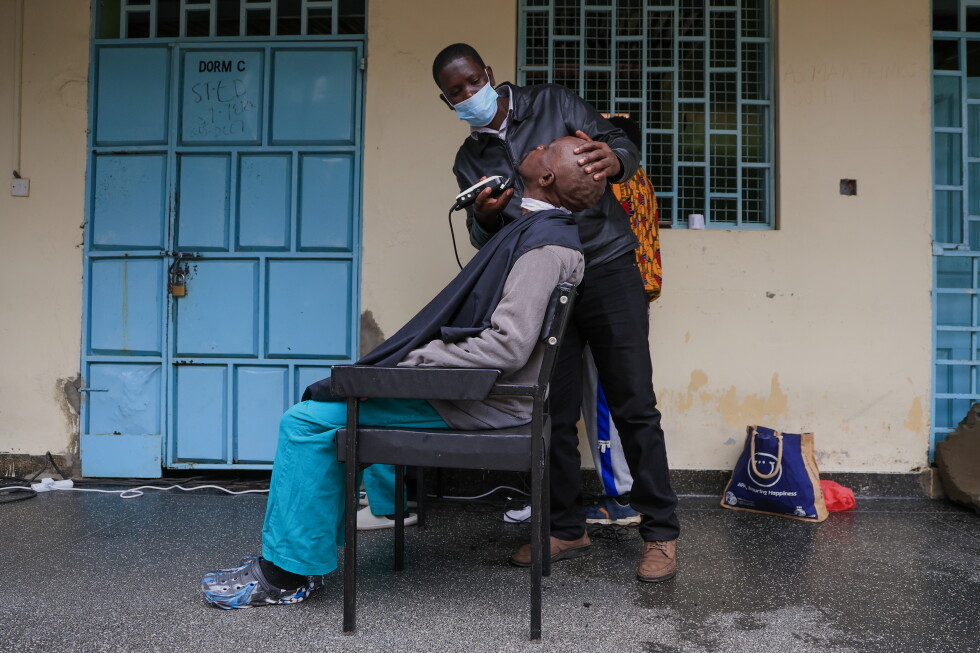
At Mathari National Teaching and Referral Hospital, Kenya’s largest facility for specialized mental health care, a unique, community-led therapy program is transforming the recovery journey for male patients: monthly free personal grooming sessions delivered by volunteer barbers. As soon as barbers lay out their clippers, scissors and shaving supplies, a palpable wave of excitement moves through the waiting group of patients. One by one, men take their seat in the temporary barber chair, eager to walk away with a fresh cut and clean shave that many have not had in months.
Healthcare providers at the facility explain that targeted self-care interventions like this fill a critical gap in standard mental health treatment. A common, widely overlooked symptom of many mental health conditions—particularly depression, which is one of the most prevalent mental health disorders in Kenya—is a gradual loss of motivation to maintain personal hygiene and physical appearance. For patients struggling with severe mental illness, this neglect can quickly spiral into lower self-worth, deeper social isolation, and slower progress toward recovery.
Kenya’s mental health care system still faces major gaps in data and infrastructure, with limited national tracking of mental illness prevalence. The most recent official government policy framework, released in the 2015 National Mental Health Policy, estimates that 25% of all outpatient care attendees and 40% of inpatient admissions across Kenyan health facilities live with a diagnosable mental health condition. Mental health practitioners note that mood disorders like depression and anxiety top the list of most commonly diagnosed conditions, while substance use disorders remain an especially persistent and widespread challenge among male patients.
The initiative comes as June marks global Men’s Mental Health Awareness Month, a moment that local health workers are leveraging to encourage a cultural shift in how Kenyan men address mental health struggles. Francis Kabugua, a senior nursing officer at Mathari Hospital, stresses that harmful cultural expectations of emotional stoicism often push men to cope with distress through harmful coping mechanisms rather than open discussion. “Many men with progressive depressive disorders start to withdraw from their families, step back from their responsibilities, and isolate themselves entirely,” Kabugua explained. Too often, instead of seeking professional support, they turn to alcohol and drugs to numb their symptoms, worsening their condition over time.
The free grooming program is run by Uniquely Gifted, a community-based organization founded by Sheila Lugaliki, who drew on her own personal experience receiving inpatient psychiatric care to launch the monthly initiative. “I saw firsthand what it feels like to be hospitalized for months without anyone helping you care for your appearance, and how that makes you feel invisible and neglected,” Lugaliki said. She designed the program not just as a practical service, but as a gesture of human connection: the simple act of a haircut is intended to restore patients’ sense of dignity, rebuild their confidence, and remind them that they are seen and valued members of the community. “When someone has been admitted for half a year and no one has trimmed their hair, their outward appearance doesn’t just reflect neglect—it deepens the negative feelings they already have about themselves,” she added.
Titus Enko, a psychiatric nurse at Mathari Hospital, echoes this perspective, noting that personal care is often sidelined in treatment plans that prioritize medication and traditional talk therapy. “We focus so much on clinical interventions that we forget the small, tangible acts of care that signal recovery. When a patient starts caring about how they look, that’s a clear sign they are starting to feel better about themselves,” Enko explained. “Personal grooming builds self-esteem, and that boost in self-worth directly supports long-term recovery and overall well-being.”
By the end of the latest grooming session, as barbers finished trimming beards and cleaning up necks, one patient summarized the impact of the program in one simple, powerful word: he said he felt “alive.”