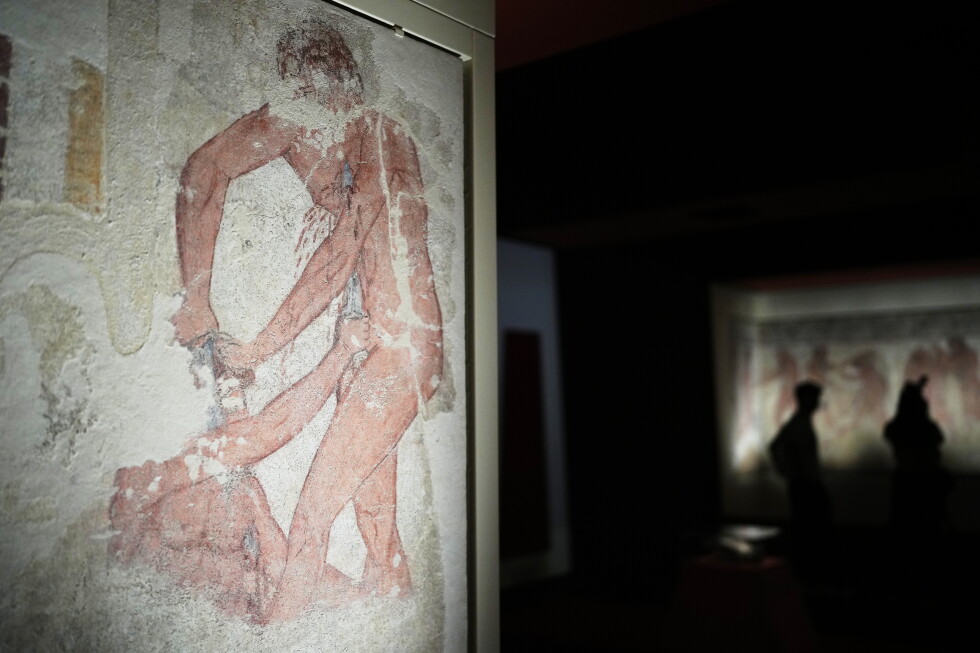
ROME – After more than a century of diplomatic and administrative efforts to reclaim a cornerstone of Italy’s ancient cultural legacy, the Italian Ministry of Culture on Tuesday publicly unveiled the iconic fresco panels from the Etruscan Francois Tomb, the latest high-value cultural acquisition in the government’s targeted push to repatriate key pieces of the nation’s heritage to public access.
Dating back to the 4th century BCE, the celebrated painted panels were purchased earlier this year from heirs of the Torlonia family, one of Italy’s oldest noble dynasties that held the vast, rarely displayed private collection of antiquities for nearly 160 years after the tomb’s discovery. The site itself was first uncovered in 1857 by French archaeologist Alessandro Francois on the Torlonia family’s estate in Vulci, an ancient Etruscan city located in central Italy. Just six years after excavation, the frescoes were carefully detached from the tomb’s walls in the necropolis and added to the Torlonia private collection, while other artifacts recovered from the burial site were split between Francois, his archaeological colleagues, and the noble family.
Italy’s national government first launched formal efforts to take ownership of the frescoes back in 1921. The acquisition aligns with the country’s long-running national mission to recover historically significant artifacts and antiquities that were split among private owners or taken out of public ownership during the 19th-century boom in large-scale archaeological excavations across the Italian peninsula. Starting Wednesday, the fresco panels will open to the general public at Rome’s Villa Giulia National Etruscan Museum, Italy’s premier institution dedicated to Etruscan art and history. To complement the display, the exhibition has gathered jewelry, Etruscan ceramic vessels, and other small artifacts originally discovered inside the Francois Tomb, all on loan from museum collections across the globe that have held these items for decades.
According to official reports, the Italian government paid approximately 15 million euros (equal to $17 million USD) to acquire the frescoes. This purchase marks the third major high-cost cultural acquisition completed by the Ministry of Culture in 2024, following the purchase of Antonello da Messina’s *Ecce Homo* for 14.9 million euros ($16 million USD) and a rare Caravaggio portrait of Maffeo Barberini, who would later become Pope Urban VIII, for $35 million USD. All acquisition funds have been drawn from the ministry’s annual dedicated budget for cultural property purchases. Ministry officials confirmed that current Culture Minister Alessandro Giuli has shifted the department’s acquisition strategy: rather than purchasing a larger number of smaller, less significant artworks and antiquities, Giuli has prioritized acquiring fewer, high-impact pieces of exceptional cultural and historical importance to the nation.
In public comments on the acquisition, Giuli emphasized that the Francois Tomb frescoes are a “fundamental” component of Italian history, and that after more than a century outside public access, the masterpiece is finally returned to the Italian people to study and enjoy.