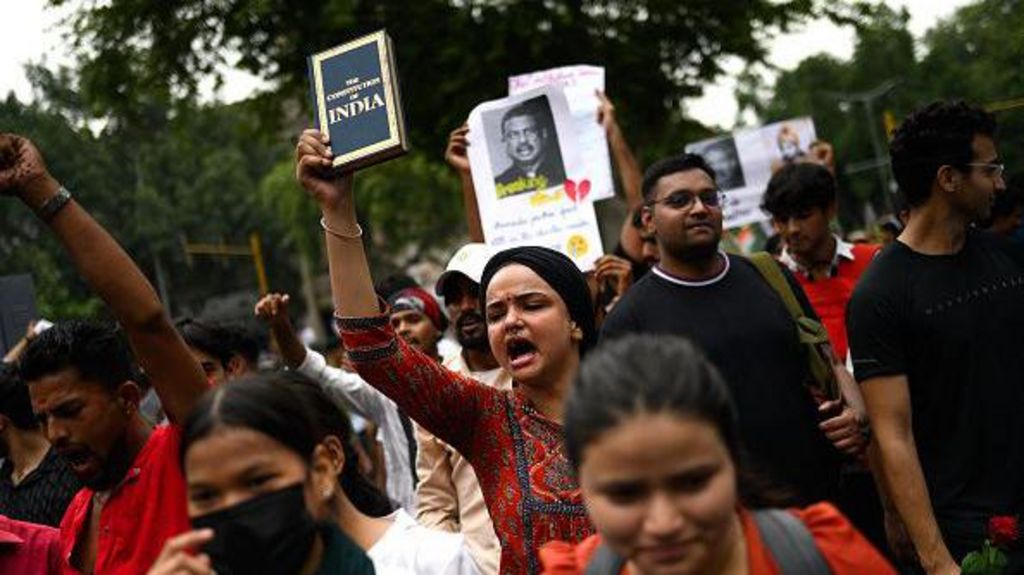
On a rain-soaked Monday in India’s capital Delhi, tens of thousands of demonstrators gathered to participate in a mass protest organized by the youth-led Cockroach Janta Party (CJP), defying an official police ban to march toward India’s parliament and call for the resignation of the nation’s education minister. What began as a localized movement sparked by widespread allegations of public exam paper leaks has ballooned into one of the most significant displays of public opposition to Prime Minister Narendra Modi’s sitting government in recent years, uniting students, working professionals, parents, and teachers behind a broader platform demanding systemic education reform and greater accountability for public officials.
The CJP’s unexpected momentum received a major boost over the preceding weekend, when Delhi police intervened to forcibly transfer prominent activist Sonam Wangchuk to a hospital on the 21st day of his hunger strike in solidarity with the movement. Wangchuk, who has continued his fast despite medical intervention, formally appealed to attending physicians to discharge him so he could join Monday’s march, a request that was ultimately denied. The movement’s unusual name itself carries a charged origin story: it was adopted after India’s chief justice drew widespread public condemnation for comparing unemployed young Indians to “cockroaches” during a public court hearing. Though the justice later retracted the remark, CJP founder Abhijeet Dipke reclaimed the label, transforming the insect into the movement’s official symbol of grassroots resistance.
Despite explicit police warnings that no permission would be granted for a march to parliament, crowds began assembling at Delhi’s historic Jantar Mantar observatory before dawn, with thousands more joining through the morning even as steady rain soaked the protest site. The contrast between the peaceful gathering at the observatory and the heavy security lockdown surrounding parliament was stark: while young demonstrators draped in Indian national flags queued for volunteer-distributed food, painted protest placards, and posed for photos, rows of uniformed police and paramilitary personnel blocked every road leading to the legislative complex, with barricades stretching across all major access points. Movement organizers repeatedly urged participants to avoid violent confrontation with law enforcement, even as patriotic protest songs blared from speakers across the site.
When the march officially got underway, protesters spilled onto surrounding streets only to be stopped at successive layers of police barricades. Large groups sat down on paved roads, waving national flags and chanting demands for reform, while smaller splinter groups attempted to reach parliament by navigating narrow residential side streets. Inside the legislative complex, the opening day of parliament’s annual monsoon session was repeatedly adjourned as opposition lawmakers joined the outcry over the alleged exam leaks and broader education system failures.
As police moved to push back crowds attempting to breach barricades, reports of injuries quickly began to spread across social media. Multiple protesters told reporters they had been injured in police baton charges, with dozens returning to the Jantar Mantar site bleeding from head wounds or suffering limb injuries. Volunteer medical worker Gaurish Batra, treating injured demonstrators on site, told the BBC that his team had provided care to at least 10 injured people, including one man with a severe head wound and a woman with a suspected broken leg. Delhi Police have not issued any formal comment on the allegations of excessive force. Authorities also suspended mobile internet service across large parts of central Delhi, cutting off many demonstrators from reliable access to messaging apps and social media platforms.
By early afternoon, two senior CJP representatives met with Union Health Minister JP Nadda after waiting for roughly two hours outside his official residence. CJP spokesperson Saurav Das confirmed that the delegation submitted a formal letter outlining the movement’s core demands, and that Nadda gave assurances he would bring the group’s concerns to the full Union Cabinet. Shortly after the closed-door meeting, Nadda posted a public statement on the social platform X urging protesters to disperse and help restore “normalcy” to the capital. The meeting and minister’s statement did little to defuse tensions, however, with thousands of demonstrators remaining at Jantar Mantar through the afternoon, committed to seeing their demands addressed.
Even when heavy rain intensified, the protest barely slowed. Volunteers stretched blue tarpaulins to shelter crowds, and chants continued as soaked demonstrators waited for updates from police lines. Among the out-of-town participants was commercial pilot Samrat Khanna, who rearranged his professional flying schedule to attend the demonstration. “I felt I had to be here,” Khanna said. “I couldn’t just watch from the sidelines.” For most demonstrators, the original trigger of the alleged exam leaks has become a symptom of deeper frustrations, rather than the movement’s only goal: protesters say the leaks are just one example of systemic failures around employment access, economic opportunity, and government transparency that have left young Indians disillusioned.
Since its first small public protest in June, the CJP has grown at an extraordinary rate, expanding from a fledgling online campaign to a national movement with chapters in major cities across the country, drawing support from a broad cross-section of Indian society. By Monday evening, the situation shifted again when riot police entered the Jantar Mantar protest site, announcing over loudspeakers that protesters had lost permission to remain in the area. Officers began pushing crowds back, prompting some demonstrators to flee while others linked arms to resist eviction. Brief confusion emerged around founder Abhijeet Dipke’s location after the CJP initially announced he had been detained by police, before clarifying that officers had attempted to take him into custody but were blocked by crowds of protesters. Delhi Police later issued a statement calling the detention claims “entirely false.” As of Monday evening, thousands of demonstrators remained committed to the movement, with protests continuing to draw crowds across the capital.