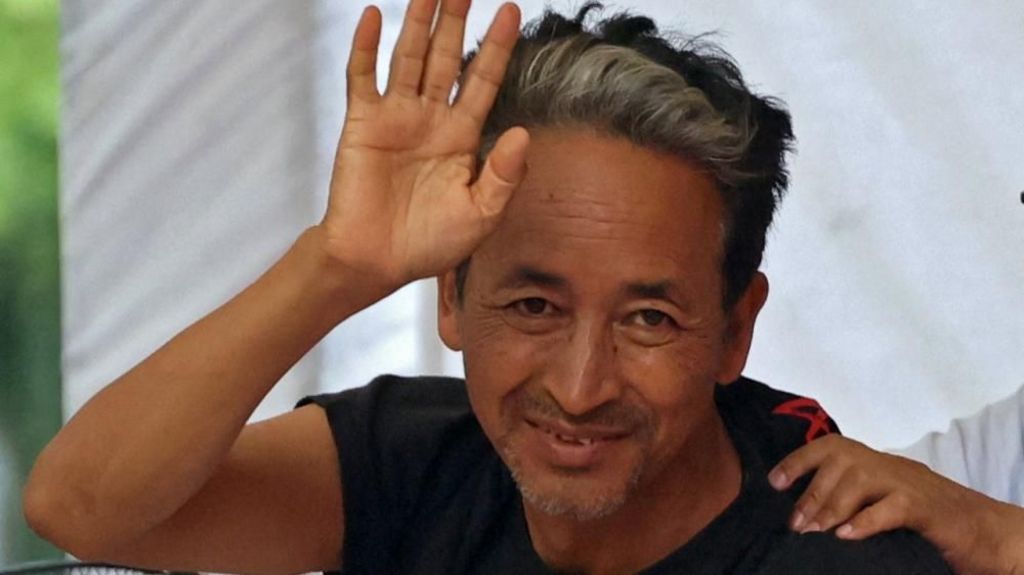
One of India’s most high-profile grassroots advocates, 59-year-old Sonam Wangchuk, has become the center of a growing national political firestorm after launching an open-ended hunger strike in New Delhi to back youth-led demands for sweeping overhaul of India’s crisis-plagued education system. Since starting his fast on June 28, Wangchuk has survived only on salt and water, shedding more than 9 kilograms as his health has declined sharply, prompting police to forcibly admit him to a hospital on July 18 – a move that escalated tensions between authorities and thousands of supporting protesters.
Wangchuk’s protest is anchored in backing the Cockroach Janta Party (CJP), a viral online satirical youth movement that draws its provocative name from a comment by India’s most senior Supreme Court justice, who labeled young critics of the government with that term. The CJP emerged in response to a string of high-profile education controversies, most recently repeated leaks of public examination question papers that have thrown the academic careers of millions of young Indians into chaos. Political analysts now frame the movement as one of the most significant displays of public dissent against Prime Minister Narendra Modi’s national government, which has held power since 2014.
A household name across India, Wangchuk commands widespread public respect that stretches far beyond the protest movement. A revered educator, engineer and innovator from the disputed Indian-administered region of Ladakh, he won the 2018 Ramon Magsaysay Award – widely known as Asia’s equivalent of the Nobel Prize – for his community development work. His life and innovations even served as the inspiration for the lead character in *Three Idiots*, the 2009 blockbuster Bollywood film that remains one of the most popular Indian movies of all time, and he has appeared as a celebrity guest on India’s top-rated game show *Kaun Banega Crorepati*. This public standing has turned his hunger strike into a national crisis: as his health has worsened, opposition politicians, fellow activists, A-list Bollywood stars and prominent musicians have publicly urged him to end his fast, but Wangchuk has refused three non-negotiable conditions for stopping: government accountability for recent systemic failures in education, a meeting between CJP leaders and members of parliament where lawmakers commit to taking up reform, or a personal visit from lawmakers to his hospital bed with the same assurance.
This is far from Wangchuk’s first act of political protest via fasting, a tactic long rooted in India’s political and cultural history, where many major faiths frame voluntary self-denial as a moral act of conscience. Just one year ago, he staged two multi-week hunger strikes to draw attention to the environmental threats facing Ladakh, a high-altitude cold desert in the Himalayas that sits at the center of a long-running border dispute between India and China. Before launching that protest, Wangchuk and hundreds of supporters marched hundreds of kilometers from Ladakh to New Delhi to demand greater regional autonomy and constitutional safeguards for Ladakh’s fragile ecosystem. He argues that the Indian federal government’s accelerated push for large-scale infrastructure development – including new highways, power projects and military installations, built in response to the region’s strategic importance bordering both China and Pakistan – is irreparably damaging the Himalayan environment without any meaningful consultation with local communities. “We don’t oppose development. We want sustainable growth,” Wangchuk has said, noting that Ladakh’s unique ecology cannot accommodate the one-size-fits-all development model imposed by the national government on other Indian states.
Wangchuk’s lifelong advocacy for education reform stems from his own childhood experiences in the Indian education system. As a young boy from Ladakh studying in Srinagar, where lessons were taught only in English, Urdu and Hindi, he recalled being mocked as a “dumb boy from the mountains” who could not fluently speak the dominant languages. That experience shaped his decades-long critique of India’s centralized education system, which he says fails to meet the needs of regional and indigenous communities. In the 1980s, he began organizing protests against the use of Delhi-published textbooks written in unfamiliar languages, full of cultural and environmental references that made no sense to Ladakhi children – examples ranging from ships and oceans to coconut trees and monsoon rains, concepts unrecognizable to most children growing up in the high Himalayan desert. He co-founded a local school focused on adapting curricula to Ladakh’s unique cultural and environmental context, working for decades alongside local communities and government officials to center regional needs in education.
Beyond his education advocacy, Wangchuk has earned acclaim as a pioneering innovator focused on sustainable, low-cost solutions for Himalayan communities. After a relative noticed his early experiments using concave mirrors to heat dark mountain homes and cook food, he went on to study mechanical engineering. In recent years, he developed an affordable, passive-heating mud house that maintains a steady 15°C internal temperature even when external winter temperatures drop to -15°C, cutting reliance on carbon-intensive heating fuel for remote communities. He also designed the ice stupa, an artificial glacial spring shaped like a traditional Buddhist hemispherical monument that stores glacial meltwater for use by farmers during the critical late spring planting season, when water supplies often run dry.